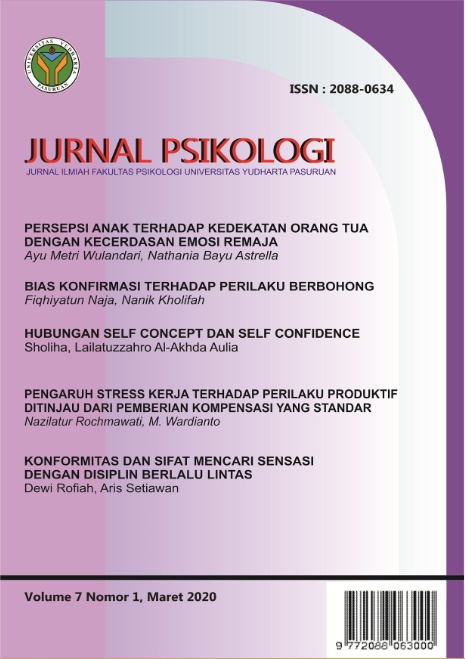
Persepsi Anak terhadap Kedekatan Orang Tua dengan Kecerdasan Emosi Remaja
DOI:
https://doi.org/10.35891/jip.v7i1.1952Keywords:
emotional intelligence, parental closeness, perceptionAbstract
Behaviors that show failure to manage a relationship and interact with the environment and failure to manage and control emotions more often in youth, such as rudeness, abuse of others, even self-injury. One factor that affects the emotional intelligence of a youth is the family environment especially a parent, the teen's perception of a parent's closeness that affects attitudes, views, assessments, and the quality of relationships that grow. This closeness is made by parents and youth essential to shaping emotional intelligence, as parental experience becomes the basis of emotional learning to internalize life. The purpose of this study is to determine if there is a connection between a child's perception of parental closeness and the emotional intelligence of a teen. The population used was 475 high school students, sampling taken with sampling techniques of 21% a total of 100 students. Coefficient validity of the scale of a youth's emotional intelligence is acquired between 0.3307 to 0.6120 and some of its religious coefficiencies. 7391. The child's perception of a parent's closeness scale is between 0.3726 and 0.5912 and the religious coefficiencies of 0.8307. The correlation test shows rxy = 0.4007 with are table 1% = 0.256 and freg = 18,7464 with table 1% = 6.63, the more positive the child's perception of parent proximity, the higher the emotional intelligence.
References
Asyava, Tengku Shella. (2011). Hubungan attachment terhadap Ayah dengan kecerdasan Emosi pada Remaja Laki-Laki. Medan: Universitas SumateraUtara.(Online),(http://repository.usu.ac.id/bitstream/123456789/23209/7.pdf) .
Epa, Tara Nature (2013) Peran Ayah Sama Dengan Peran Ibu?. Artikel Kesehatan Umum (Online), (http://www.taranatureepa.co.id/peran-ayah-sama-dengan-peran-ibu/).
Charis, Ach. (2013). Persepsi Siswa Akan Fungsi Guru Bimbingan dan Konseling (BK)Terhadap Motivasi Berkonsultasi Di MTS Miftahul Ulum Mojokerto. Skripsi. Pasuruan: Universitas Yudarta Pasuruan.
Fatimah, Listriana. (2010). Hubungan Persepsi Anak Terhadap Keharmonisan Keluarga dan Pola Asuh Orang Tua Dengan Motivasi Belajar. (Online). Diakses Januari 2016.
Goleman, D. (2016). Kecerdasan Emosional. Jakarta: PT. Gramedia Pustaka Utama
-------------(2014).Emotional Intelligence. Jakarta: PT Gramedia Pustaka Utama.
Hermasanti, Winahyu Kaula. (2009). Pengaruh Pola Kelekatan dengan Kecerdasan Emosi Remaja. Surakarta: Universitas Sebelas Maret. (Online), (http://core.ac.uk/download/files/478/12346778.pdf) diakses Desember 2015.
Jahja, Yudrik. (2011). Psikologi Perkembangan. Jakarta: Kencana.
Kurasi, (2015) 7 Hal yang Harus Orang Tua Ketahui Tentang Pelukan Pada Anak. Sayangianak.com. (Online) (http://www.9detik.co/2015/07/7-hal-yang-harus-orang-tua-ketahui.html ) diakses Desember 2015.
Safitri, Yuliana. (2012). Hubungan Antara Persepsi Pola Asuh Demokratis Dengan Pemilihan Karir Pada Siswa Kelas XI SMA Negeri 11 Yogyakarta. Skripsi. Yogyakarta: Universitas Negeri Yogyakarta Diakses Januari 2016
Sholikah, Munifatus. 2011. Kedekatan Orang Tua Dengan Anak Pengaruhnya Terhadap Motivasi Belajar Siswa Madrasah Ibtidaiyah Ma’arif Grabag 2 Magelang Tahun 2011/1012. Skripsi. Salatiga: Sekolah Tinggi Agama Islam Negei Di akses pada Desember 2015.
Tanjung, M Azhari. (2015). Pem-bully dari SMPN 4 Binjai dari Keluarga Broken Home.Tribunnews.com.(Online)(http://medan.tribunnews.com/2015/09/07/pem-bully-dari-smpn-4-binjai-dari-keluarga-broken-home) diakses Desember 2015.
Downloads
Published
Issue
Section
License
The author sends the manuscript with the understanding that if accepted for publication, the copyright of the article belongs to the author and retains publishing rights without restriction.
Copyright includes the non-exclusive right to reproduce and submit articles in all forms and media, including reprints, photographs, microfilm, and other similar reproductions, as well as translations. Reproduction of any part of this journal, its storage in the database, and its transmission by all forms of media, such as electronic, electrostatic and mechanical copies, photocopying, recording, magnetic media, etc.