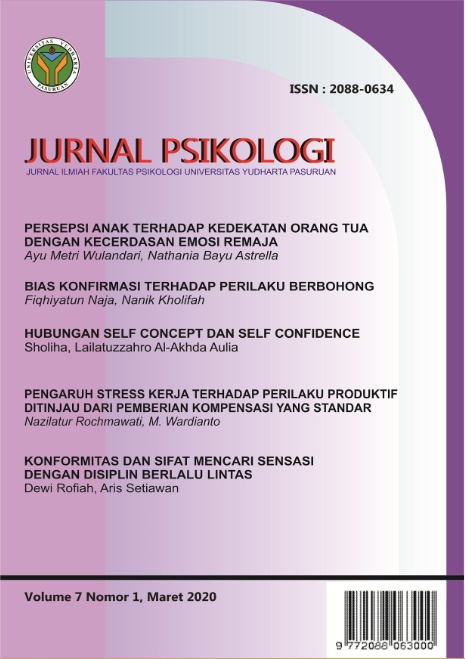
Bias Konfirmasi terhadap Perilaku Berbohong
DOI:
https://doi.org/10.35891/jip.v7i1.1953Keywords:
Behavior Lying, Confirmation Bias, Social MediaAbstract
The spread of fake news in Indonesia is now increasingly widespread, especially through social media, many negative impacts have been caused from the spread of fake information. Fake information can defame the reputation of others, cruel slander, fighting between groups, and disrupt national disintegration and even disrupt national security stability. Confirmation bias is one of the reasons why someone conducts or disseminates fake information, where individuals tend to only seek and receive information that is in accordance with their thoughts and ignores different opinions that might be true facts. This study aims to measure the effect of confirmation bias on lying behavior that is prevalent around us. The sample in this study was the millennial generation of social media users who are members of the PMII Pasuruan organization of 80 members, the samples were taken by purposive sampling technique. Data collection used a lying behavior scale and a confirmation bias scale compiled by the researchers using Likert answer method. The data were then analyzed using One Predictor Linear Regression Analysis. The results of data analysis resulted r value of 0.102228 with a significance value of 0.286. This shows that there is no significant correlation between confirmation bias and lying behavior.
References
Abdulwaly, C. (2015). Hati-Hati Dalam Berprasangka. Jakarta: Abdulwaly.
Assad, Muhammad. (2017). Breakthrough. Jakarta: Gramedia
Aunillah, Isna, Nurla. (2011). Membaca Tanda-Tanda Orang Berbohong. Jogjakarta: laksana
Azwar, Saifuddin. (2017). Metode Penelitian Psikologi Edisi 11. Yogyakarta: Pustaka Pelajar
Basyaib, Fachmi. (2006). Teori Pembuatan Keputusan. Jakarta: Grasindo
Blount, Jeb. (2017). Sales SQ How Ultra High Performers Leverage Sales Specific Emotional Intelegence to Close The Complex Deal. Jakarta: Gramedia
Ekman, Paul. (2009). Mendeteksi Kebohongan. Yogyakarta: Pustaka Buku
Gani, Handoko. (2016). Mendeteksi Kebohongan. Jakarta: Mediakita
Gilovich, Thomas. (1993). How We Know What Isn’t So: The Fability Of Human Reason In Everyday Life. New York: The Free Press.
Gunawan, Budi. & Ratmono. (2018). Kebohongan di Dunia Maya. Jakarta: Gramedia
Hamka. (2017). Bohong Di Dunia. Jakarta: Gema Insani.
Matarasso, F. (2013). Lying for Truth. The Bush Theatre, 1(11/13): 1-3
Morissan. (2013). Psikologi Komunikasi. Bogor: Ghalia Indonesia.
Myrvang, M. (2017). Bullying Confirmation Bias Tunnel Vision. Norway: Ehandbooks.
Novia, A. (2014). Aspek Bias Dalam Pengambilan Keputusan Pembelian Produk Asuransi Jiwa (Studi Empiris Pada Pegawai Akademik UKSW). Skripsi tidak dierbitkan. Salatiga: Universitas Kristen Setya Wacana.
Ronson, j. (2013). Confirmation Bias: After I learned about Confirmation Bias, I started seeing it everywhere, (Online), https://www.academia.edu/people/search?utf8=%E2%9C%93&q=confirmation+bias (diakses 4 april 2013)
Sopian. (2016). Public Relations Writing. Jakarta: Gramedia Widiasarana.
Sulistiawan, Dedhy. (2015). Reaksi Asimetri atas Sinyal Beli dan Jual Analisis Teknik: Pengujian Bias Konfirmasi Sebelum Pengumuman Laba. Jurnal Keuangan dan Perbankan, 19(3), 400-408.
SSNovel. (2014). Super Handbook For Perfect Lie Detector. Jakarta: Grasindo
Wade, Carole. & Tavris, Carol. (2007). Psikologi Jilid 2 Edisi Kesembilan. Jakarta: Erlangga.
Downloads
Published
Issue
Section
License
The author sends the manuscript with the understanding that if accepted for publication, the copyright of the article belongs to the author and retains publishing rights without restriction.
Copyright includes the non-exclusive right to reproduce and submit articles in all forms and media, including reprints, photographs, microfilm, and other similar reproductions, as well as translations. Reproduction of any part of this journal, its storage in the database, and its transmission by all forms of media, such as electronic, electrostatic and mechanical copies, photocopying, recording, magnetic media, etc.