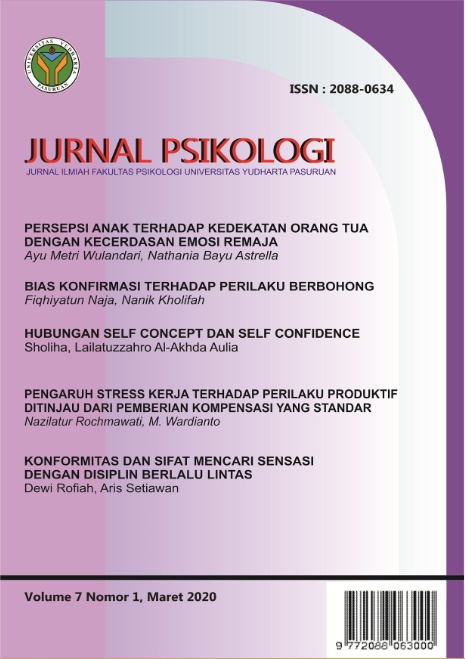
Hubungan Self Concept dan Self Confidence
DOI:
https://doi.org/10.35891/jip.v7i1.1954Keywords:
Self Concept, Self Confidence, TeenAbstract
A confidence and an attitude toward a persons ability to accept both positive and negative that are shaped and learned through the process of studying with a view to his own happiness. While self concept is an idea, mind, feeling, belief and position known by the individual in relating to others. The purpose of this study is to know a self concept relationship with a self confident. The hypothesis of this study is there's a self concept relationship with a self confidence. In the study, researchers used a quantitative approach in an attempt to test hypotheses that had been drafted. The subject in this study is a teenager sitting in class 7 and 8 MTS miftahul ulum pandaan. The sampling technique used was staggerate stratified random sampling. The analysis of data in this study uses the scale of self concept and self confidence. Data analysis was calculated by using product moment Pearson and acquired rxy by 0.657 with an r-tab 1% of 0.254. Thus there is a highly significant correlation between self concept and a self confidence.
References
Mangkunegara, Anwar Prabu. (1993). Psikologi Perusahaan. Bandung: Trigenda Karya.
Marwansyah. (2012). Manajemen Sumber Daya Manusia. Bandung: Alfabeta.
Moekijat. (1995). Manajamen Personalia dan Sumber Daya Manusia. Bandung: Mandar Maju.
Mohyi. Ach. (2012). Teori dan Perilaku Organisasi. Malang: UMM Press.
Nevid, Jeffrey S., Rathus, Spencer A., & Greene Beverly. (2003). Psikologi Abnormal. Diterjemahkan oleh Tim Fakultas Psikologi UI. Jakarta: Erlangga.
Rini, Jacinta F. (2002). Stress Kerja, (online), http://www. e-psikologi. com/artikel/organisasi-industri/stress-kerja, (diakses, 22 Mei 2014).
Sedarmayanti. (2001). Sumber Daya Manusia dan Produktivitas Kerja. Bandung: Mandar Maju.
Sedarmayanti. (2007). Manajemen SDM Reformasi Birokrasi dan Manajemen PNS. Bandung: PT. Refika Aditama.
Sinungan, M. (2003). Produktivitas Apa dan Bagaimana. Jakarta: Bumi Aksara.
Slamet I. S, Suprapti dan Sumarno Markam. (2003). Pengantar Psikologi Klinis. Jakarta: Universitas Indonesia (UI-Press).
Stoltz, Paul G. (2000). Adversity Quotient: Mengubah Hambatan Menjadi Peluang. Diterjemahkan oleh: Hermaya. Jakarta: IKAPI.
Suhariadi, F. (2005). Diskripsi Adversity Quotient dan Perilaku Produktif dari Pemogok Kerja. INSAN Media Psikologi, 7(1), 45-69.
Wijono, S. (2011). Psikologi Industry dan Organisasi. Jakarta: Kencana
Winarsunu, T. (2011). Psikologi Keselamatan Kerja. Malang: UMM Press.
Downloads
Published
Issue
Section
License
The author sends the manuscript with the understanding that if accepted for publication, the copyright of the article belongs to the author and retains publishing rights without restriction.
Copyright includes the non-exclusive right to reproduce and submit articles in all forms and media, including reprints, photographs, microfilm, and other similar reproductions, as well as translations. Reproduction of any part of this journal, its storage in the database, and its transmission by all forms of media, such as electronic, electrostatic and mechanical copies, photocopying, recording, magnetic media, etc.