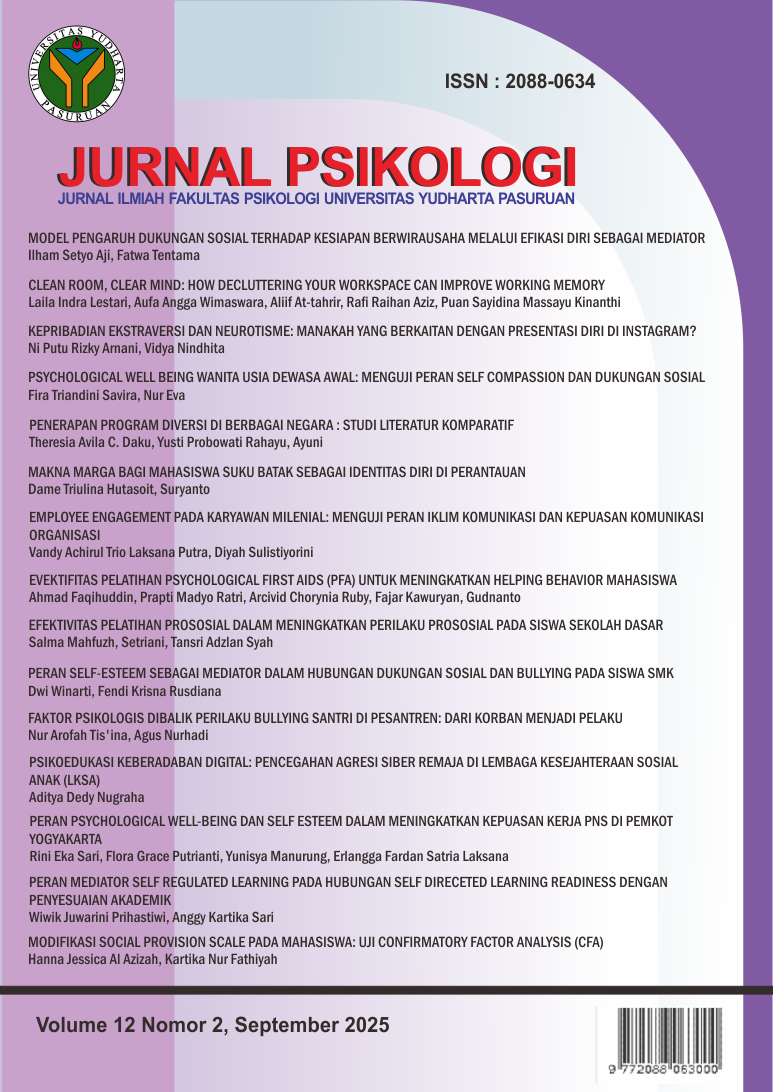
Modifikasi Social Provision Scale pada Mahasiswa: Uji Confirmatory Factor Analysis (CFA)
DOI:
https://doi.org/10.35891/jip.v12i2.6413Keywords:
cfa, dukungan sosial, validitas konstrukAbstract
Dukungan sosial memberikan rasa aman dan nyaman untuk orang lain dan menghargai keberadaannya. Tujuan penelitian ini adalah untuk menguji validitas konstruk skala Social Provision Scale (SPS) yang dikembangkan oleh Russel & Cutrona (1987). Skala ini digunakan untuk mengukur dukungan sosial yang dirasakan oleh individu yang dilandaskan konsep bahwa hubungan interpersonal memenuhi kebutuhan sosial. Responden dalam penelitian ini berjumlah 105 orang mahasiswa dengan rentang umur berusia 18 tahun hingga 26 tahun. Penelitian ini menggunakan metode kuantitatif dengan desain penelitian survey yang menggunakan pendekatan cross-sectional. Pengambilan sampel dalam penelitian ini menggunakan teknik purposive sampling. Analisis data yang digunakan dalam penelitian ini adalah Confirmatory Factor Analysis (CFA) dengan bantuan software JAMOVI. Hasil penelitian menemukan bahwa model 6 faktor SPS terbukti FIT dengan data dengan nilai CFI sebesar 0.955>0.90, kemudian TLI sebesar 0,939 > 0,90 dan nilai RMSEA sebesar 0,0412 < 0,06, sehingga nilai CFA bisa dikategorikan sudah FIT.
References
Amaliah, N., Andika, Fadhilla, A. R., Rachmani, H. A., Zahira, N. H., & Wyandini, D. Z. (2024). Analisis Psikometri Self-Compassion Scale for Youth Versi Bahasa Indonesia. Jurnal Psikologi Insight, 8(1), 21–34. https://doi.org/10.17509/insight.v8i1.68476
Astuti, T. P., & Hartati, S. (2013). Dukungan Sosial Pada Mahasiswa Yang Sedang Menyusun Skripsi (Studi Fenomenologis Pada Mahasiswa Fakultas Psikologi Undip). Jurnal Psikologi Undip, 12(1), 69–81.
Astuty, H. A., Rasyid, M., & Suhesty, A. (2023). Learning Motivation in Students in Online Lectures Reviewed from Social Support. Psikoborneo: Jurnal Ilmiah Psikologi, 11(2), 271278. https://doi.org/10.30872/psikoborneo.v11i2.9251
Deviana, T., Hayat, B., & Suryadi, B. (2020). Validation of the Social Provision Scale with Indonesian Student Sample: A Rasch Model Approach. Indonesian Journal of Educational Assesment, 3(1), 1. https://doi.org/10.26499/ijea.v3i1.54
Ellis, R., Sampe, P. D., Mahaly, S., & Makulua, I. J. (2023). Pengaruh Dukungan Sosial Terhadap Stres Akademik Mahasiswa. Pedagogika: Jurnal Pedagogik Dan Dinamika Pendidikan, 11(1), 102–110. https://doi.org/10.30598/pedagogikavol11issue1page102-110
Hascoët, M., & Audrin, C. (2025). Exploring social support: How sources and types relate to academic self-perception and emotions in primary school students. Acta Psychologica, 260(105551), 1–9. https://doi.org/10.1016/j.actpsy.2025.105551
Kusumaningrum, F. A. (2018). Generasi Sandwich: Beban Pengasuhan dan Dukungan Sosial pada Wanita Bekerja. Psikologika: Jurnal Pemikiran Dan Penelitian Psikologi, 23(2), 109–120. https://doi.org/10.20885/psikologika.vol23.iss2.art3
Nababan, S. Y., & Aulia, P. (2024). Hubungan Antara Dukungan Sosial Teman Sebaya dengan Quarter Life Crisis pada Fresh Graduate Universitas Negeri Padang. Causalita: Journal of Psychology, 2(1), 141–149. https://doi.org/10.62260/causalita.v2i1.188
Prayitno, H. A., & Andayani, B. (2023). The Relationship Between Peer Social Support and Academic Stress Among University Students During the COVID-19 Pandemic. Anima Indonesian Psychological Journal, 38(1), 86–104. https://doi.org/10.24123/aipj.v38i1.4711
Primadasa, A., & Raihana, P. A. (2024). Modifikasi dan Validasi Student-Life Stress Inventory pada Mahasiswa Selama Pembelajaran Online COVID-19. Jurnal Psikologi Dan Konseling West Science, 2(01), 58–67. https://doi.org/10.58812/jpkws.v2i01.1067
Putra, M. D. K. (2015). Uji Validitas Konstruk the Social Provisions Scale. Jurnal Pengukuran Psikologi Dan Pendidikan Indonesia, 44(4), 1–18.
Salma, A. R., & Sawitri, D. R. (2021). Hubungan Antara Dukungan Sosial Teman Sebaya Dengan Ketangguhan Akademik Pada Mahasiswa Tahun Kedua Departemen Kedokteran Umum Fakultas Kedokteran Universitas Diponegoro. Jurnal Empati, 10(1), 29–33. https://doi.org/10.14710/empati.2021.30418
Sari, C. A. K., & Zaini, A. H. (2024). Peran Dukungan Sosial pada Penyesuaian Akademik Mahasiswa Baru dengan Resiliensi Akademik sebagai Mediator. Personifikasi: Jurnal Ilmu Psikologi, 15(1), 64–78. https://doi.org/10.21107/personifikasi.v15i1.23190
Saudi, A. N. A., Bintang, R. S., Loloallo, V. L., & Zainuddin, N. I. (2024). Multidimensional Scale of Perceived Social Support (MSPSS): Uji Validitas Konstruk dengan Confirmatory Factor Analysis (CFA). Edukatif : Jurnal Ilmu Pendidikan, 6(4), 4266–4275. https://doi.org/10.31004/edukatif.v6i4.7492
Suciani, D., & Rozali, Y. A. (2014). Hubungan dukungan sosial dengan motivasi belajar pada Mahasiswa Universitas Esa Unggul. Jurnal Psikologi, 12(2), 43–47. https://www.esaunggul.ac.id/wp-content/uploads/2019/10/UEU-Journal-10730-11_0032.pdf
Sulaeman, M. R., & Kustimah. (2024). Hubungan Perceived Social Support dengan Psychological Well-Being pada Ibu Bekerja. Journal of Psychological Science and Profession, 8(1), 52–65. https://doi.org/10.24198/jpsp.v8i1.53033
Umar, J., & Nisa, Y. F. (2020). Uji Validitas Konstruk dengan CFA dan Pelaporannya. JP3I: Jurnal Pengukuran Psikologi Dan Pendidikan Indonesia, 9(2), 1–11. https://doi.org/10.15408/jp3i.v9i2.16964
Vigneau, F., Rousselle, P., & Breno, D. (2025). Psychometric properties of the 10-item English-language Social Provisions Scale. European Review of Applied Psychology, 75(101098), 1–6. https://doi.org/10.1016/j.erap.2025.101098
Widyaswari, N. I., & Heng, P. H. (2022). Hubungan Antara Dukungan Sosial Dengan Penyesuaian Diri Mahasiswa Tingkat Pertama (Studi Pada Masa Pandemi Covid-19). Jurnal Muara Ilmu Sosial, Humaniora, Dan Seni, 6(2), 331–339. https://doi.org/https://doi.org/10.24912/ jmishumsen.v6i2.18765
Wilson, K. E., Michaud, T. L., Sweet, C. C., Katula, J. A., Almeida, F. A., Brito, F. A., Schwab, R., & Estabrooks, P. A. (2022). Psychometric Assessment of an Adapted Social Provisions Survey in a Sample of Adults with Pradiabetes. Journal of Applied Measurement, 3(4), 249–269. https://doi.org/doi.org/10.21203/rs.3.rs-966071/v2
Downloads
Published
Issue
Section
License
Copyright (c) 2025 Hanna Jessica Al Azizah, Kartika Nur Fathiyah

This work is licensed under a Creative Commons Attribution-ShareAlike 4.0 International License.
The author sends the manuscript with the understanding that if accepted for publication, the copyright of the article belongs to the author and retains publishing rights without restriction.
Copyright includes the non-exclusive right to reproduce and submit articles in all forms and media, including reprints, photographs, microfilm, and other similar reproductions, as well as translations. Reproduction of any part of this journal, its storage in the database, and its transmission by all forms of media, such as electronic, electrostatic and mechanical copies, photocopying, recording, magnetic media, etc.