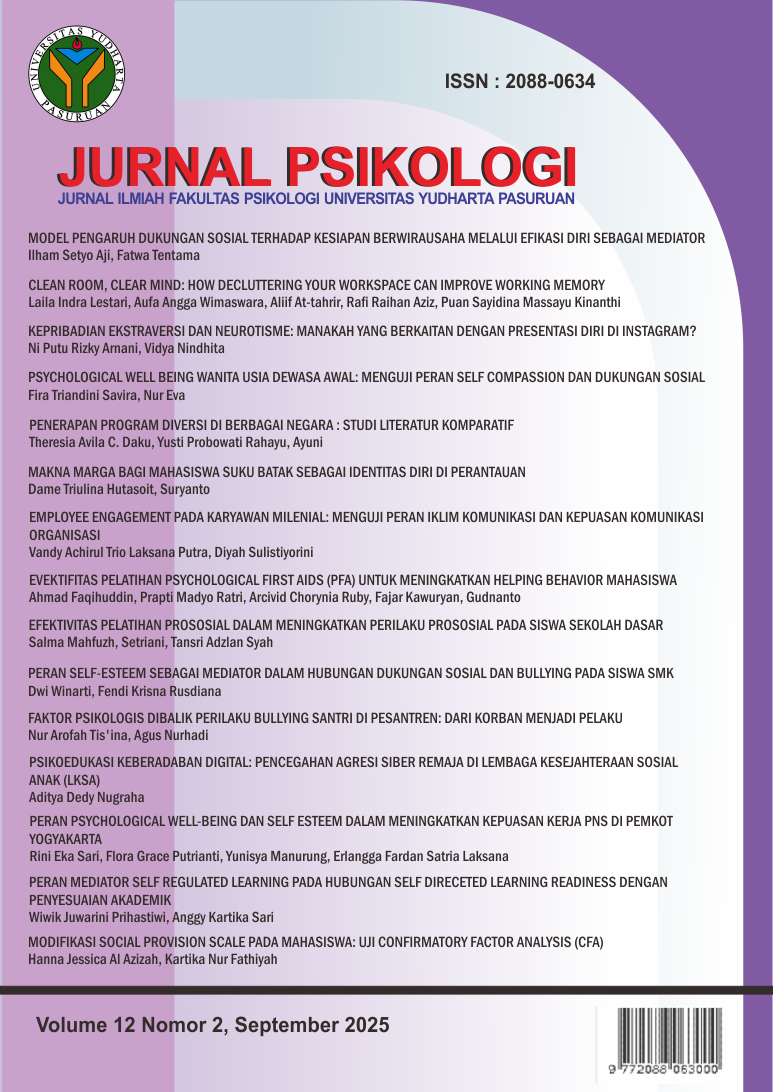
Model Pengaruh Dukungan Sosial terhadap Kesiapan Berwirausaha melalui Efikasi Diri sebagai Mediator
DOI:
https://doi.org/10.35891/jip.v12i2.6445Keywords:
dukungan sosial, efikasi diri, kesiapan berwirausaha, siswaAbstract
Tingkat pengangguran tertinggi berasal dari sekolah menengah kejuruan. Isu tersebut memerlukan kesiapan berwirausaha sebagai solusi. Faktor yang mempengaruhi kesiapan berwirausaha di antaranya dukungan sosial dan efikasi diri. Tingginya efikasi diri dipengaruhi dukungan sosial. Tujuan penelitian adalah menguji model teoritis pengaruh dukungan sosial terhadap kesiapan berwirausaha melalui efikasi diri sebagai mediator. Pendekatan kuantitatif digunakan, melibatkan 199 siswa kelas XI dari SMK “X”. Pengumpulan data menggunakan skala dukungan sosial, skala efikasi diri, dan skala kesiapan berwirausaha. Hasil penelitian menunjukkan bahwa model teoritis pengaruh dukungan sosial terhadap kesiapan berwirausaha melalui efikasi diri sebagai mediator fit dengan data empiris. Penelitian juga menemukan bahwa efikasi diri berpengaruh secara langsung dan signifikan terhadap kesiapan berwirausaha. Temuan lainnya menunjukkan bahwa dukungan sosial secara signifikan berpengaruh langsung maupun tidak langsung melalui efikasi diri terhadap kesiapan berwirausaha. Hasil penelitian ini menjelaskan dan berkontribusi terhadap perkembangan teori bahwa efikasi diri hanya bersifat mediasi komplementer pada pengaruh tidak langsung dukungan sosial terhadap kesiapan berwirausaha.
References
Adeniyi, A. O., Derera, E., & Gamede, V. (2022). Entrepreneurial self-efficacy for entrepreneurial readiness in a developing context: A survey of exit level students at TVET Institutions in Nigeria. Sage Open, 12(2). https://doi.org/10,1177/21582440221095059
Adeniyi, A. O., Gamede, V., & Derera, E. (2024). Individual entrepreneurial orientation for entrepreneurial readiness. Humanities and Social Sciences Communications, 11(1), 1-10, https://doi.org/10,1057/s41599-024-02728-9
Ajzen, I. (1991). The theory of planned behavior. Organizational Behavior and Human Decision Processes, 50(2), 179-211. https://doi.org/10,1016/0749-5978(91)90020-T
Amali, Y., Susyanti, J., & Bastomi, M. (2024). Pengaruh Financial Knowledge, Self efficacy dan Social Support Terhadap Kesiapan Berwirausaha (Studi Pada Mahasiswa Kota Malang). E-JRM: Elektronik Jurnal Riset Manajemen, 13(01), 327-336. https://jim.unisma.ac.id/index.php/jrm/article/view/23884
Apiatun, R., & Prajanti, S. D. W. (2019). Peran self-efficacy sebagai variabel intervening pengaruh pengetahuan kewirausahaan dan pengalaman prakerin terhadap kesiapan berwirausaha. Economic Education Analysis Journal, 8(3), 1163-1181. https://doi.org/10,15294/eeaj.v8i3.35714
Badan Pusat Statistik (2025). Keadaan ketenagakerjaan Indonesia. Jakarta: BPS https://www.bps.go.id/id/statistics-table/2/MTE3OSMy/tingkat-pengangguran-terbuka-berdasarkan-tingkat-pendidikan.html
Bandura, A. (1997). Self-efficacy: The exercise of control. W.H Freeman and Company.
Bandura, A., & Wessels, S. (1997). Self-efficacy (pp. 4-6). Cambridge University Press.
Efli, H. T., Elida, E., Gusnita, W., & Indrayeni, W. (2024). Hubungan Efikasi Diri dengan Kesiapan Berwirausaha Siswa Kuliner di SMK Negeri 2 Bukittinggi. Jurnal Pendidikan dan Kewirausahaan, 12(2), 856-870, https://doi.org/10,47668/pkwu.v12i2.1466
Ernsting, A., Knoll, N., Schneider, M., & Schwarzer, R. (2015). The enabling effect of social support on vaccination uptake via self-efficacy and planning. Psychology, health & medicine, 20(2), 239-246. https://doi.org/10,1080/13548506.2014.920957
Fiqrianto, M. I., Wahono, B., & Bastomi, M. (2024). Pengaruh Literasi Digital, Pengetahuan Kewirausahaan Dan Dukungan Sosial, Terhadap Kesiapan Berwirausaha Santri PP. Anwarul Huda Malang. E-JRM: Elektronik Jurnal Riset Manajemen, 13(02), 228-237. https://jim.unisma.ac.id/index.php/jrm/article/view/26200
Fute, A., Mushi, B. R., Kangwa, D., & Oubibi, M. (2024). Combating youth’s unemployment rate by integrating entrepreneurship in middle school education. Discover Education, 3(1), 37. https://doi.org/10,1007/s44217-024-00124-8
Hair Jr, J. F., Hult, G. T. M., Ringle, C. M., Sarstedt, M., Danks, N. P., & Ray, S. (2021). Partial least Squares structural equation modeling (PLS-SEM) using R: A workbook (p.197). Springer Nature. https://library.oapen.org/handle/20,500,12657/51463
Hair, J. F., Risher, J. J., Sarstedt, M., & Ringle, C. M. (2019). When to use and how to report the results of PLS-SEM. European business review, 31(1), 2-24. https://doi.org/10,1108/EBR-11-2018-0203
Henseler, J. (2017). Partial least Squares path modeling. Advanced methods for modeling markets, 361-381. https://doi.org/10,1007/978-3-319-53469-5_12
Hlad′ o, P., Kvasková, L., Ježek, S., Hirschi, A., & Macek, P. (2020). Career adaptability and social support of vocational students leaving upper secondary school. Journal of Career Assessment, 28(3), 478-495. https://doi.org/10,1177/1069072719884299
House, J. S., Kahn, R. L., McLeod, J. D., & Williams, D. (1985). Measures and concepts of social support. Academic Press.
House, J.S. (1981). Measurement and Concepts of Social Support. Academic Press.
Hutasoit, T. M. M. (2021). Pengaruh Self Efficacy, Adversity Quotient, Pendidikan Kewirausahaan, dan Dukungan Sosial Keluarga terhadap Kesiapan Berwirausaha. (Doctoral dissertation). Universitas Sumatera Utara. https://repositori.usu.ac.id/handle/123456789/45799
Isaac, S., & Michael, W. B. (1995). Handbook in research and evaluation: A collection of principles, methods, and strategies useful in the planning, design, and evaluation of studies in education and the behavioral sciences. Edits publishers. https://www.scribd.com/embeds/712461724/content?start_page=1&view_mode=scroll&access_key=key-fFexxf7r
Kemendikbud. (2018, 01 Februari). Terobosan model pembelajaran di smk. https://www.kemdikbud.go.id/main/blog/2018/02/terobosanmodel-pembelajaran-di-smk
Kemendikbud. (2022, 11 Juni). Ini dia pilihan untuk lulusan smk. https://www.vokasi.kemdikbud.go.id/read/b/ini-dia-pilihan-untuk-lulusan-smk
Kemendikbud. (2024, 30 November). Kecakapan berwirausaha tingkatkan kebekerjaan lulusan smk. https://www.kemdikbud.go.id/main/blog/2024/11/kecakapan-berwirausaha-tingkatkan-kebekerjaan-lulusan-smk
Kesumadewi, E., & Aprilyani, A. (2024). Mengatasi Pengangguran Melalui Peningkatan Kewirausahaan dengan Program Tenaga Kerja Mandiri. Journal of Macroeconomics and Social Development, 1(4), 1-15. https://doi.org/10,47134/jmsd.v1i4.360
Klyver, K., Honig, B., & Steffens, P. (2018). Social support timing and persistence in nascent entrepreneurship: exploring when instrumental and emotional support is most effective. Small Business Economics, 51, 709-734. https://doi.org/10,1007/s11187-017-9964-5
Kock, N. (2017). WarpPLS user manual: Version 6.0, ScriptWarp Systems: Laredo, TX, USA, 141, 47-60, http://www.scriptwarp.com/warppls/UserManual_v_8_0,pdf
Lau, V. P., Dimitrova, M. N., Shaffer, M. A., Davidkov, T., & Yordanova, D. I. (2012). Entrepreneurial readiness and firm growth: an integrated etic and emic approach. Journal of International Management, 18(2), 147-159. https://doi.org/10,1016/j.intman.2012.02.005
Lim, W. M., Bansal, S., Kumar, S., Singh, S., & Nangia, P. (2024). Necessity entrepreneurship: A journey from unemployment to self‐employment. Global Business and Organizational Excellence, 43(6), 41-58. https://doi.org/10,1002/joe.22256
Maddy III, L. M., Cannon, J. G., & Lichtenberger, E. J. (2015). The effects of social support on self‐esteem, self‐efficacy, and job search efficacy in the unemployed. Journal of Employment Counseling, 52(2), 87-95. https://doi.org/10,1002/joec.12007
Masdarini, L., Candiasa, I. M., Agustini, K., & Sudatha, I. G. W. (2024). The Effect of Project-Based Learning and Self-Efficacy Towards Students' Entrepreneurial Readiness in Vocational High School. Pegem Journal of Education and Instruction, 14(2), 324-330, https://orcid.org/0000-0003-2071-4265
Melyana, I. P., & Pujiati, A. (2015). Pengaruh sikap dan pengetahuan kewirausahaan terhadap kesiapan berwirausaha melalui self-efficacy. Journal of Economic Education, 4(1). https://journal.unnes.ac.id/sju/jeec/article/view/6833
Mufidah, A. C. (2017). Hubungan antara dukungan sosial terhadap resiliensi mahasiswa bidikmisi dengan mediasi efikasi diri. Jurnal sains psikologi, 6(2), 68-74. https://www.academia.edu/download/58741618/1484-5341-2-PB.pdf
Nasution, N., Dewi, S. S., & Darmayanti, N. (2025). Pengaruh Dukungan Sosial Terhadap Kesejahteraan Psikologis Dengan Efikasi Diri Sebagai Variabel Mediator Pada Mahasiswa. Psychocentrum Review, 7(1), 25-39. https://doi.org/10,26539/pcr.713889
Nurdin, S. M. N. (2024). Pengaruh employability skill dan dukungan keluarga terhadap kesiapan berwirausaha siswa kelas xii smk negeri rengel. (Doctoral dissertation). Universitas Negeri Malang. https://repository.um.ac.id/313932/
Okoye, L. J., Audu, A., & Karatu, B. A. (2017). Emotional intelligence and social support as determinants of entrepreneurial success among business owners in onitsha metropolis, nigeria. European Journal of Research in Social Sciences, 5(3). https://www.researchgate.net/publication/316915588
Olugbola, S. A. (2017). Exploring entrepreneurial readiness of youth and startup success components: Entrepreneurship training as a moderator. Journal of innovation&Knowledge, 2(3),155-171. https://doi.org/10,1016/j.jik.2016.12.004
Puteri, A. H., Agustina, T., Wahab, A., Adha, S., & Mahyudiansyah, M. (2024). Membangun Kesiapan Berwirausaha Dari Penguatan Pendidikan dan Efikasi Diri. Journal Pendidikan Ilmu Pengetahuan Sosial, 16(2), 176-189. https://doi.org/10,37304/jpips.v16i2.17325
Renaningtyas, D. L., Wahyudin, A., & Khafid, M. (2021). The effect of entrepreneurial knowledge, industrial work practices (internship), and family environment on entrepreneurial readiness through self-efficacy. Journal of Economic Education, 10(2), 173-184. https://journal.unnes.ac.id/sju/jeec/article/view/52210
Royyan, R. F., & Pahlevi, T. (2022). Pengaruh Pengetahuan Kewirausahaan dan Lingkungan Keluarga Terhadap Kesiapan Berrwirausaha Melalui Efikasi Diri. Jurnal Pajar (Pendidikan Dan Pengajaran), 6(4), 1092-1105. https://doi.org/10,33578/PJR.V6I4.8805
Schillo, R. S., Persaud, A., & Jin, M. (2016). Entrepreneurial readiness in the context of national systems of entrepreneurship. Small Business Economics, 46(4), 619–637. https://doi.org/10,1007/s11187-016-9709-x
Schunk, D. H., & DiBenedetto, M. K. (2016). Self-efficacy theory in education. Handbook of motivation at school (pp. 34-54). Routledge.
Sinaga, D. H., & Kustanti, E. R. (2017). Hubungan antara dukungan sosial teman sebaya dengan efikasi diri wirausaha pada mahasiswa fakultas ilmu sosial dan ilmu politik universitas diponegoro. Jurnal Empati, 6(1), 74-79. https://ejournal3.undip.ac.id/index.php/empati/article/view/15133
Tentama, F., & Kurniawati, K. (2024). Entrepreneurial Readiness of Young Muslim Entrepreneurs: The Role of Need for Achievement, Family Support, and Entrepreneurial Interest. Islamic Guidance and Counseling Journal, 7(2). https://orcid.org/0000-0002-9050-9462
Tentama, F., & Paputungan, T. H. (2019). Entrepreneurial Intention of Students Reviewed from Self-Efficacy and Family Support in Vocational High School. International Journal of Evaluation and Research in Education, 8(3), 557-562. https://files.eric.ed.gov/fulltext/EJ1232308.pdf
Tentama, F., Mulasari, S. A., Sukesi, T. W., Damaiwanti, A., Labiba, K., Al Qomar, N. I., & Sari, M. P. W. (2024). Faktor Kesiapan Berwirausaha pada Pelaku UMKM. Psychopreneur Journal, 8(1), 26-42. https://doi.org/10,37715/psy.v8i1.4105
Tentama, F., Subardjo, S., Abdillah, M. H. (2019). Motivation to learn and social support determine employability among vocational high school. International Journal of Evaluation and Research in Education (IJERE), 8(2), 237-242. https://files.eric.ed.gov/fulltext/EJ1220575.pdf
Yıldırım, N., Çakır, Ö., & Aşkun, O. B. (2016). Ready to dare? A case study on the entrepreneurial intentions of business and engineering students in Turkey. Procedia-Social and Behavioral Sciences, 229, 277-288. https://doi.org/10,1016/j.sbspro.2016.07.138
Zhang, Y., & Jin, S. (2016). The impact of social support on postpartum depression: The mediator role of self-efficacy. Journal of health psychology, 21(5), 720-726. https://doi.org/10,1177/1359105314536454
Zhao, X., Lynch Jr, J. G., & Chen, Q. (2010). Reconsidering Baron and Kenny: Myths and truths about mediation analysis. Journal of consumer research, 37(2), 197-206. https://doi.org/10,1086/651257
Downloads
Published
Issue
Section
License
Copyright (c) 2025 Ilham Setyo Aji, Fatwa Tentama

This work is licensed under a Creative Commons Attribution-ShareAlike 4.0 International License.
The author sends the manuscript with the understanding that if accepted for publication, the copyright of the article belongs to the author and retains publishing rights without restriction.
Copyright includes the non-exclusive right to reproduce and submit articles in all forms and media, including reprints, photographs, microfilm, and other similar reproductions, as well as translations. Reproduction of any part of this journal, its storage in the database, and its transmission by all forms of media, such as electronic, electrostatic and mechanical copies, photocopying, recording, magnetic media, etc.