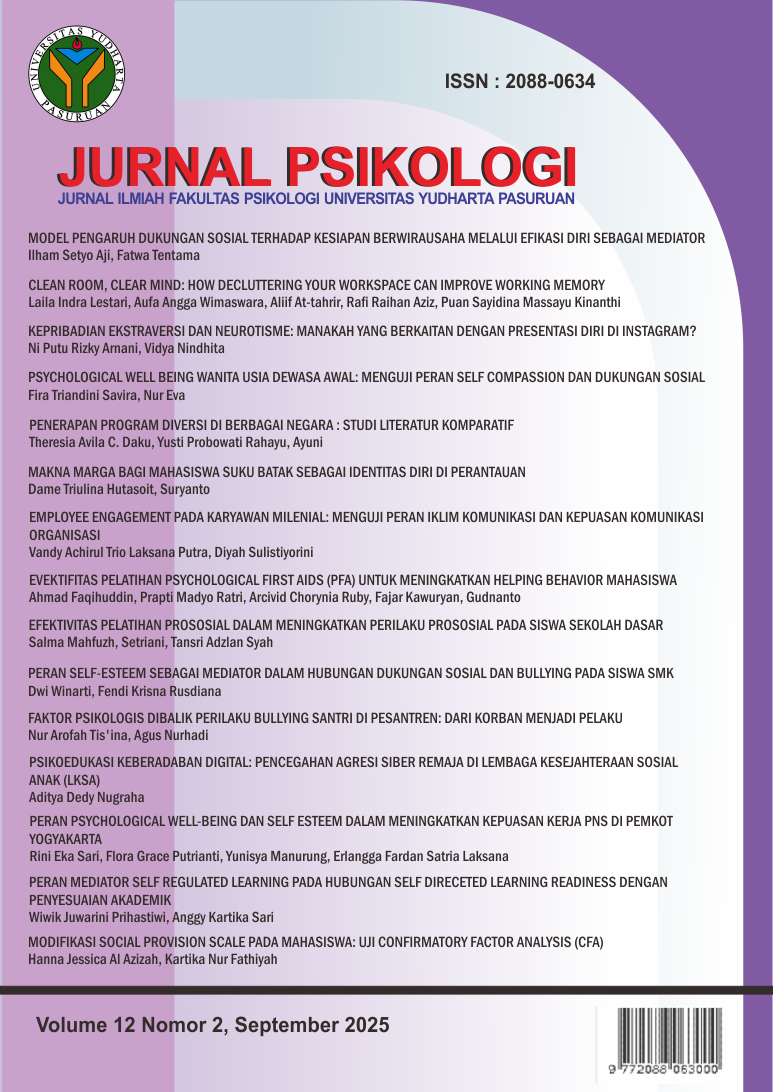
Kepribadian Ekstraversi dan Neurotisme: Manakah yang Berkaitan dengan Presentasi Diri di Instagram?
DOI:
https://doi.org/10.35891/jip.v12i2.6514Keywords:
ekstraversi, instagram, neurotisme, presentasi diriAbstract
Media sosial yang berkembang saat ini berkontribusi terhadap revitalisasi hubungan sosial individu. Individu membutuhkan ruang untuk mencari jati diri, eksistensi diri, dan penerimaan teman sebaya. Instagram menjadi ruang bagi untuk memenuhi kebutuhan ini. Metode penelitian menggunakan pendekatan kuantitatif dengan partisipan usia 15-20 tahun sebanyak 202 orang. Instrumen penelitian menggunakan skala tipe kepribadian extraversion, neuroticism, dan bentuk presentasi diri. Hasil penelitian membuktikan kepribadian ekstraversi dan neurotisisme secara bersama memberikan sumbangan sebesar 8% terhadap presentasi diri secara online di instagram. Namun jika dilihat dari masing-masing kepribadian menunjukkan hasil yang berbeda. Kepribadian ekstraversi berperan terhadap presentasi diri secara online, sedangkan kepribadian neurotisisme tidak berperan terhadap presentasi diri secara online. Ada korelasi positif antara extraversion dengan bentuk presentasi diri ingratiation, namun memiliki hubungan negatif dengan bentuk presentasi diri intimidation dan supplication. Kepribadian neuroticism memiliki hubungan positif dengan bentuk presentasi diri self-promotion dan supplication.
References
Amichai-Hamburger, Y., & Vinitzky, G. (2010). Social network use and personality. Computers in Human Behavior, 26(6). https://doi.org/10.1016/j.chb.2010.03.018
Amichai-Hamburger, Y., Wainapel, G., & Fox, S. (2002). “On the internet no one knows I’m an introvert”: Extroversion, neuroticism, and internet interaction. Cyberpsychology and Behavior, 5(2). https://doi.org/10.1089/109493102753770507
Baumeister, R. F., Tice, D. M., & Hutton, D. G. (1989). Self‐presentational motivations and personality differences in self‐esteem. Journal of Personality, 57(3). https://doi.org/10.1111/j.1467-6494.1989.tb02384.x
Besser, A., & Priel, B. (2010). Grandiose narcissism versus vulnerable narcissism in threatening situations: Emotional reactions to achievement failure and interpersonal rejection. Journal of Social and Clinical Psychology, 29(8). https://doi.org/10.1521/jscp.2010.29.8.874
Brown, J. D., & Marshall, M. A. (2010). The Three Faces of Self-Esteem.
Buunk, B. P., Van Der Zee, K., & VanYperen, N. W. (2001). Neuroticism and social comparison orientation as moderators of affective responses to social comparison at work. Journal of Personality, 69(5). https://doi.org/10.1111/1467-6494.695162
Chen, X., Pan, Y., & Guo, B. (2016). The influence of personality traits and social networks on the self-disclosure behavior of social network site users. Internet Research, 26(3). https://doi.org/10.1108/IntR-05-2014-0145
Cheung, T. T. (2014). A study of motives, usage, self-presentation and number of followers on Instagram. Discovery-SS Student E-Journal, 3.
Chow, T. S., & Wan, H. Y. (2017). Is there any ‘Facebook Depression’? Exploring the moderating roles of neuroticism, Facebook social comparison and envy. Personality and Individual Differences, 119. https://doi.org/10.1016/j.paid.2017.07.032
Costa, P. T., & McCrae, R. R. (1992). Normal personality assessment in clinical practice: The NEO Personality Inventory. Psychological Assessment, 4(1), 5-13 https://doi.org/10.1037//1040-3590.4.1.5
Dominick, J. R. (1999). Who do you think you are? Personal home pages and self-presentation on the world wide web. Journalism and Mass Communication Quaterly, 76(4). https://doi.org/10.1177/107769909907600403
Fauzia, A. Z., Maslihah, S., & Ihsan, H. (2019). Pengaruh tipe kepribadian terhadap self-disclosure pada dewasa awal pengguna media sosial instagram di kota Bandung. Journal Psychology of Science and Profession, 3(3), 151–160.
Ferryanti, N. V., Setiasih, & Kesumaningsari, N. P. A. (2021). Self-presentation berperan terhadap psychological well-being: survey pada emerging adulthood pengguna instagram. Jurnal Ilmiah Psikologi Mind Set, 12(2), 88–96.
Ferwerda, B., & Tkalcic, M. (2018). Predicting users’ personality from instagram pictures: Using visual and/or content features? UMAP 2018 - Proceedings of the 26th Conference on User Modeling, Adaptation and Personalization. https://doi.org/10.1145/3209219.3209248
Ghaisani, A. P., Handayani, P. W., & Munajat, Q. (2017). Users’ motivation in sharing information on social media. Procedia Computer Science, 124. https://doi.org/10.1016/j.procs.2017.12.186
Gil De Zuniga, H., Diehl, T., Huber, B., & Liu, J. (2017). Personality traits and social media use in 20 countries: how personality relates to frequency of social media use, social media news use, and social media use for social interaction. Cyberpsychology, Behavior, and Social Networking, 20(9). https://doi.org/10.1089/cyber.2017.0295
Goldberg, L. R. (1992). The development of markers for the big-five factor structure. Psychological Assessment, 4(1). https://doi.org/10.1037/1040-3590.4.1.26
Gonzales, A. L., & Hancock, J. T. (2011). Mirror, mirror on my Facebook wall: Effects of exposure to Facebook on self-esteem. Cyberpsychology, Behavior, and Social Networking, 14(1–2), 79–83. https://doi.org/10.1089/cyber.2009.0411
Gustina, H. (2015). KoreIasi media sosial instagram dengan presentasi diri mahasiswa jurusan ilmu komunikasi Universitas Riau. In Jom FISIP, 2(2)
Hollenbaugh, E. E., & Ferris, A. L. (2014). Facebook self-disclosure: Examining the role of traits, social cohesion, and motives. Computers in Human Behavior, 30, 50–58. https://doi.org/10.1016/j.chb.2013.07.055
Huang, H.-Y. (2014). Self-presentation tactics in media social. International Conference on Social Science, 416-421
Hunt, D. S., & Langstedt, E. (2014). The Influence of Personality Factors and Motives on Photographic Communication. The Journal of Social Media in Society, 3(2).
Jackson, C. A., & Luchner, A. F. (2018). Self-presentation mediates the relationship between Self-criticism and emotional response to Instagram feedback. Personality and Individual Differences, 133, 1–6. https://doi.org/10.1016/j.paid.2017.04.052
Jennewein, C., Baumann, A., & Lessmann, S. (2020). To use or not to use: the relationship between personality traits and instagram usage. In WI2020 Zentrale Tracks. https://doi.org/10.30844/wi_2020_o3-jennewein
Jimenez, L. N. (2014). Personality Differences in Social Networking and Online SelfPresentation. Dominican University of California.
Jones, E. E., & Pittman, T. S. (1982). Toward a general theory of strategic self-presentation. Dalam Jery Suls (Eds), (pp. 231–262). Lawrence Erlbaum Associates.
Kayiş, A. R., Satici, S. A., Yilmaz, M. F., Şimşek, D., Ceyhan, E., & Bakioǧlu, F. (2016). Big five-personality trait and internet addiction: A meta-analytic review. Computers in Human Behavior, 63. https://doi.org/10.1016/j.chb.2016.05.012
Kim, B., & Kim, Y. (2019). Facebook versus Instagram: How perceived gratifications and technological attributes are related to the change in social media usage. Social Science Journal, 56(2). https://doi.org/10.1016/j.soscij.2018.10.002
Kusumasari, H., & Hidayati, D. S. (2014). Rasa malu dan presentasi diri remaja di media sosial. Jurnal Psikologi Teori dan Terapan, 4(2), 91-105. https://doi.org/10.26740/jptt.v4n2.p91-105
Latupeirissa, A., & Wijono, S. (2022). Self-esteem dengan self-presentation pada mahasiswa pengguna media sosial instagram. Bulletin of Counseling and Psychotherapy, 4(2). https://doi.org/10.51214/bocp.v4i2.200
Lee, E., Lee, J. A., Moon, J. H., & Sung, Y. (2015). Pictures speak louder than words: motivations for using instagram. Cyberpsychology, Behavior, and Social Networking, 18(9), 552–556. https://doi.org/10.1089/cyber.2015.0157
Liu, D., & Campbell, W. K. (2017). The Big Five personality traits, Big Two metatraits and social media: A meta-analysis. Journal of Research in Personality, 70. https://doi.org/10.1016/j.jrp.2017.08.004
Lueders, A., Hall, J. A., Pennington, N. R., & Knutson, K. (2014). Nonverbal decoding on facebook: applying the IPT-15 and the SSI to personality judgments. Journal of Nonverbal Behavior, 38(4). https://doi.org/10.1007/s10919-014-0195-z
Lynn, T., Muzellec, L., Caemmerer, B., & Turley, D. (2017). Social network sites: early adopters’ personality and influence. Journal of Product and Brand Management, 26(1). https://doi.org/10.1108/JPBM-10-2015-1025
Mahendra, B., Communications, M., & Security, G. P. (2017). Eksistensi sosial remaja dalam instgram. In Jurnal Visi Komunikasi (Vol. 16, Issue 01). www.frans.co.id
Mantovani, G. (2001). The psychological construction of the Internet: From information foraging to social gathering to cultural mediation. Cyberpsychology and Behavior, 4(1). https://doi.org/10.1089/10949310151088370
Mehdizadeh, S. (2010). Self-Presentation 2.0: Narcissism and Self-Esteem on Facebook.
Michikyan, M., Dennis, J., & Subrahmanyam, K. (2015). Can you guess who i am? real, ideal, and false self-presentation on facebook among emerging adults. Emerging Adulthood, 3(1), 55–64. https://doi.org/10.1177/2167696814532442.
Michikyan, M., Subrahmanyam, K., & Dennis, J. (2014). Can you tell who i am? Neuroticism, extraversion, and online self-presentation among young adults. Computers in Human Behavior, 33, 179–183. https://doi.org/10.1016/j.chb.2014.01.010.
Miller, J. D., Hoffman, B. J., Gaughan, E. T., Gentile, B., Maples, J., & Keith Campbell, W. (2011). Grandiose and vulnerable narcissism: a nomological network analysis. Journal of Personality, 79(5). https://doi.org/10.1111/j.1467-6494.2010.00711.x.
Moon, J. H., Lee, E., Lee, J. A., Choi, T. R., & Sung, Y. (2016). The role of narcissism in self-promotion on Instagram. Personality and Individual Differences, 101. https://doi.org/10.1016/j.paid.2016.05.042
Musse, M. F. (2016). Photography on instagram: self-representation, indetities and new ways of sociability. Universitat Pompeu Fabra.
Nastiti, A. D. S., & Purworini, D. (2018). Pembentukan harga diri: analisis presentasi diri pelajar sma di media sosial. Jurnal Komunikasi, 10 (1), 33-47.
Nurhayati, & Nurmina. (2020a). Kontribusi big five personality terhadap strategi presentasi diri pada pengguna instagram. Jurnal Pendidikan Tambusai, 4(3), 2488–2494.
Nurhayati, & Nurmina. (2020b). Kontribusi Big Five Personality Terhadap Strategi Presentasi Diri pada Pengguna Instagram. Jurnal Pendidikan Tambusai, 4(3), 2488–2494.
Paliszkiewicz, J., & Madra-Sawicka, M. (2016). Impression Management in Social Media: The Example of LinkedIn.
Ramdhani, N. (2012). Adaptasi bahasa dan budaya inventori big five. Jurnal Psikologi, 39(2), 189–207. http://ipip.
Rarasati, D. B., Hudaniah, H., & Prasetyaningrum, S. (2019). Strategi presentasi diri pengguna instagram ditinjau dari tipe kepribadian. Jurnal Ilmiah Psikologi Terapan, 7(2), 235–251. https://doi.org/10.22219/jipt.v7i2.8164.
Rozgonjuk, D., Ryan, T., Kuljus, J. K., Täht, K., & Scott, G. G. (2019). Social comparison orientation mediates the relationship between neuroticism and passive Facebook use. Cyberpsychology, 13(1). https://doi.org/10.5817/CP2019-1-2.
Ryan, T., & Xenos, S. (2011). Who uses Facebook? An investigation into the relationship between the Big Five, shyness, narcissism, loneliness, and Facebook usage. Computers in Human Behavior, 27(5). https://doi.org/10.1016/j.chb.2011.02.004.
Santrock, J. W. (2007). A topical approach to life-span development, 3E. Ch, 5, 192.
Saraswati, P. A. A. (2023). Hubungan antara big five personality dengan self-disclosure pada dewasa awal pengguna media sosial instagram. COMSERVA: Jurnal Penelitian Dan Pengabdian Masyarakat, 3(1). https://doi.org/10.59141/comserva.v3i1.763.
Sartana, S., & Afriyeni, N. (2019). Tipe kepribadian dan intensi berbagi informasi di media sosial. Jurnal Ecopsy, 6(1). https://doi.org/10.20527/ecopsy.v6i1.6255.
Seidman, G. (2013). Self-presentation and belonging on Facebook: How personality influences social media use and motivations. Personality and Individual Differences, 54(3). https://doi.org/10.1016/j.paid.2012.10.009.
Şenormanci, Ö., Saraçli, Ö., Atasoy, N., Şenormanci, G., Koktürk, F., & Atik, L. (2014). Relationship of internet addiction with cognitive style, personality, and depression in university students. Comprehensive Psychiatry, 55(6). https://doi.org/10.1016/j.comppsych.2014.04.025.
Sheldon, P., & Bryant, K. (2016). Instagram: Motives for its use and relationship to narcissism and contextual age. Computers in Human Behavior, 58. https://doi.org/10.1016/j.chb.2015.12.059
Shidiq, N. A. (2022). Big five personality dan keterbukaan diri pada dewasa awal pengguna media sosial. Material Safety Data Sheet, 33(1).
Tackett, J. L. (2006). Evaluating models of the personality-psychopathology relationship in children and adolescents. Clinical Psychology Review, 26(5). https://doi.org/10.1016/j.cpr.2006.04.003.
Wallace, L., James, T. L., & Warkentin, M. (2017). How do you feel about your friends? Understanding situational envy in online social networks. Information and Management, 54(5). https://doi.org/10.1016/j.im.2016.12.010.
Wibowo, Y., & Silaen, S. M. J. (2018). Hubungan self-esteem dan penggunaan media sosial instagram dengan perilaku narsisme di kalangan siswa kelas VIII SMPK Penabur Bintaro Jaya. Ikraith-Humaniora: Jurnal Sosial dan Humaniora, 2(2).
Wong, W. K. W. (2012). Faces on facebook: A Study of Self-presentation and Social Support on Facebook. Discovery-SS Student E-Journal, 1.
Xu, R., Frey, R. M., Fleisch, E., & Ilic, A. (2016). Understanding the impact of personality traits on mobile app adoption - Insights from a large-scale field study. Computers in Human Behavior, 62. https://doi.org/10.1016/j.chb.2016.04.011
Zhang, H. (2015). Gender, Personality, and Self Esteem as Predictors of Social Media Presentation. East Tennessee State University.
Zulkifli, A. (2018). Self-disclosure ditinjau dari tipe kepribadian dan self-esteem pada remaja pengguna media sosial. Journal of Psychological Science and Profession, 2(2). https://doi.org/10.24198/jpsp.v2i2.21194
Downloads
Published
Issue
Section
License
Copyright (c) 2025 Ni Putu Rizky Arnani, Vidya Nindhita

This work is licensed under a Creative Commons Attribution-ShareAlike 4.0 International License.
The author sends the manuscript with the understanding that if accepted for publication, the copyright of the article belongs to the author and retains publishing rights without restriction.
Copyright includes the non-exclusive right to reproduce and submit articles in all forms and media, including reprints, photographs, microfilm, and other similar reproductions, as well as translations. Reproduction of any part of this journal, its storage in the database, and its transmission by all forms of media, such as electronic, electrostatic and mechanical copies, photocopying, recording, magnetic media, etc.