Productive Zakat Based on Local Potential: A Multi-Case Study in Rural and Urban Areas
DOI:
https://doi.org/10.35891/ml.v17i2.6153Keywords:
Economic Empowerment, Local Potential, Productive Zakat, Rural Community, Urban CommunityAbstract
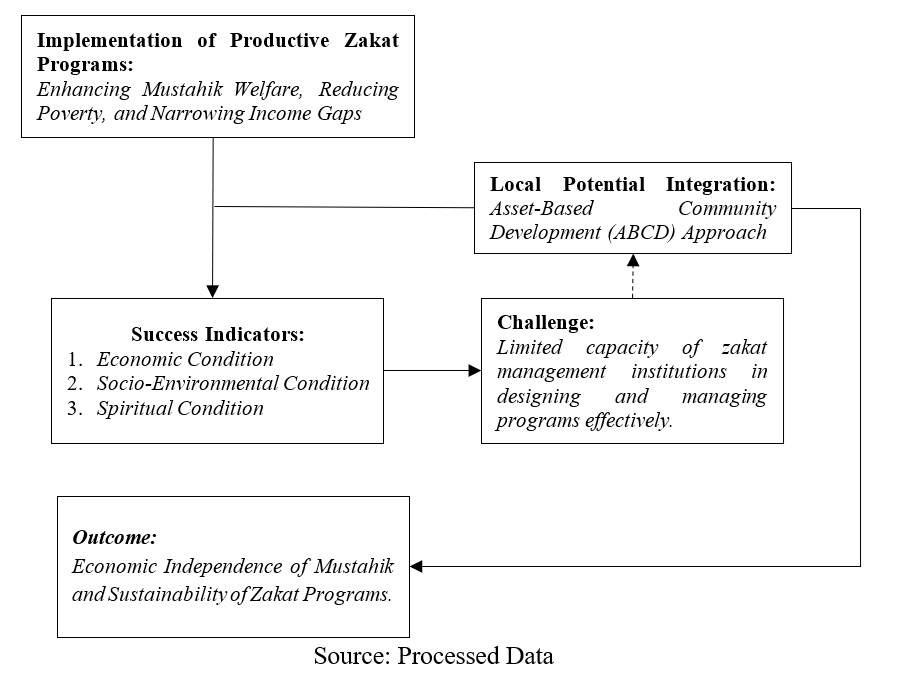
Introduction: This study explores the implementation of locally-based productive zakat programs in urban and rural contexts, aiming to analyze the effectiveness of integrating local economic potential in empowering zakat beneficiaries. Using a qualitative multi-case study approach, Wahdah Inspirasi Zakat (WIZ) Makassar was selected as the urban case and LAZISMU Grobogan as the rural case. Methods:
Data were collected through in-depth interviews and document analysis. Results: The results reveal that leveraging local potential in productive zakat programs significantly improves the income and economic independence of mustahik. WIZ Makassar focuses on skills training, micro-business support, and women empowerment to address urban poverty. In contrast, LAZISMU Grobogan utilizes rural resources such as goat farming and organic fertilizer production to support small businesses and community welfare. The study identifies five key phases in program success: mapping potential, selecting beneficiaries, providing continuous assistance, monitoring business progress, and conducting evaluation. Conclusion and Suggestion: However, challenges persist, including beneficiaries' preference for consumptive aid and the limited human resources in zakat institutions. To overcome these barriers, strategies such as community education, institutional capacity development, and funding diversification are necessary. The findings underscore the importance of context-specific zakat management models tailored to local characteristics, ensuring sustainable economic empowerment. This research offers a practical framework for zakat institutions seeking to optimize the impact of productive zakat programs in varied socioeconomic settings.
Downloads
References
Al-Bawwab, R. A. (2023). Zakat: changing the framework of giving. Islamic Economic Studies, 30(2), 86–103. https://doi.org/10.1108/ies-08-2021-0026
Al-Hassan, F. A. (2017). Waqf Management in Indonesia Through Asset Based Community Development ( Abcd ) Approach. International Journal of Social Science and Economic Research, 2(08), 4070–4087. Retrieved from https://ijsser.org/uploads/ijsser_02__256.pdf
Amirah, N., Sulfinadia, H., & Efrinaldi, E. (2024). Pembangunan Berkelanjutan (SDGs): Sociopreneur Zakat Produktif Sebagai Upaya Pengentasan Kemiskinan. Al-Intaj : Jurnal Ekonomi Dan Perbankan Syariah, 10(1), 23. https://doi.org/10.29300/aij.v10i1.2382
Anderson, G., Herr, K., & Nihlen, A. (2014). Studying Your Own School: An Educator’s Guide to Practitioner Action Research. Studying Your Own School: An Educator’s Guide to Practitioner Action Research, 26–28. https://doi.org/10.4135/9781483329574
Apriyani, N. (2024). Zakat Distribution in Minimizing Poverty Levels For Economic Development. 10, 187–203. https://doi.org/10.24252/iqtisaduna.v10i1.39931
Arum, H. S., Rupita, N. E., Arum, H. S., Rupita, N. E., Albahi, M., & Info, A. (2024). Maqasid Sharia As A Philosophical Foundation In Islamic Economic Policy Making. 16(1), 28–43. https://doi.org/10.35891/ml.v16i1.5798
Arwani, A., & Muhammad, R. (2024). Sustainable development and Islamic philanthropy: Synergy of zakat and SDGs. Al-Uqud: Journal of Islamic …, 8, 124–160. Retrieved from https://journal.unesa.ac.id/index.php/jie/article/view/32226
Aulia, D. E., Faizal, A. N., & Sunan, M. I. N. (2023). Asset Based Community Development: Upaya Badan Amil Zakat Nasional Dalam Mendayagunakan Potensi Lokal Desa Menuju Tujuan Pembangunan Berkelanjutan. Jurnal Multidisiplin West Science, 2(07), 558–567. https://doi.org/10.58812/jmws.v2i07.519
Ayuniyyah, Q., Pramanik, A. H., Md Saad, N., & Ariffin, M. I. (2022). The impact of zakat in poverty alleviation and income inequality reduction from the perspective of gender in West Java, Indonesia. International Journal of Islamic and Middle Eastern Finance and Management, 15(5), 924–942. https://doi.org/10.1108/IMEFM-08-2020-0403
Beik, I. S., & Arsyianti, L. D. (2016). Measuring Zakat Impact on Poverty and Welfare Using Cibest Model. Journal of Islamic Monetary Economics and Finance, 1(2), 141–160. https://doi.org/10.21098/jimf.v1i2.524
Birt, L., Scott, S., Cavers, D., Campbell, C., & Walter, F. (2016). Member Checking: A Tool to Enhance Trustworthiness or Merely a Nod to Validation? Qualitative Health Research, 26(13), 1802–1811. https://doi.org/10.1177/1049732316654870
Charities Aid Foundation. (2024). World Giving Index 2024: Global trends in generosity. In charities Aid Foundation. Retrieved from cafonline.org
Daulay, J. R., Khoiri, N., & Syahputera, A. (2022). Zakat Produktif (Tinjauan Hukum Islam dalam Karya Prof. DR. Yusuf Al-Qardawi). Al-Mashlahah: Jurnal Hukum Islam Dan Pranata Sosial Islam, 10(2), 1001–1016. https://doi.org/10.30868/am.v10i02.3184
Ekaviana, D., Ramadhani, F. N., & Mulawarman, A. D. (2019). Investigating an Indonesian Equitable Financing: Case Study on Baitul Maal Masjid Jogokariyan. International Journal of Zakat and Islamic Philantropy, 1(2), 85–93.
Fauzan, A. F., Zakaria, Z. A., & Siregar, S. (2024). Human Resources Aspects in Mosque Financial Management in Jogokariyan Mosque and Al-Ikhlash Jatipadang Mosque. International Journal Ihya’ ’Ulum Al-Din, 26(1), 44–56. https://doi.org/10.21580/ihya.26.1.20479
Frodermann, L. (2018). Case Description and Within-Case Analysis. 51–96. https://doi.org/10.1007/978-3-658-21949-9_4
Gabriele Lailatul Muharromah, & Mustofa. (2021). Paradigma SDGs dalam Manajemen Zakat di Indonesia. Malia: Jurnal Ekonomi Islam, 13(1), 1–16. https://doi.org/10.35891/ml.v13i1.2788
Green, G. P., & Haines, A. (2016). Asset Building and Community Development. SAGE Publication.
Hadi, S., & Hana, K. F. (2023). The Problems Of Zakat Management In Indonesia. Indonesian Conference of Zakat-Proceedings. Retrieved from https://www.iconzbaznas.com/submission/index.php/proceedings/article/view/621%0Ahttps://www.iconzbaznas.com/submission/index.php/proceedings/article/download/621/290
Hassan, M. K., Khan, M. Z. H., Miah, M. A., & Islam, M. K. (2024). The national-level potential of Zakat and its integration into the fiscal framework: sector-specific insights from the economy of Bangladesh. International Journal of Islamic and Middle Eastern Finance and Management, 17(1), 146–169. https://doi.org/10.1108/IMEFM-09-2023-0313
Herianingrum, S., Supriani, I., Sukmana, R., Effendie, E., Widiastuti, T., Fauzi, Q., & Shofawati, A. (2024). Zakat as an instrument of poverty reduction in Indonesia. Journal of Islamic Accounting and Business Research, 15(4), 643–660. https://doi.org/10.1108/JIABR-11-2021-0307
Husna, N., & Siregar, M. H. (2023). IZI To Success: The Impact Of The Productive Zakat Empowerment Program On The Welfare Of Beneficiaries By The Indonesian Zakat Initiative (IZI) In North Sumatra. Jurnal Pamator : Jurnal Ilmiah Universitas Trunojoyo, 16(3), 454–476. https://doi.org/10.21107/pamator.v16i3.20879
Hustedde, R. J., & Ganowicz, J. (2020). The Basics: What’s Essential About Theory for Community Development Practice? In 50 Years of Community Development Vol I (1st Editio, p. 19). Routledge.
Iqbal, M. N. (2022). Pendayagunaan Zakat Produktif Dalam Pemberdayaan Ekonomi Umat Menurut Yusuf Qardhawi. Jurnal Landraad, 1(1), 22–42. Retrieved from https://jurnal.ishlahiyah.ac.id/index.php/jl/article/view/27
Islam, M. K., Mitu, S. T., Munshi, R., & Khanam, R. (2023). Perceptions about the common malpractice of Zakat paying in Bangladesh during Covid-19 pandemic: evidence from the supply side. Journal of Islamic Accounting and Business Research, 14(3), 361–378. https://doi.org/10.1108/JIABR-09-2021-0253
Jamaludin, H., Zhang, H., Syed Salleh, S. N., & Lacheheb, Z. (2025). Trust as the engine of change: a conceptual model for trust building in zakat institutions. Journal of Islamic Accounting and Business Research. https://doi.org/10.1108/JIABR-03-2024-0099
Kasri, R. A. (2016). Effectiveness of Zakah Targeting in Alleviating Poverty in Indonesia. Al-Iqtishad: Journal of Islamic Economics, 8(2), 169–186. https://doi.org/10.15408/aiq.v8i2.3005
Kretzmann, J. P., & Mcknight, J. L. (1993). Building Communities from the Inside Out: A Path Toward Finding and Mobilizing a Community’s Assets. In The Asset-Based Community Development Institute, DePaul University Steans Center. Evanston: ACTA Publication.
Lestari, R. S. D., & Alwi, M. A. (2022). Zakat Produktif sebagai Instrumen Pengentasan Kemiskinan untuk Masyarakat Usia Produktif. Malia (Terakreditasi), 14(1), 37–50. https://doi.org/10.35891/ml.v14i1.3679
Lubis, R. A., & Sazali, H. (2024). Productive Management of Zakat Funds for Mustahiq. Istinbath Journal of Islamic Law and Economics Journal of Islamic Law and Economics, 23(1), 124–138.
Lulu Musa Dil Piero, Laily Dwi Arsyanti, Yuda Asnawi, & Budi Susilo Setiawan. (2022). Model Pengembangan Wakaf untuk Pemberdayaan Ekonomi Masyarakat pada Peternakan Domba. Malia: Jurnal Ekonomi Islam, 13(2), 213–228. https://doi.org/10.35891/ml.v13i2.3266
Luntajo, M. M. R., & Hasan, F. (2023). Optimalisasi Potensi Pengelolaan Zakat di Indonesia melalui Integrasi Teknologi. Al-’Aqdu: Journal of Islamic Economics Law, 3(1), 14. https://doi.org/10.30984/ajiel.v3i1.2577
Mathie, A., & Cunningham, G. (2005). Who is driving development? Reflections on the transformative potential of asset-based community development. Canadian Journal of Development Studies, 26(1), 175–186. https://doi.org/10.1080/02255189.2005.9669031
Mawardi, I., Widiastuti, T., Al Mustofa, M. U., & Hakimi, F. (2023). Analyzing the impact of productive zakat on the welfare of zakat recipients. Journal of Islamic Accounting and Business Research, 14(1), 118–140. https://doi.org/10.1108/JIABR-05-2021-0145
Miles, M. B., & Huberman, A. M. (1994). Qualitative Data Analyis. Sage Publication, (1987), 1–354.
Nayak, V., & Hegde, K. P. (2023). Examining the Impact of Wealth Redistribution through Zakat. Millah: Journal of Religious Studies, 22(2), 285–312. https://doi.org/10.20885/millah.vol22.iss2.art1
Qardawi, Y. (2007). Hukum Zakat. Bogor: Pustaka Litera AntarNusa.
Rozak, I., & Sulistyowati, E. (2022). Studi Komparasi Internet Financial Reporting (IFR) Pada Lembaga Amil Zakat Nasional Dan Provinsi. Malia: Jurnal Ekonomi Islam, 13(2), 245–260. https://doi.org/10.35891/ml.v13i2.3267
Ryan, C. (2012). Cross-case analysis. In Advances in Culture, Tourism and Hospitality Research (Vol. 6). Emerald Group Publishing Ltd. https://doi.org/10.1108/S1871-3173(2012)0000006033
Saad, R. A. J., Ahmi, A., Sawandi, N., & Abdul Aziz, N. M. (2023). Zakat administration reformation towards an effective and efficient zakat revenue generation. Journal of Islamic Accounting and Business Research, 14(8), 1232–1260. https://doi.org/10.1108/JIABR-05-2021-0151
Sari, A. (2018). The Problematic of Zakat Productive Utilization in BAZNAS Jepara. Jurnal Bimnas Islam, 637–669. Retrieved from https://jurnalbimasislam.kemenag.go.id/jbi/article/view/65
Sarif, S., Ali, N. A., & Kamri, N. ‘Azzah. (2024). Zakat for generating sustainable income: an emerging mechanism of productive distribution. Cogent Business and Management, 11(1). https://doi.org/10.1080/23311975.2024.2312598
Setiawan, A., Armina, S. H., Novika, S., Gontor, D., Sayyid, U. I. N., & Rahmatullah, A. (2024). The Typology of Islamic Social Entrepreneurship : Principles , and Characteristic from a Maqashid Shariah Perspective. 18(02), 21–32. https://doi.org/10.21111/ijtihad.v18i2.12362
Shabbir, M. S. (2021). The Role of Islamic Microfinance Approach for Community Development. Journal of Economics & Management Research, 2(2), 1–10. https://doi.org/10.47363/jesmr/2021(2)127
Shodiq, S. J., Chotib, M., & Rahayu, N. W. I. (2024). ZAKAT PRODUKTIF DALAM PERSPEKTIF HUKUM ISLAM. Jurnal Bisnis Dan Manajemen, 4(1), 19–29.
Siregar, D. A., Siregar, S., & Marliyah, M. (2023). Productive Zakat As An Alternative Islamic Social Financial Instrument In Community Economic Empowerment Reflection Of The Covid-19 Era. Jurnal Indonesia Sosial Teknologi, 4(12), 2499–2509. https://doi.org/10.59141/jist.v4i12.848
Stake, R. E. (2006). Multiple Case Study Analysis. Guilford Press.
Sugianto, E., Wei, Z., & Xu, S. (2024). Evaluation of the Zakat System as a Tool for Redistribution of Wealth in the Modern Economy. 2(3), 163–173.
Suharto, E. (2005). Membangun Masyarakat Memberdayakan Rakyat Kajian Strategis Pembangunan Kesejahteraan Sosial Dan Pekerjaan Sosial. Refika Aditama.
Sunarsih, S., Hamdani, L., Rizal, A., & Yusfiarto, R. (2023). Motivational factors to paying zakat through institutions: a multigroup analysis of urban and suburban muzakki based on digital payment scheme. Journal of Islamic Accounting and Business Research. https://doi.org/10.1108/JIABR-12-2022-0333
Syauqi, M., Fitriyah, N., & Jumuaati. (2022). Dampak Islamic Corporate Governance Terhadap Keyakinan Muzaki Pada Lembaga Amil Zakat. Malia: Jurnal Ekonomi Islam, 14(1), 69–84. https://doi.org/10.35891/ml.v14i1.3739
Yasmeen, K. (2023). Justice in the workplace: Islamic principles for wage determination. Islamic Economic Studies, 31(1/2), 43–87. https://doi.org/10.1108/ies-03-2023-0011
Yin, R. K. (2018). Case Study Research and Applications: Design and Methods (6th Edition). SAGE Publication.
Yumna, A. (2019). Productive Zakat and social justice. In Social Justice and Islamic Economics (p. 19). Routledge.
Yusmita, D., & Amrizal. (2024). Analisis Strategi Manajemen Badan Amil Zakat Nasional Sibolga Berdasarkan Analisis SWOT. 5(10), 4131–4149.
Zainuddin, Z., & Khalid, H. (2020). Legal Perception of the Community Regarding Productive Zakat and Its Utilization In Makassar. Fiat Justisia: Jurnal Ilmu Hukum, 14(1), 69–82. https://doi.org/10.25041/fiatjustisia.v14no1.1796
Zakiy, F. S., Falikhatun, F., & Fauziah, N. N. (2023). Sharia governance and organizational performance in zakat management organization: evidence from Indonesia. Journal of Islamic Accounting and Business Research. https://doi.org/10.1108/JIABR-06-2023-0188
Zein, A. S., Lubis, D. S., & Sovia, A. K. (2020). Digitalization of Mustahiq Economic Empowerment Model based on Productive Zakah Fund. International Conference of Zakat, (March 2019), 419–428. https://doi.org/10.37706/iconz.2020.220