The Marginalized Maqasid al-Shariah Problems of Profit Orientation in Indonesia's Islamic Financial System
DOI:
https://doi.org/10.35891/ml.v16i2.6244Keywords:
Maqasid al-shariah, Islamic finance, profit orientation, financial regulation, inclusive economyAbstract
Introduction: This study addresses the growing concern over the marginalization of maqasid al-shariah the ethical and social objectives of Islamic law in Indonesia’s Islamic financial institutions (IFIs). Despite notable growth in assets and institutional presence, many IFIs remain fixated on profit-maximization, often replicating conventional banking models and neglecting the core values of Islamic economics such as justice, welfare, and human dignity.
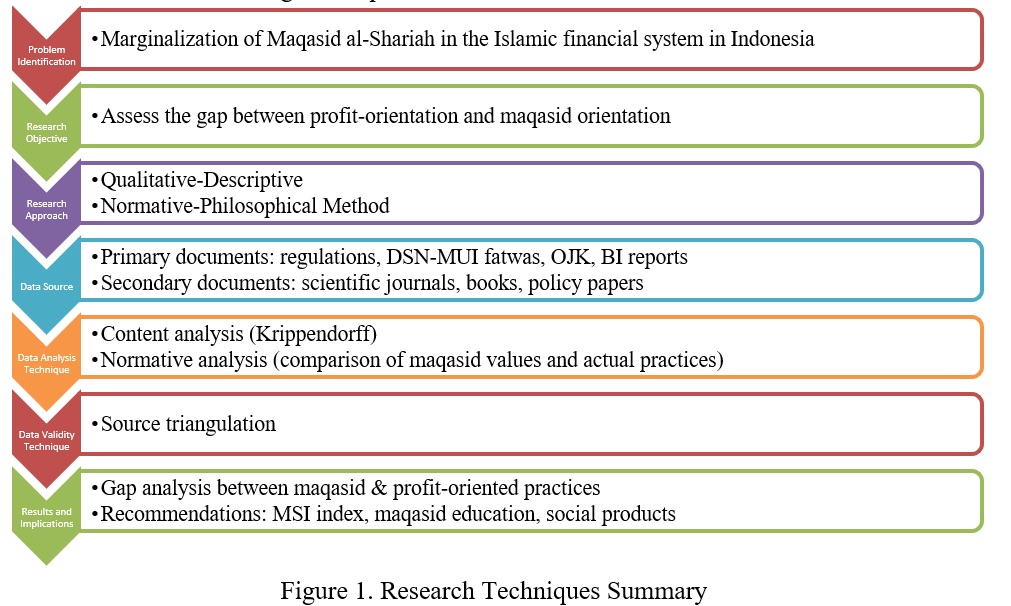
Methods: This research employs a qualitative-descriptive approach using a normative-philosophical method. Data were collected through document and content analysis of Islamic financial regulations, fatwas, academic publications, and policy papers. The study also applies triangulation to enhance data validity and reliability..
Results: Findings indicate that profit orientation dominates Islamic banking operations in Indonesia, with little institutional incentive to implement maqasid-aligned policies. Regulatory indicators such as ROA and CAR fail to reflect social objectives, and maqasid literacy among practitioners remains low. These gaps have contributed to reduced social impact, especially among lower-income groups who are central to maqasid values.
Conclusion and suggestion: The study recommends the integration of a Maqasid Shariah Index (MSI) into regulatory evaluation tools, development of socially-oriented products such as qard hasan and productive waqf, and mandatory maqasid education for IFI leadership. These steps aim to create a more balanced, ethical, and socially inclusive Islamic financial ecosystem in Indonesia.
Downloads
References
Adzkiya, U. (2020). Analisis Maqashid Al-Syariah Dalam Sistem Ekonomi Islam dan Pancasila. JESI (Jurnal Ekonomi Syariah Indonesia), 10(1), 23. https://doi.org/10.21927/JESI.2020.10(1).23-35
Alvesson, M., & Sköldberg, K. (2017). Reflexive methodology: New vistas for qualitative research (3rd ed.). SAGE Publications.
Amsari, S., Harahap, I., & Nawawi, Z. M. (2024). Transformasi Paradigma Pembangunan Ekonomi: Membangun Masa Depan Berkelanjutan melalui Perspektif Ekonomi Syariah. Ekonomis: Journal of Economics and Business, 8(1), 729–738. https://doi.org/10.33087/EKONOMIS.V8I1.1703
Analia, A. L., Hakim, A., Anto, M. B. H., & Perdana, A. R. A. (2024). Implementing maqasid sharia: Impact on stability ofIndonesian Islamic banks. Jurnal Ekonomi & Keuangan Islam, 10(2). https://doi.org/10.20885/JEKI
Arum, H. S., Rupita, N. E., Syahpawi, & Albahi, M. (2024). Maqasid Syariah As A Philosophical In Islamic Economic Policy Making. Malia: Jurnal Ekonomi Islam, 16(1), 28–43. https://doi.org/10.35891/ml.v16i1.5798
Asutay, M. (2020). Fintech and Islamic Finance: Opportunities and Challenges. Journal of Islamic Business and Management, 10, 324–338.
Aziz, A., Anwar, K., Aprilia, V., Nurpadilah, E., & Yunita. (2025). Peran Zakat Dalam Mengetaskan Kemiskinan. Jurnal Inovasi Keuangan Dan Manajemen, 6(1). https://ijurnal.com/1/index.php/jikm/article/view/591
Baehaqi, A., Birton, M. N. A., & Hudaefi, F. A. (2020). Time value of money in Islamic accounting practice: a critical analysis from maqÄá¹£id al-Sharī‘ah. Journal of Islamic Accounting and Business Research, 11(9), 2035–2052. https://doi.org/10.1108/JIABR-09-2018-0155
Bank Indonesia. (2022). Laporan Ekonomi dan Keuangan Syariah - 2021.
Bank Syariah Indonesia. (n.d.). Retrieved May 6, 2025, from https://www.bankbsi.co.id/news-update/berita/perjalanan-3-tahun-bsi-dari-merger-tiga-bank-syariah-menuju-pasar-global
Ceasario, A. F., & Nisa, F. L. (2025). Transformasi Keuangan Digital dalam Perspektif Ekonomi Syariah : Peluang, Tantangan, dan Dampak Terhadap Inklusi Keuangan. Al Rikaz: Jurnal Ekonomi Syariah, 3(1), 102–114. https://doi.org/10.35905/rikaz.v3i2.9596
Chapra, M. U. (2022). Moral Vision of Islamic Economics: Toward Socioeconomic Justice. Islamic Research and Training Institute.
Creswell, J. ., & Poth, C. . (2025). Qualitative Inquiry and Research Design: Choosing Among Five Approaches (5th ed.). SAGE Publications.
Deza, R. L. R., & Sofyani, H. (2019). Syariah Governance dan Maqashid Syariah di PerbankanSyariah di Indonesia: Pendekatan Integrated MaqashidAl-Sharīʿah Based Performance Measure (IMSPM). Reviu Akuntansi Dan Bisnis Indonesia. https://doi.org/10.18196/rab.010101
Dusuki, A. W., & Abdullah, N. I. (2020). Maqasid al-Shariah, Maslahah, and Corporate Social Responsibility. The American Journal of Islamic Social Sciences, 24(1), 25–45.
Fachry, M. (2022). Pandangan Akademisi Tentang Islamic Social Enterprise dan Kaitannya Dengan Lembaga Filantropi Islam (Studi Kasus Program Studi Ekonomi Islam UII) [Universitas Islam Indonesia]. https://dspace.uii.ac.id/handle/123456789/53760
Flick, U. (2018). An Introduction to Qualitative Research (6th ed.). SAGE Publications.
Govender, N., Laryea, S., & Watermeyer, R. (2024). Conceptual research methodology to investigate the relationship between fees and quality of professional service outputs. Journal of Engineering, Design and Technology, 22(4), 1185–1205.
Haniifah, N. I. F. (2025). Analisis Dampak Merger Pt. Bank Syariah Indonesia Terhadap Kinerja Keuangan Dan Kinerja Syariah Dengan Pendekatan Rgec Dan Maqashid Shariah Index. Universitas Islam Sultan Agung Semarang.
Hidayatullah, M. S. (2020). Membumikan Ekonomi Syariah Di Indonesia (Sebuah Upaya Memasyarakatkan Ekonomi Syariah dan Mensyariahkan Ekonomi Masyarakat). UIN Antasari Banjarmasin, 14(2).
Hudaefi, F. A., & Noordin, K. (2019). Harmonizing and constructing an integrated maqÄá¹£id al-SharÄ«Ê¿ah index for measuring the performance of Islamic banks. ISRA International Journal of Islamic Finance, 11(2), 282–302. https://doi.org/10.1108/IJIF-01-2018-0003
Indranata, C. J. (2024). Analisis Manajemen Zakat Berbasis Blockchain Technology Sebagai Strategi Optimaliasasi Kebijakan Suistainable Development Goals [Universitas Islam Indonesia]. https://dspace.uii.ac.id/handle/123456789/48871
Ishak, A. H., Amira Mohamad, S. N., Ab Manan, S. K., Yahaya, M. H., Wan Daud, W. N., & Sharif, D. (2025). The critical success factors of waqf land development for sustainable agriculture. Social Sciences and Humanities Open, 11(December 2024). https://doi.org/10.1016/j.ssaho.2024.101244
Kementrian Agama. (2019). Al-Qur’an &Terjemahannya.
Krippendorff, K. (2018). Content Analysis: An Introduction to Its Methodology (4th ed.). SAGE Publications.
Lubis, R. H. (2020). Governance, Risk Management, and Compliance : Implementasi dan Implikasi Pada Koperasi Syariah di Kota Tangerang Selatan [Sekolah Pascasarjana UIN Syarif Hidayatullah Jakarta]. https://repository.uinjkt.ac.id/dspace/handle/123456789/57927
Malihah, L., & Sauqi, M. (2024). The Role of the Halal Value Chain Process in MSMEs on the Economy of South Kalimantan. Malia: Jurnal Ekonomi Islam, 16(1), 124–144. https://doi.org/10.35891/ml.v16i1.5716
Marito, D. (2024). Analisis Kinerja Keuangan Bank Umum Syariah Di Indonesia Menggunakan Pendekatan Islamicity Performance Index. UIN Syekh Ali Hasan Ahmad Addary Padangsidimpuan.
Monawer, A. T. M., Abdul Rahman, N. N., Qasem Al-‎Nahari, A. A. A., Haji Abdullah, L., Ali, A. K., & Meguellati, A. (2022). The actualization of maqÄá¹£id al-SharÄ«Ê¿ah in Islamic finance: a conceptual framework. International Journal of Islamic and Middle Eastern Finance and Management, 15(5), 847–864. https://doi.org/10.1108/IMEFM-06-2020-0293
Mundzir, A., Zukhriyah, A., & Sulhan, M. (2024). The Implementation of Halal Network Indonesia (HNI) Business Among Muslim and Non-Muslim Communities. Malia: Jurnal Ekonomi Islam, 15(2), 147–157. https://doi.org/10.35891/ml.v15i2.4308
Nurhidayatullah, A. S., & Fathurohman, O. S. (2024). Maqashid Syariah Sebagai Kerangka Kerja Untuk Inovasi Produk Keuangan Non Bank Dalam Era Digital. Jurnal Masharif Al-Syariah: Jurnal Ekonomi Dan Perbankan Syariah, 9(5). https://doi.org/10.30651/jms.v9i5.24835
Otoritas Jasa Keuangan. (2024a). Perbankan Syariah. https://ojk.go.id/id/kanal/syariah/Pages/Perbankan-Syariah.aspx
Otoritas Jasa Keuangan. (2024b). Prinsip dan Konsep Perbankan Syariah. https://ojk.go.id/id/kanal/syariah/tentang-syariah/Pages/Prinsip-dan-Konsep-PB-Syariah.aspx
Purwanto, H. (2024). Integrasi Prinsip ESG (Environmental, Social, Governance) Dalam Perbankan Syariah. Studia Economica : Jurnal Ekonomi Islam, 10(2), 240–250. https://doi.org/10.30821/SE.V10I2.21738
Purwanto, H., Sakir, M., Munir, S., & Adinugraha, H. H. (2024). Analisis Pengaruh Prinsip-Prinsip Tasawuf, Literasi Keuangan Syariah, dan Kualitas Pelayanan terhadap Keputusan Nasabah dalam Memilih Produk Perbankan Syariah. Velocity: Journal of Sharia Finance and Banking, 4(2), 133–149. https://doi.org/10.28918/VELOCITY.V4I2.8935
Putra, R. H., Jaswir, I., Wira, A., & Novia, A. (2025). Epistemologi Ekonomi Islam: Perspektif Sosiologi Dalam Menghadapi Krisis Ekonomi Global. ISTIKHLAF: Jurnal Ekonomi, Perbankan Dan Manajemen Syariah, 7(1), 169–186. https://doi.org/10.51311/ISTIKHLAF.V7I1.707
Rahmi, C., Rohman, A. A., Sari, A. E., Nadhifah, S. L., & Azmi, M. R. (2024). Penerapan Maqashid Syariah Dalam Perbankan Syariah Di Indonesia Studi Kasus: Pada Bank Bsi (Bank Syariah Indonesia). Jurnal Ilmiah Research And Development Student, 2(2), 01–09. https://doi.org/10.59024/jis.v2i2.711
Ratnawati, N., Faruqi, F., Arsjah, R. J., Salfinnia, M., Nugraha, A. Z., & Ahmad, S. (2025). Meningkatkan Produktivitas Kewirausahaan Islam Melalui Pelatihan Berbasis Syariah untuk Siswa di Islamic Entrepreneur Boarding School di Purwakarta. BERDAYA: Jurnal Pendidikan Dan Pengabdian Kepada Masyarakat, 7(1), 119–132. https://doi.org/10.36407/BERDAYA.V7I1.1497
Rio, D. R. (2022). Efektifitas Pembiayaan Bank Syariah Dalam Perwujudan Umkm Sejahtera Pada Masa Pandemi Covid-19 Dalam PerspektifEkonomi Islam (Studi Pada UMKM Yang Mendapatkan Pembiayaan Oleh Bank Syariah Indonesia KC Bandar Lampung Kedaton). UIN Raden Intan Lampung.
Rohmah, R. R. (2024). Evolusi Hukum Perbankan Syariah Di Indonesia. AL MIDAD: Jurnal Ilmu Pendidikan Dan Studi Keislaman, 1(1), 49–62. https://ejournal.staidhtulungagung.ac.id/index.php/almidad/article/view/20
Srisusilawati, P., Hardianti, P. D., Erlianti, N., Pitsyahara, I. R., & Nuraeni, S. K. (2022). Implementasi Maqashid Syariah Terhadap Produk Perbankan Syariah. Al-Mustashfa: Jurnal Penelitian Hukum Ekonomi Syariah, 7(1), 1–11. https://doi.org/10.24235/JM.V7I1.8409
Tumanggor, D. V. (2024). Integrated Maqasid Al-Shariah in Cash Waqf Linked Deposit: A Study Approach to Sustainable. Jurnal Penelitian Ilmu Ekonomi Dan Keuangan Syariah, 2(4), 91–105. https://doi.org/10.59059/JUPIEKES.V2I4.1724
Wijaya, M. Y. (2024). Consumption Behavior of Students of Sunan Kalijogo Jabung Islamic Boarding School on Syariah Fashion Products (Reviewed in the Maqashid Syariah Approach). MALIA: Jurnal Ekonomi Islam, 16(1), 111–123. https://doi.org/10.35891/ML.V16I1.5924
Wulandari, A., & Andni, R. (2024). The Influence Of Financial Performance, Corporate Governance, And Trading Volume On Islamic Stock Prices (Case Study on ISSI BUMN Sector in 2011-2023). Malia: Jurnal Ekonomi Islam, 16(1), 70–89. https://doi.org/10.35891/ml.v16i1.5818
Zain, S. (2020). PENGARUH PERSEPSI SANTRI, RELIGIUSITAS DAN PROMOSI BANK SYARIAH TERHADAP MINAT MENABUNG SANTRI PADA PRODUK SIMPANAN PELAJAR (Studi Pada Santri Pondok Pesantren Al-Mukhlishin) [UNIVERSITAS ISLAM NEGERI SYARIF HIDAYATULLAH JAKARTA]. https://repository.uinjkt.ac.id/dspace/bitstream/123456789/52190/1/SULAIMAN ZAIN-FEB.pdf
Zulkhibri, M. (2016). Financial inclusion, financial inclusion policy and Islamic finance. Macroeconomics and Finance in Emerging Market Economies, 9(3), 303–320. https://doi.org/10.1080/17520843.2016.1173716
Zulqarnain, Siregar, Y. T., Gunawan, R., & Ramadhani, M. (2025). Kearifan Lokal Dalam Kebijakan Penyusunan Ekonomi Syariah: Integrasi Nilai-Nilai Lokal Untuk Pembangunan Berkelanjutan. Jurnal Keuangan Dan Manajemen Terapan, 6(1). https://ejurnals.com/ojs/index.php/jkmt/article/view/1152