The Role of Attitude in Mediating Gen Z’s Intention in Use of Digital Sharia Banking
DOI:
https://doi.org/10.35891/ml.v16i2.6249Keywords:
Convenience, Digital Banking, Attitude, Gen ZAbstract
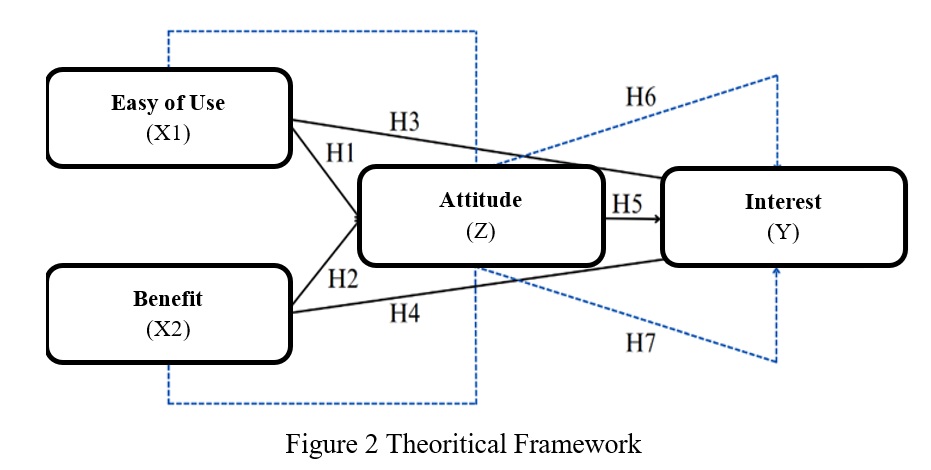
Introduction: Dynamic technological developments make a significant contribution to human life. In the banking world, one of the technological developments that has changed the way of transactions is the emergence of payment instruments known as digital banking. Therefore, this research aims to determine the effect of convenience and usefulness on interest in using digital banking with attitude as an intervention variable for Gen Z in Cirebon Regency.
Method: The research uses a quantitative approach with the type of non-parametric data. The sampling technique used random sampling with a number of samples are 100 respondents. The data analysis technique uses Structural Equation Modeling (SEM) with the tool is SEM-PLS.
Result: The results of the first test show that the Convenience and Usefulness has a significant effect on attitudes to use digital banking. Likewise in the second test show the Convenience, Benefit and Attitude has a significant effect on interest in using digital banking. Whereas the result of mediating test show that the Attitudes have a significant influence as an intervening variable between ease and interest in using digital banking, also has a significant effect as an intervening variable between ease and interest in using digital banking.
Conclusion & Suggestion: The findings of this study show that the main factor that attracts Gen Z in using Digital Banking is the ease of use factor, therefore banks must always pay attention to the user interface (UI) and user experience (UX) of their applications. The intuitive design and easy transaction process will be very attractive to Gen Z. In addition to convenience, the benefits offered also need to be more concrete and relevant to the needs of Gen Z. Knowing that attitudes have a very important role in influencing interest, digital banks can build campaigns that focus not only on features and benefits, but also on forming a positive perception of digital banking.
Downloads
References
Abdillah, W., & Hartono, J. (2015). Konsep dan Aplikasi PLS (Partial Least Square) untuk Penelitian Empiris. Yogyakarta: Penerbit Andi.
Agia, L. N., & Nurjannah, H. (2022). Analisis Kualitas Layanan Bank Syariah Indonesia Menggunakan Importance Performance Analysis. Journal of Economic, Bussines and Accounting (COSTING), 5(2), 1570–1574.
Andi Fauziah, & Tenrypada. (2021). Pengaruh Kepercayaan, Kemudahan, Dan Resiko Terhadap Penggunaan E-Banking (Survei pada Nasabah BRI Syariah di Kota Palu). Jurnal Ilmu Perbankan Dan Keuangan Syariah, 3(1), 74–81. https://doi.org/10.24239/jipsya.v3i1.40.74-81
Atieq, M. Q., & Nurpiani, E. (2022). Pengaruh kemudahan penggunaan, manfaat dan risiko terhadap minat nasabah menggunakan mobile banking bank syariah. Jurnal Valuasi: Jurnal Ilmiah Ilmu Manajemen Dan Kewirausahaan, 2(1), 401–423.
Bank Indonesia. (2023). Laporan Keuangan BI 2023. Departemen Komunikasi.
Bank Indonesia. (2024). Laporan Keuangan BI Triwulan I. Departemen Komunikasi.
Bougie, S. dan. (2019). Partial Least Square (Konsep, Teknik Dan Aplikasi menggunakan Program SmartPLS 3.0. Univesitas Diponegoro Semarang.
BPS. (2024). Kabupaten Cirebon Dalam Angka. BPS Kabupaten Cirebon.
Chauhan, S., Akhtar, A., & Gupta, A. (2022). Customer experience in digital banking: a review and future research directions. International Journal of Quality and Service Sciences, 14(2), 311–348. https://doi.org/10.1108/IJQSS-02-2021-0027
Fadillah, M., Nurbalqis, A., & Agustina, L. (2022). Pengaruh Konten Digital Terhadap Generasi Z Dalam Pemanfaatan Media Sosial Dan Digital Native Di Kota Tanjungpinang. Al Yazidiy: Jurnal Sosial Humaniora Dan Pendidikan, 4(2), 01–11.
Fajri, R. (2024). Gen Z Cenderung Pilih Bank Digital.
Ghozali, I. (2021). Partial Least Squares, konsep, Teknik dan Aplikasi edisi 3. Semarang ; Badan Penerbit Undip.
Ghozali, I., & Kusumadewi, K. A. (2023). Partial Least Squares Konsep Teknik dan Aplikasi (Universita). Yoga Pratama.
Indriasari, E., Prabowo, H., Lumban Gaol, F., & Purwandari, B. (2022). Intelligent Digital Banking Technology and Architecture. International Journal of Interactive Mobile Technologies (IJIM), 16(19), 98–117. https://doi.org/10.3991/ijim.v16i19.30993
Jogiyanto Hartono, M. (2018). Metoda pengumpulan dan teknik analisis data. Penerbit Andi.
Karnadi, Z., Zulkarnain, Z., & Alwie, A. F. (2018). Pengaruh persepsi manfaat, persepsi kemudahan, sikap, kontrol prilaku, dan norma subyektif terhadap minat penggunaan uang elektronik pada Bank BUMN di kota Pekanbaru. Jurnal Tepak Manajemen Bisnis, 10(3), 617–631.
Lalu Agustino. (2021). Pengaruh Promosi, Persepsi Kemudahan Dan Persepsi Manfaat Terhadap Minat Penggunaan E-Wallet Dengan Kepercayaan Sebagai Variabel Mediasi Pada Pengguna E-Wallet di Kota Banjarmasin. Kindai, 17(3), 401–422. https://doi.org/10.35972/kindai.v17i3.631
Luigi, W., Jeo, L., & Michael C, T. (2020). Disruptions and Digital Banking Trends. Journal of Applied Finance & Banking.
Lutfiah, D., Lubis, F. A., & Anggraini, T. (2023). Pengaruh Persepsi Kebermanfaatan, Kemudahan Penggunaan, Dan Risiko Terhadap Minat Menggunakan Layanan Mobile Banking Dengan Attitude Toward Using Sebagai Variabel Intervening (Studi Kasus Mahasiswa Uin Sumatera Utara Pengguna BSI Mobile). JURNAL ILMIAH EDUNOMIKA, 8(1). https://doi.org/DOI: https://doi.org/10.29040/jie.v8i1.10683
Mbama, C. I., & Ezepue, P. O. (2018). Digital banking, customer experience and bank financial performance. International Journal of Bank Marketing, 36(2), 230–255. https://doi.org/10.1108/IJBM-11-2016-0181
Musianto, L. S. (2002). Perbedaan pendekatan kuantitatif dengan pendekatan kualitatif dalam metode penelitian. Jurnal Manajemen Dan Kewirausahaan, 4(2), 123–136.
Navira, A., & Sobarsyah, M. (2023). PENGARUH PERCEIVED EASE OF USE, PERCEIVED USEFULNESS TERHADAP INTENTION TO USE FINANCIAL TECHNOLOGY DENGAN ATTITUDE TOWARD USING SEBAGAI VARIABEL INTERVENING (STUDI PADA UMKM DI KECAMATAN PANAKUKKANG KOTA MAKASSAR). Journal of Accounting Issues, 2(1), 1–25.
Nguyen, O. T. (2020). Factors Affecting the Intention to Use Digital Banking in Vietnam. The Journal of Asian Finance, Economics and Business, 7(3), 303–310. https://doi.org/10.13106/jafeb.2020.vol7.no3.303
Pratama, A. B., & Suputra, I. D. G. D. (2019). Pengaruh Persepsi Manfaat, Persepsi Kemudahan Penggunaan, dan Tingkat Kepercayaan Pada Minat Menggunakan Uang Elektronik. E-Jurnal Akuntansi, 927. https://doi.org/10.24843/EJA.2019.v27.i02.p04
Rismalia, R., & Sugiyanto, S. (2022). Pengaruh Persepsi Kemudahan, Persepsi Manfaat Dan Kepercayaan Terhadap Keputusan Penggunaan Uang Elektronik Dengan Sikap Sebagai Variabel Intervening Pada Pengguna Dana Di Universitas Esa Unggul. SINOMIKA Journal: Publikasi Ilmiah Bidang Ekonomi Dan Akuntansi, 1(3), 561–588. https://doi.org/10.54443/sinomika.v1i3.309
Ruslan, R. (2018). Metode Penelitian Public Relations dan Komunikasi. In Metode Penelitian Public Relations dan Komunikasi.
Sarstedt, M., & Cheah, J.-H. (2019). Partial least squares structural equation modeling using SmartPLS: a software review. Journal of Marketing Analytics, 7(3), 196–202. https://doi.org/10.1057/s41270-019-00058-3
Sarstedt, M., Ringle, C. M., & Hair, J. F. (2022). Partial Least Squares Structural Equation Modeling. In C. Homburg, M. Klarmann, & A. Vomberg (Eds.), Handbook of Market Research (pp. 587–632). Springer International Publishing.
Schiffman, L. G., & Kanuk, L. L. (2008). Perilaku Konsumen (7th ed.). PT Indeks.
Setyawati, R. E. (2020). Pengaruh Perceived Usefullness, Perceived Ease of Use Terhadap Behavioral Intention To Use dengan Atittude Towards Using sebagai Variabel Intervening (Studi Kasus Pada Gopay Dikota Yogyakarta). Jurnal Ekobis Dewantara, 3(1), 39–51.
Simatupang, M. B. (2021). Perbankan Digital : Menuju Bank 4.0 (Jakarta). PT Gramedia Pustaka Utama.
Subagiyo, R. (2016). Metode Penelitian Ekonomi Islam: Konsep dan Penerapan. Alim’s Publishing.
Suhaemin, S., & Arikunto, S. (2013). Manajemen perpustakaan di madrasah aliyah negeri Yogyakarta. Jurnal Akuntabilitas Manajemen Pendidikan, 1(2), 252–268.
Sulastini, N. P., & Warmika, I. G. K. (2014). Aplikasi Tam, Persepsi Risiko, Dan Kepercayaan Dalam Menjelaskan Niat Masyarakat Menggunakan Internet Banking [PhD Thesis]. Udayana University.
Syafika, N., Wahyuni, E. S., & Hartini, K. (2024). Revealing Gen Z’s Interest in Sharia Investment in The Capital Market. MALIA: Jurnal Ekonomi Islam, 16(1), 56–69. https://doi.org/https://doi.org/10.35891/ml.v16i1.5713
Syofyan, N. (2021). Pengaruh Persepsi Manfaat, Kemudahan Penggunaan Dan Kepuasan Terhadap Minat Menggunakan Kembali e-Wallet Pada Masa Pandemi Covid-19. (Doctoral Dissertation, Universitas Andalas).
Ulfah, M. (2020). Digital Parenting (Tasikmalay). Edu Publiser.
Wardani, D. K., Primastiwi, A., & Hermalia, H. (2020). Persepsi Kemanfaatan dan Persepsi Kemudahan pada Minat Membayar PBB Menggunakan Go-Pay dengan Sikap Penggunaan sebagai Variabel Intervening. EXERO: Journal of Research in Business and Economics, 3(1), 128–146.
Wardani, D., Primastiwi, A., & Hermalia, H. (2022). Persepsi Kemanfaatan dan Persepsi Kemudahan pada Minat Membayar PBB Menggunakan Go-Pay dengan Sikap Penggunaan sebagai Variabel Intervening. EXERO : Journal of Research in Business and Economics, 3(1), 128–146. https://doi.org/10.24071/exero.v3i1.4240
Wardoyo, W., & Andini, I. (2017). Faktor-Faktor Yang Berpengaruh Terhadap Keputusan Pembelian Secara Online Pada Mahasiswa Universitas Gunadarma. Jurnal Manajemen Dayasaing, 19(1), 12–26. https://doi.org/10.23917/dayasaing.v19i1.5101
Wartoyo, W., & Haida, N. (2024). The Impact of Government Sukuk Emissions on Islamic Banking Activities in Indonesia. Equilibrium: Jurnal Ekonomi Syariah, 12(1), 232–252. https://doi.org/DOI: 10.21043/equilibrium.v12i1.28223