The Mediating Role of Circle of Friends and Flexing on FOMO and Israf in Gen Z’s Imitation Fashion Purchase Decisions
DOI:
https://doi.org/10.35891/ml.v16i2.6282Keywords:
FOMO, Israf, Circle of Friends, Flexing, Imitation Fashion Purchase Decisions.Abstract
Introduction: This study aims to analyze the mediating role of Circle of Friends and Flexing on the influence of Fear of Missing Out (FOMO) and Israf (excessive consumption) on purchasing decisions of imitation fashion products among Generation Z in Bone Regency. These social and psychological factors are known to be the main drivers of increased consumption of counterfeit goods.
Methods: This research uses a quantitative approach with associative methods and Structural Equation Modeling-Partial Least Square (SEM-PLS) analysis techniques. Primary data were obtained through the distribution of online questionnaires to 230 respondents using a purposive sampling technique. The measurement instrument used a Likert scale of 1 to 5 and was tested for validity and reliability.
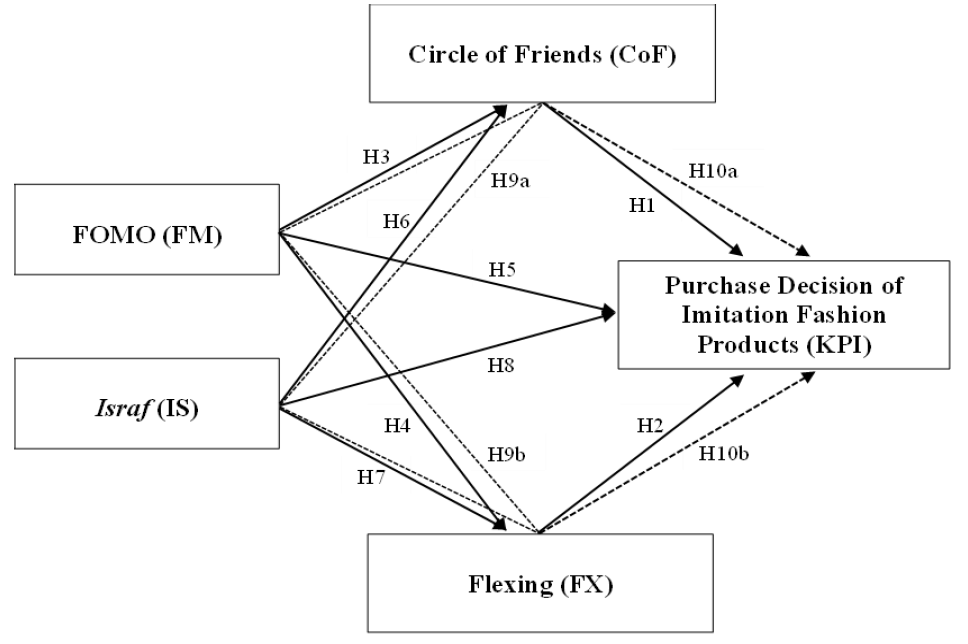
Results: The t-value for the Circle of Friends variable on Purchase Decisions was 7.333 with a significance level of 0.000, and Flexing had a t-value of 3.235 with a significance of 0.001. Both were statistically significant. FOMO had a significant effect on Circle of Friends (t = 2.575; p = 0.010) and Flexing (t = 3.162; p = 0.002), but it did not directly affect Purchase Decisions. Meanwhile, Israf had a significant effect on Circle of Friends (t = 5.354; p = 0.000), Flexing (t = 4.914; p = 0.000), and Purchase Decisions (t = 2.606; p = 0.010). The indirect influence through both mediators was also proven significant.
Conclusion and suggestion: The results of the study conclude that Circle of Friends and Flexing significantly mediate the influence of FOMO and Israf on purchasing decisions of imitation fashion products. These findings confirm the importance of social influence and self-imaging motivation in Generation Z's consumption behavior. It is recommended that education about authentic consumption and strengthening regulations against counterfeit goods be improved.
Downloads
References
Abdullah, Q. A., & Yu, J. (2019). Attitudes and Purchase Intention towards Counterfeiting Luxurious Fashion Products among Yemeni Students in China. American Journal of Economics, 9(2), 53–64. https://doi.org/10.5923/j.economics.20190902.03
Ajzen, I. (1991). The theory of planned behavior. Organizational Behavior and Human Decision Processes, 50(2), 179–211. https://doi.org/10.1016/0749-5978(91)90020-T
Ajzen, I. (2015). Consumer attitudes and behavior : the theory of planned behavior applied to food consumption decisions. Rivista Di Economia Agraria, 20(2), 121–138. https://doi.org/10.13128/REA-18003
Alton Endarwanto Hadi Susanto, Nadiroh, Hafid Abbas, & Agung Purwanto. (2023). Lifestyle: Flexing Behavior in Social Media. International Journal of Economics (IJEC), 2(1), 27–31. https://doi.org/10.55299/ijec.v2i1.410
Alutaybi, A., Al-Thani, D., McAlaney, J., & Ali, R. (2020). Combating Fear of Missing Out (FoMO) on Social Media: The FoMO-R Method. International Journal of Environmental Research and Public Health, 17(17), 6128. https://doi.org/10.3390/ijerph17176128
Anshori, M., & Iswati, S. (2019). Metodologi Penelitian Kuantitatif. Surabaya: Airlangga University Press.
Arabi, S. El, & Taghipour, A. (2023). The Psychological, Social and Economic Effect of The Purchase of The Fake Brand in Ready-To-Wear Sector in The Saudi Arabia: Case Study Done on Saudi Women. Iris Journal of Economics & Business Management, 1(2), 1–4. https://doi.org/10.33552/ijebm.2023.01.000508
Arifah, M., Asnawi, A., & Listyawati, L. (2024). Pengaruh Celebrity Endorse dan Word Of Mouth Terhadap Keputusan Pembelian Produk Ms Glow Mabruro Arifah. Liling Listyawati SAB, 2(1), 307–322.
Badan Pusat Statistik. (2024). Kabupaten Bone dalam Angka. In B. K. Bone (Ed.), BPS Kabupaten Bone (Vol. 19). Bone: BPS Kabupaten Bone.
Banindro, B. S. (2021). “Fake Brands†Studi Kasus Peniruan Identitas Visual pada Consumer Products Industry. ANDHARUPA: Jurnal Desain Komunikasi Visual & Multimedia, 7(2), 363–374. https://doi.org/10.33633/andharupa.v7i2.5048
Bilhuda, U., & Thamrin. (2022). Pengaruh Norma Subjektive Terhadap Minat Pembelian Produk Sepatu Adidas Palsu Melalui Sikap Sebagai Variabel Mediasi Studi Kasus Mahasiswa Universitas Negeri Padang. Banking and Management Review, 11(1), 1569–1581. https://doi.org/10.52250/bmr.v11i1.502
Bupalan, K., Rahim, S. A., Ahmi, A., & Rahman, N. A. A. (2019). Consumers’ Repurchase Intention towards Counterfeit Products. International Journal of Supply Chain Management, 8(3), 973–981.
Catur Widayati, C., Sinambela, S., Magito, M., & Ikhsani, K. (2021). Analysis of Affecting Factors on Purchase Decision of Sport Shoes “Fake Product†of Gold’S Gym Consumers in West Jakarta. Dinasti International Journal of Management Science, 2(4), 537–550. https://doi.org/: https://doi.org/10.31933/dijms.v2i4
Chellasamy, A. (2020). Consumer Perception and Purchasing Behavior towards Counterfeit Products- Effect on Original Brand Image. International Journal of Research and Review (Ijrrjournal.Com), 7(9), 128.
Christy, C. C. (2022). FoMo di media sosial dan e-WoM : pertimbangan berbelanja daring pada marketplace. Jurnal Studi Komunikasi (Indonesian Journal of Communications Studies), 6(1), 331–357. https://doi.org/10.25139/jsk.v6i1.3742
Çıtak, F. S. (2024). The theory of planned behavior: Definition, model and examples. Retrieved April 16, 2024, from Forms.app website: https://forms.app/en/blog/the-theory-of-planned-behavior
Dian Octaviani, R., Sucherly, Prabowo, H., & Sari, D. (2023). Determinants of Indonesian Gen Z’s purchase behavior on online travel platforms: Extending UTAUT model. Innovative Marketing, 19(4), 54–65. https://doi.org/10.21511/im.19(4).2023.05
Djayapranara, G. F., & Setyawan, A. (2024). Antecedents Factors that Influence CUstomer’s Purchase Intention Towards Purchasing Counterfeit Products. International Symposium on Management (INSYMA 2023), 328–335. https://doi.org/10.2991/978-94-6463-244-6_50
Fahlevi, R., Giorgyna, G., & Sinambela, F. A. (2024). Analysis of Factors Influencing Purchase Intention. Jurnal Fokus Manajemen Bisnis, 14(1), 32–53. https://doi.org/10.12928/fokus.v14i1.8974
Fathrul Quddus, M. (2021). Kritik Konsumerisme dalam Etika Konsumsi Islam. Malia: Jurnal Ekonomi Islam, 13(1), 43–60. https://doi.org/10.35891/ml.v13i1.2771
Frida Thomas Pacho. (2023). Self–Brand Connection and the Decision to Purchase Counterfeit and Original Luxury Brands in Tanzania. Journal of Consumer Sciences, 8(2), 93–110. https://doi.org/10.29244/jcs.8.2.93-110
Hariyono, M., & Hendra, H. P. (2024). Fenomena Flexing Pada Media Sosial: Persepsi Generasi Z. Psycho Aksara Jurnal Psikologi, 2(1), 29–36.
He, Y. (2023). The Influence of Social Network Characteristics in Shaping Consumers Behavior and Market Outcome. Advances in Economics, Management and Political Sciences, 55(1), 265–270. https://doi.org/10.54254/2754-1169/55/20231021
Ikhwanda, F. K., & Giyana. (2025). Analisis Peran Trend Fashion dan Fear of Missing Out terhadap Keputusan Pembelian Produk Von Dutch pada Mahasiswa-Mahasiswi. Jurnal Manajemen Dan Ekonomi Kreatif, 3(1).
Insani, N. K., & Riyanto, E. D. (2024). Pengaruh Faktor Ekonomi pada Pola Konsumsi: Perilaku Pemakaian Brand Sepatu Imitasi Converse di Kota Surabaya. Metahumaniora, 14(2), 92–100. https://doi.org/10.24198/metahumaniora.v14i2.54061
International Trademark Association. (2019). Gen Z Insights: Brands and Counterfeit Products Indonesia Country Report.
Ishak, D., Akmal, F. A., & Halide, N. (2024). GENERATION Z INVOLVEMENT IN HALAL ECOSYSTEM. Jurnal Al-Dustur, 7(2), 211–221. https://doi.org/10.30863/aldustur.v7i2.7199
J. F, A., R. D, B., & P.W, M. (2005). Perilaku Konsumen (Jilid 1). Jakarta: Binarupa Aksara.
Khan, M. A. (2020). Theory of Consumer Behavior : An Islamic Perspective. MPRA Paper, (104208), 1–36.
Kiburu, L., Njiraini, N., & Boso, N. (2023). Social networks and consumer technology usage: A systematic literature review and future research directions. Cogent Business & Management, 10(1). https://doi.org/10.1080/23311975.2022.2153487
Kimura, S., & Nakamura, Y. (2020). Global Circulation of Imitated Products, Poor Quality Pharmaceuticals, Fake Products, and Health Problems. Singapore: Springer. https://doi.org/10.1007/978-981-15-2089-1_2
Kotler, P., & Keller, K. L. (2016). Marketing Management (15th ed.). Pearson.
Littman Ovadia, H., & Russo Netzer, P. (2024). Exploring the lived experience and coping strategies of Fear of Missing Out (FoMO) among emerging adults. Current Psychology, 43(42), 32665–32685. https://doi.org/10.1007/s12144-024-06793-w
M. Syarif Adi Pramana, & Muhammad Saiful Khair. (2024). Israf’s Prohibition in QS. al-A’raf : 31 (Abdullah Saeed’s Contextual Approach). Al-Fahmu: Jurnal Ilmu Al-Qur’an Dan Tafsir, 3(1), 108–124. https://doi.org/10.58363/alfahmu.v3i1.191
Maghfur, I. (2017). Ekonomi Sufistik (Spiritualitas dalam Bermuamalah). MALIA: Jurnal Ekonomi Islam, 8(2), 151–166.
Marhaban, I., & Suryadi. (2021). Pengaruh Perilaku Konsumen dan Desain Produk terhadap Keputusan Pembelian Produk Imitasi Jenis Fashion (Sepatu Vans) di Kalangan Mahasiswa FEB Universitas Muhammadiyah Metro. Jurnal Manajemen DIVERSIFIKASI, 1(2), 221–236. https://doi.org/10.24127/diversifikasi.v1i2.569
Marlina, Prakosa, A., & Imam Basri, A. (2021). Pengaruh Kesadaran Nilai, Materialisme dan Pengaruh Sosial Terhadap Sikap Konsumen pada Merek Supreme Palsu. Equilibrium: Jurnal Ilmu Manajemen, 1(1), 9–15. https://doi.org/https://doi.org/10.56393/equilibrium.v1i1.51
Muchamad Bagus Satrio Wibowo, & Muhammad Iqbal. (2022). Faktor Pengetahuan dan Religiusitas Generasi Z Terhadap Minat Menabung di Bank Syariah. MALIA (TERAKREDITASI), 13(1), 93–106. https://doi.org/10.35891/ml.v13i1.2795
Muhamad Oldy Royantara, Agung Wijaya, Rini Sugiarti, & Fendy Suhariadi. (2025). Peran FOMO (Fear of missing out) dalam Meningkatkan Kecemasan Terhadap Media Sosial pada Generasi Z. EduInovasi: Journal of Basic Educational Studies, 5(1), 426–441. https://doi.org/10.47467/edu.v5i1.6503
Muhammad Fahmul Iltiham, & Nizar, M. (2020). Pengaruh Label Halal Majelis Ulama Indonesia (MUI), Harga Pada Oleh-Oleh Makanan Khas Pasuruan Terhadap Minat Beli dan Keputusan Pembelian. Malia: Jurnal Ekonomi Islam, 11(2), 311–326. https://doi.org/10.35891/ml.v11i2.2149
Muthohharoh, F. M., Azizah, N., Mina Holihah, & Anggraini, D. N. (2023). Dampak Lingkaran Pertemanan Terhadap Proses Belajar Mahasiswa. The Indonesian Journal of Social Studies, 6(2), 102–114. https://doi.org/https://doi.org/10.26740/ijss.v6n2.p102-114
Mutmainah, K., Guspul, A., Machfud, Y., Affandi, A., Khanifa, N. K., & Fatmawati, F. (2024). Determinan Counterfeit Purchase Intention. Journal of Economic, Management, Accounting and Technology, 7(1), 91–104. https://doi.org/10.32500/jematech.v7i1.5895
Mutmainnah, Fahimatussyam, A., & Rakhman Wijaya, A. (2023). Fenomena Flexing dalam Ekonomi Islam. Jurnal Econetica: Jurnal Ilmu Sosial, Ekonomi, Dan Bisnis, 5(1), 30–40. https://doi.org/10.69503/econetica.v5i1.360
Nurmanto, D., Mulyanto, H., Wiyatno, T. N., Purnamasari, P., & Putra, H. M. M. (2024). Faktor Pengaruh Reputasi dan Kualitas Layanan Terhadap Minat Beli Ulang Konsumen Pada Platform E-commerce Shopee. Jurnal Kajian Ilmiah, 24(1), 33–44. https://doi.org/10.31599/h1ctjy38
Permadi, A. A., & Syarifah, D. (2021). Sikap atas Produk Tiruan sebagai Mediator Kerentanan Konsumen terhadap Intensi Membeli Produk Fashion Tiruan. Buletin Riset Psikologi Dan Kesehatan Mental (BRPKM), 1(1), 892–902. https://doi.org/10.20473/brpkm.v1i1.27491
Przybylski, A. K., Murayama, K., DeHaan, C. R., & Gladwell, V. (2013). Motivational, Emotional, and Behavioral Correlates of Fear of Missing Out. Computers in Human Behavior, 29(4), 1841–1848. https://doi.org/10.1016/j.chb.2013.02.014
Rahman, A., & Dkk. (1995). Doktrin ekonomi Islam. Yogyakarta: Dana Bhakti Wakaf.
Rahmayanty, D., Triana, F. F., Ananta, G., & Andreani, R. (2023). Konformitas Teman Sebaya Terhadap Gaya Hidup Di Lingkungan Pertemanan. Jurnal Dimensi Pendidikan Dan Pembelajaran, 11(1), 212–220. https://doi.org/10.24269/dpp.v11i1.8498
Renganathan, T. S., & Teh, G. M. (2023). The Effect of Social Media Influencers on Fashion Counterfeit Purchase Intention among Young Generation. Information Management and Business Review, 15(2), 128–143.
RI, A. K. A. (2022). Al-Qur’an dan Terjemahnya. Jakarta Timur: Lajnah Pentashihan mushaf Al-Qur’an.
Rohman, A. K., Sriyono, & Setiyono, W. P. (2024). The Role of Spritual Intellegence, Self Control, Socio Economic Parents, and Circle of Frienship on The Financial Management of University Student. COSTING:Journal of Economic, Business and Accounting, 7(4).
Rosely, N., Raja Yusof, R. N., & Hashim, H. (2023). Boasting and Gloating: How Social Media Networks Motivate Consumers to Show Off their Counterfeit Branded Fashion Goods? International Journal of Academic Research in Business and Social Sciences, 13(6), 1946–1964. https://doi.org/10.6007/ijarbss/v13-i6/17502
Sa’bani, P. S., Lestari, S. P., & Asyiah, A. K. (2024). The Effect Of Fear Of Missing Out ( FOMO ) and Viral Marketing on Consumer Shopee Purchasing Decisions in Generation Z in Tasikmalaya City Pengaruh Fear Of Missing Out ( FOMO ) dan Viral Marketing Terhadap Keputusan Pembelian Konsumen Shopee Pada Generasi. Jurnal Ekonomi Manajemen, Akuntansi, 1(2), 139–154. https://doi.org/https://doi.org/10.37676/ema
Sa’diyah, S., Rizka, R., & Rosyadi, I. (2024). Flexing as a Marketing Strategy: A Perspective from Islamic Economic Law. Perisai : Islamic Banking and Finance Journal, 8(1), 15–30. https://doi.org/10.21070/perisai.v8i1.1638
Sadali, A., Hermawan Adinugraha, H., & Shulthoni, M. (2024). ISLAMIC ECONOMIC REVIEW OF CONSUMPTION: A SYSTEMATIC LITERATURE REVIEW APPROACH. JIM : Journal Of International Management, 3(01), 74–90. https://doi.org/10.62668/jim.v3i01.1029
Saputro, E. P., Setyaningrum, D. P., & Febriyanto, A. (2025). Understanding Generation Z Muslims in Indonesia to switching intention to buy green products: a stimulus-organism-response approach. Journal of Islamic Marketing. https://doi.org/10.1108/JIMA-02-2024-0083
Sariani, K. W., & Anggarawati, S. (2023). Social Media Marketing, Product Knowledge Dan Fear Of Missing Out (Fomo) Terhadap Cosmetic Purchase Decision. REVITALISASI, 12(2), 301. https://doi.org/10.32503/revitalisasi.v12i2.4540
Setiawan, Z., Herawati, H., Ratnawita, R., Rijal, S., & Pratiwi, R. (2023). The Influence Of Group Conformity, Consumer Attitude And Lifestyle On The Purchase Decision Counterfeit Fashion Products. Journal of Economic, Bussines and Accounting (COSTING), 6(2), 2215–2227. https://doi.org/10.31539/costing.v6i2.6109
Sheikh, M. H., Barsha, U. H., & Islam, M. (2025). Drivers of Fashion Overconsumption: A Systematic Literature Review. Making Waves Toward A Sustainable and Equitable Future. https://doi.org/10.31274/itaa.18692
Shepherd, D., Whitman, K., Button, M., & Wilson, J. M. (2023). The Impact of Deviant Social Media Influencers and Consumer Characteristics on Purchasing Counterfeit Goods. Deviant Behavior, 44(12), 1746–1760. https://doi.org/10.1080/01639625.2023.2233041
Solimun. (2002). Multivariate Analysis Structural Equation Modelling (SEM) Lisrel dan Amos. Fakultas MIPA.
Suryaningrum, D. A., Utami, E. Y., Lusianawati, H., & Thalib, N. (2023). Analysis of Generation Z Consumer Behavior in the Food and Beverage Industry in Indonesia: The Influence of Product Personalization, Social Media Engagement, and Brand Experience. West Science Journal Economic and Entrepreneurship, 1(07), 172–180. https://doi.org/10.58812/wsjee.v1i07.461
Syaifuddin. (2024). Pengaruh Kualitas Produk terhadap Keputusan Pembelian pada PT. Elco Indonesia Sejahtera. Jurnal Informatika Ekonomi Bisnis, 6, 240–245. https://doi.org/10.37034/infeb.v6i1.856
Syauqi, M., Fitriyah, N., & Jumaati. (2022). Dampak Islamic Corporate Governance terhadap Keyakinan Muzaki pada Lembaga Amil Zakat. Malia: Jurnal EkonomiIslam, 14(1). https://doi.org/https://doi.org/10.35891/ml.v14i1.3739
Tampubolon, I. L., & Sofia, E. (2024). The Influence of Brand Reputation and Price on the Decision to Purchase Counterfeited Crocs Products (Case Study of Users of Fake Crocs Products, South Jakarta). J-MAS (Jurnal Manajemen Dan Sains), 9(1), 681. https://doi.org/10.33087/jmas.v9i1.1780
Wang, L., Tang, Y., & Wang, C. (2024). Combating lookalike product through adapting advertising appeals to consumer value: Strategic implications to brand imitation management. International Journal of Consumer Studies, 48(4). https://doi.org/10.1111/ijcs.13073
Weir, D., & Ali, S. (2024). Social Network Theory. In A Guide to Key Theories for Human Resource Management Research (pp. 280–286). Edward Elgar Publishing. https://doi.org/10.4337/9781035308767.ch36
Wilkinson, R. G. (2022). Consumer Concerns on Counterfeiting in the Fashion Supply Chain: Gen Y and Z Point of View. In Counterfeiting and Fraud in Supply Chains (pp. 219–240). Emerald Publishing Limited. https://doi.org/10.1108/978-1-80117-574-620221010
Yan, Y., & Ming, C. W. (2024). A Theoretical and Empirical Investigation of Consumer Behavior and Decision-Making in Real Estate: An Application of the Theory of Planned Behavior. Journal of Digitainability, Realism & Mastery (DREAM), 3(09), 12–24. https://doi.org/10.56982/dream.v3i09.255
Yaputri, M. S., Dimyati, D., & Herdiansyah, H. (2022). Correlation Between Fear Of Missing Out (FoMO) Phenomenon And Consumptive Behaviour In Millennials. Eligible : Journal of Social Sciences, 1(2), 116–124. https://doi.org/10.53276/eligible.v1i2.24
Yasmita, H., Nasution, J., & Dharma, B. (2024). Pengaruh Harga dan Kualitas Produk terhadap Keputusan Pembelian Perhiasan Imitasi pada Toko Rara Aksesoris. Oikonomia : Jurnal Manajemen, 20(1), 17–26. https://doi.org/http://dx.doi.org/10.47313/oikonomia.v20i1.2988
Yunos, M. A. H. B. M., & Abdul Lasi, M. Bin. (2020). Factors Affecting Consumers’ Intention to Purchase Counterfeit Products in Fashion Industry. International Journal of Academic Research in Business and Social Sciences, 10(10), 939–949. https://doi.org/10.6007/ijarbss/v10-i10/8013
Zhu, J. Y., & Szekely, I. (2023). Buying Happiness: How Influencer Marketing Affects the Identity and Purchasing Patterns of Teens. Journal of Student Research, 11(1). https://doi.org/10.47611/jsrhs.v11i1.2372.