Intention to Invest in Islamic Capital Market Among Youth: The Influence of Sharia Financial Literacy and Religiosity
DOI:
https://doi.org/10.35891/ml.v16i2.6296Keywords:
Literacy, Religiosity, Islamic Capital MarketAbstract
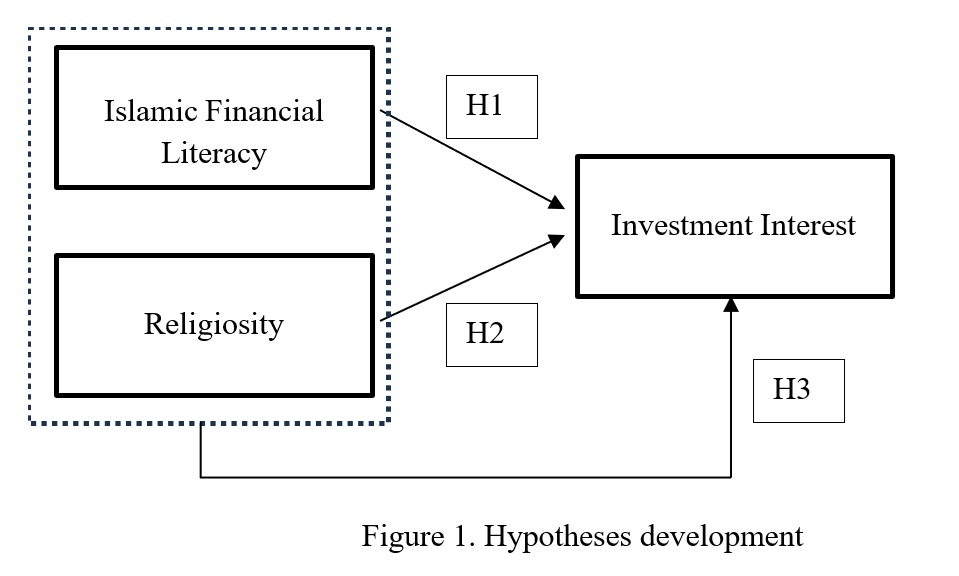
Introduction: According to the National Survey of Financial Literacy and Inclusion conducted in 2019, the number of Islamic stocks and Islamic capital market assets has increased in Indonesia, but the level of Islamic financial literacy and Islamic capital markets of the Indonesian population is still very low compared to conventional ones. This study aims to determine the effect of Islamic financial literacy and religiosity on investment interest in the Islamic capital market.
Methods: This research employed quantitative methods with regression analysis. Data were collected using a questionnaire through Google Forms, resulting in a sample of 203 students in Malang, Indonesia.
Results: The results showed that, either partially or simultaneously, Sharia financial literacy and religiosity variables had a significant positive effect on investment intention in the Islamic capital market. Moreover, it had a high coefficient determination of about 0.752, indicating that the financial literacy and religiosity variables can influence the investment intention variable by 75.2%.
Conclusion and suggestion: Based on the findings, it was demonstrated that religiosity had a greater impact on the intention to invest in the Islamic capital market compared to Sharia financial literacy. This could be due to the fact that the level of Sharia financial literacy among respondents remains low. Thus, to boost young participation in the Islamic capital market, it is recommended that academic institutions educate young people about Sharia financial literacy through formal education. Also, the businesses could provide informal information about investing in the Islamic capital market.
Downloads
References
Adiningtyas, S., & Hakim, L. (2022). Pengaruh Pengetahuan Investasi, Motivasi, dan Uang Saku terhadap Minat Mahasiswa Berinvestasi di Pasar Modal Syariah dengan Risiko Investasi sebagai Variabel Intervening. Jurnal Ilmiah Ekonomi Islam, 8(1), 474. https://doi.org/10.29040/jiei.v8i1.4609
Ajzen, I. (1991). The theory of planned behavior. Organizational Behavior and Human Decision Processes, 50(2), 179–211. https://doi.org/10.1016/0749-5978(91)90020-T
Anisa, & Kholid, M. N. (2022). Examining the determinants of Islamic stock investment. International Journal of Research in Business and Social Science (2147- 4478), 11(2), 207–213. https://doi.org/10.20525/ijrbs.v11i2.1667
Arismaya, A. D. (2024). LITERASI KEUANGAN, PERSEPSI RISIKO, DAN RELIGIUSITAS TERHADAP MINAT INVESTASI DI PASAR MODAL SYARIAH. FINANCIAL: Jurnal Akuntansi, 2. https://financial.ac.id/index.php/financial
Aslikhah, & Zuhriyah, A. (2022). Pengaruh Religiusitas dan Brand Liking terhadap Keputusan Menabung di Bank BNI Syariah Kabupaten Pasuruan. MALIA (TERAKREDITASI), 12(2), 267–276. https://doi.org/10.35891/ml.v12i2.2876
Bastomi, M., & Nurhidayah, N. (2023). Faktor Penentu Minat Investasi di Pasar Modal Syariah: Studi Pada Generasi Z Kota Malang. Widya Cipta: Jurnal Sekretari Dan Manajemen, 7(2), 185–196. https://doi.org/10.31294/widyacipta.v7i2.16255
BEI. (2025). Press Release. Https://Www.Idx.Co.Id/Id/Berita/Siaran-Pers/1974.
BPS. (2025). Statistik Indonesia.
Catur Hayati Wulandari, Saparuddin Siregar, & Aqwa Naser Daulay. (2023). The Potential of Stock Endowment in Indonesia as an Instrument for Islamic Economic Development. MALIA (TERAKREDITASI), 14(2), 309–325. https://doi.org/10.35891/ml.v14i2.4179
Ernia Taufiqoh, Nur Diana, & Junaidi. (2019). Pengaruh Norma Subjektif, Motivasi Investasi, Pengetahuan Investasi, Persepsi Return Dan Literasi Keuangan Terhadap Minat Mahasiswa Berinvestasi Saham Di Pasar Modal (Studi Empiris Pada Mahasiswa Akuntansi Feb Unisma Dan Unibraw Di Malang). Jurnal Ilmiah Riset Akuntansi, 8(5).
Falahuddin, F., Fuadi, F., & Ramadhan, M. R. (2019). Faktor-Faktor yang mempengaruhi Minat Wakaf Masyarakat di Kota Lhokseumawe. Jurnal EMT KITA, 3(2), 81. https://doi.org/10.35870/emt.v3i2.111
Fathoni, H., & Sakinah, G. (2021). Peran Pasar Modal Syariah Dalam Laju Pertumbuhan Ekonomi Di Indonesia. Khazanah Multidisiplin, 2(1). https://journal.uinsgd.ac.id/index.php/kl
Ghozali, I. (2016). Aplikasi Analisis Multivariete Dengan Program IBM SPSS 23 (8th ed.). Badan Penerbit Universitas Diponegoro.
Glock, & Stark. (1969). Religion and society intension. Rand Mc Nally Company.
Ladamay, A. Z. F., Supriyanto, T., & Nugraheni, S. (2021). Pengaruh Media Sosial, Literasi Keuangan, Risiko, Imbal Hasil, dan Religiusitas Terhadap Minat Berinvestasi Sukuk Generasi Z di Jakarta. Islamic Economic Journal, 7(2), 161. https://doi.org/10.21111/iej.v7i2
Muttaqin, R., & Ayuningtyas, R. D. (2022). Pengaruh Literasi Keuangan, Religiusitas Dan Pendapatan Terhadap Minat Investasi Di Pasar Modal Syariah (Studi Pada Masyarakat Milenial Kota Semarang). Stability: Journal of Management and Business, 5(1), 75–85. https://doi.org/10.26877/sta.v5i1.12008
OJK. (2025). Memperkuat Literasi dan Inklusi Keuangan Syariah. Https://Www.Ojk.Go.Id/Ojk-Institute/Id/Capacitybuilding/Upcoming/1340/Memperkuat-Literasi-Dan-Inklusi-Keuangan-Syariah.
Perdana, N., & Sukmana, Y. (2022). Literasi Keuangan Kota Malang 69,43 persen, Tertinggi Se-Indonesia. Kompas. https://money.kompas.com/read/2022/12/12/131511626/literasi-keuangan-kota-malang-6943-persen-tertinggi-se-indonesia.
Pramudia, R. A., & Syarief, M. E. (2020). PENGARUH PERSEPSI PENGETAHUAN, INFORMASI, DAN RELIGIUSITAS TERHADAP MINAT BERWAKAF UANG. Jurnal Justisia Ekonomika: Magister Hukum Ekonomi Syariah, 4(2). https://doi.org/10.30651/justeko.v4i2.6482
Prasetio, R., Iswanaji, C., & Khotijah, S. A. (2023). Pengaruh Persepsi Return, Risiko, Pengetahuan dan Religiusitas Terhadap Minat Berinvestasi di Pasar Modal Syariah. Al-Intaj : Jurnal Ekonomi Dan Perbankan Syariah, 9(1), 88. https://doi.org/10.29300/aij.v9i1.9651
Puspitasari, V. E., Yetty, F., & Nugraheni, S. (2021). Pengaruh Literasi Keuangan Syariah, Persepsi Imbal Hasil, dan Motivasi terhadap Minat Investasi di Pasar Modal Syariah. Journal of Islamic Economics and Finance Studies, 2(2), 122. https://doi.org/10.47700/jiefes.v2i2.3292
Putri, M. A. A., & Fikriyah, K. (2022). Pengaruh Religiusitas dan Tingkat Literasi Pasar Modal Syariah terhadap Minat Berinvestasi pada Saham Syariah: Studi Kasus pada Mahasiswa di Jawa Timur. Jurnal Ilmu Komputer, Ekonomi Dan Manajemen (JIKEM), 2(2).
Rakhmawati, A., & Nizar, M. (2023). Analysis of Small Business Performance in Terms of Islamic Financial Literacy and Inclusion. MALIA (TERAKREDITASI), 14(2), 269–285. https://doi.org/10.35891/ml.v14i2.4138
Rasela, F. (2022). Pengaruh Literasi Wakaf terhadap Minat Mahasiswa Berwakaf pada Forum Wakaf Mahasiswa Indonesia. JURNAL RISET PERBANKAN SYARIAH (JRPS) , 1(1).
Rohman, A. A. (2022). Pengaruh Religiusitas, Pengetahuan, Perspesi, Pendapatan, dan Media Infromasi terhadap Minat Wakaf Uang Masyarakat Kota Bandung. Jurnal Riset Ilmu Ekonomi Dan Bisnis, 1(2), 136–144. https://doi.org/10.29313/jrieb.v1i2.513
Setiawati, R. (2018). ISLAMIC FINANCIAL LITERACY: CONSTRUCT PROCESS AND VALIDITY. In Academy of Strategic Management Journal (Vol. 17, Issue 4).
Subandi, A., Rahmasari, N., Astuti, S., Jannah, M., Hidayat, W., Sultan, U., & Hasanuddin Banten, M. (2023). Analisis Faktor-Faktor yang Mempengaruhi Minat Mahasiswa UIN Sultan Maulana Hasanuddin Banten Dalam Berinvestasi di Pasar Modal Syariah. In IJM: Indonesian Journal of Multidisciplinary (Vol. 1). https://journal.csspublishing/index.php/ijm
Syafika, N., Wahyuni, E. S., & Hartini, K. (2024). Revealing Gen Z’s Interest in Sharia Investment in The Capital Market. MALIA (TERAKREDITASI), 16(1), 56–69. https://doi.org/10.35891/ml.v16i1.5713
Wibowo, M. B. S., & Iqbal, M. (2022). Faktor Pengetahuan dan Religiusitas Generasi Z Terhadap Minat Menabung di Bank Syariah. MALIA (TERAKREDITASI), 13(1), 93–106. https://doi.org/10.35891/ml.v13i1.2795.