The Liability of TikTok Shop Transactions via E-Money Based on the Principle of Hifdzul Mal in Maqasid al-Syari’ah at the Individual and Family Levels
DOI:
https://doi.org/10.35891/r65egm32Keywords:
Maqasid al-Shari’ah, Hifdzul Mal, Digital Transactions, TikTok Shop, E-Money, Sharia ComplianceAbstract
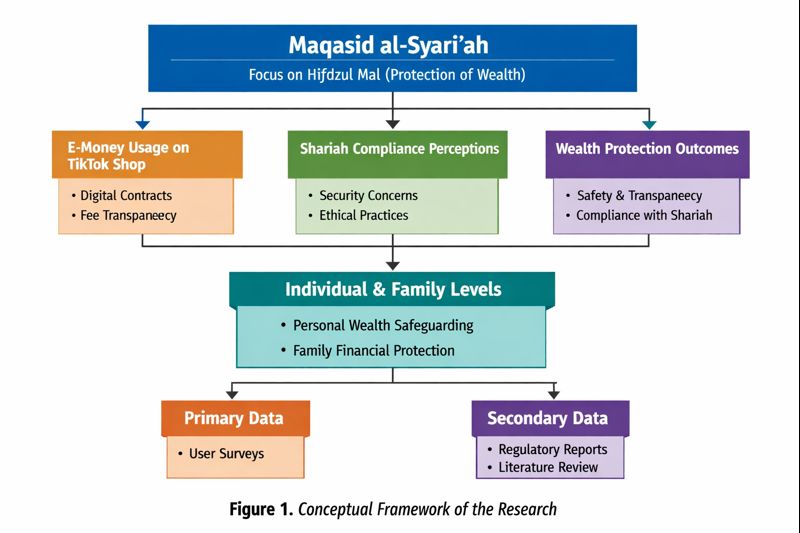
Purpose: This study aims to examine the conformity of digital transactions conducted through the TikTok Shop platform using e-money with Sharia principles, particularly the principle of Hifdzul Mal (protection of wealth) as part of Maqasid al-Shari’ah in the context of Muslim society.
Design/methodology/approach: This study adopts a descriptive quantitative approach grounded in the theory of Maqasid al-Shari’ah formulated by Al-Syatibi in Al-Muwafaqat. Data were collected through structured questionnaires distributed to 200 respondents who actively use TikTok Shop for digital transactions. The analysis focuses on respondents’ perceptions of Sharia compliance, especially related to digital contracts and transaction transparency.
Findings: The results indicate that 65% of respondents feel assured that digital transactions via TikTok Shop align with Sharia values and provide adequate protection of wealth. However, a significant proportion of respondents still express concerns regarding the full implementation of Sharia principles, particularly in relation to the clarity of digital contracts and transparency of transaction fees. These findings suggest that while digital platforms offer convenience, Sharia compliance remains a critical issue that requires further attention.
Practical implications: The study provides valuable insights for digital platform providers, policymakers, and Islamic financial authorities to enhance Sharia compliance in digital transactions. Improving Sharia financial literacy and developing more transparent and accountable transaction systems are essential to strengthen trust and ensure the effective application of the Hifdzul Mal principle.
Originality/value: This study contributes to the literature on Islamic digital finance by empirically linking e-money-based digital transactions with the Maqasid al-Shari’ah framework, particularly Hifdzul Mal, offering evidence from a popular social commerce platform in a developing country context.
Downloads
References
A Mulyana, C Vidiati, PA Danarahmanto, A. A. (2016). Metode penelitian kualitatif.
Al-Syatibi, S. Is. (2015). al-Muwafaqat fi Ushul al-Syari’ah. El-Hikam: Journal of Education and Religious Studies.
Aljamos, Y. M., Mohd Noor, A., Mohd Aswadi, M. S., & Baharuddin, A. S. (2022). The Blockchain Technology from Maqasid Shari’ah Perspective. Journal of Contemporary Maqasid Studies. https://doi.org/10.52100/jcms.v1i2.54
Andikatama, A. Z., & Turisno, B. E. (2024). Consumer Protection Law in the Digital Era. International Journal of Social Science and Human Research. https://doi.org/10.47191/ijsshr/v7-i07-03
Andrianto, A. (2020). FAKTOR YANG MEMPENGARUHI BEHAVIOR INTENTION UNTUK PENGGUNAAN APLIKASI DOMPET DIGITAL MENGGUNAKAN MODEL UTAUT2. Jurnal Ilmiah Ekonomi Bisnis. https://doi.org/10.35760/eb.2020.v25i2.2412
Antin Rakhmawati, & Muhammad Nizar. (2023). Analysis of Small Business Performance in Terms of Islamic Financial Literacy and Inclusion. Malia (Terakreditasi), 14(2), 269–285. https://doi.org/10.35891/ml.v14i2.4138
Arum, H. S., Rupita, N. E., Arum, H. S., Rupita, N. E., Albahi, M., & Info, A. (2024). Maqasid Sharia As A Philosophical Foundation In Islamic Economic Policy Making, 16(1), 28–43. https://doi.org/10.35891/ml.v16i1.5798
Ashafa, S. A., & Raimi, L. (2025). Exploring the impact of Islam’s social well-being and economic justice on peaceful coexistence in Nigeria: implications for conventional welfare policy. Journal of Entrepreneurship and Public Policy. https://doi.org/10.1108/JEPP-11-2023-0116
Bigliardi, B., & Galati, F. (2013). Models of adoption of open innovation within the food industry. Trends in Food Science and Technology. https://doi.org/10.1016/j.tifs.2012.11.001
Busriyanti. (2021). Maqasid al-Syari’ah dalam Penegakkan Hukum Lalu Lintas di Indonesia. Al-Istinbath: Jurnal Hukum Islam. https://doi.org/10.29240/jhi.v6i1.2470
Choiruddin, M. F., & Musaddad, E. (2025). The Relevance of Muamalah Hadiths in Addressing the Challenges of Modern Buying and Selling: A Study of Contemporary Islamic Law Responses. Aslama: Journal of Islamic Studies.
Dixit, A. M., Subba Rao, S. V., Article, O., Choudhary, K., Singh, M., Choudhary, O. P., … Helmy, M. (2018). PENGARUH GAYA HIDUP, KELOMPOK ACUAN, CITRA MEREK DAN LABEL HALAL TERHADAP KEPUTUSAN PEMBELIAN KOSMETIK DENGAN CELEBRATY ENDORSER SEBAGAI VARIABEL MODERASI PADA MAHASISWI JURUSAN PERBANKAN SYARIAH IAIN TULUNGAGUNG. Analytical Biochemistry.
Durrani, B. A., Lecturer, S., Ivanauskien, N., Volung, J., Rahmani-Nejad, L., Firoozbakht, Z., … Wirawan, V. (2014). Implementation of E-Government in Welcoming the Contemporary Industrial Revolution 4.0 Era in Indonesia. International Journal of Marketing Studies.
Eni. (2022). Politik ekonomi syariah (dalam perspektif al-Qur’an). Angewandte Chemie International Edition, 6(11), 951–952., 5–24.
Fahmi Halim, A., & Aziz, A. (2025). The Impact of Member Satisfaction on Sharia-Compliant Transaction Efficiency in Digital Islamic Cooperatives. El-Kahfi | Journal of Islamic Economics.
Gema Achmad Ramadhan. (2019). Perspektif Maqashid Syariah Tentang Penggunaan Dagcoin Dalam Transaksi. Pendidikan Islam.
Hakim, A. I., Marini, Y., & Basyaruddin. (2024). Penegakan Hukum Pidana dan Praktik Akutansi Rumah Tangga Terhadap Perilaku Judi Online Di Indonesia. Nusantara: Jurnal Ilmu Pengetahuan Sosial.
Halimah, I. H., & Riza, A. F. (2022). Millennials Response on The Existence of The First Sharia Electronic Money in Indonesia. Jurnal Al-Qardh, 7(2), 151–168. https://doi.org/10.23971/jaq.v7i2.5760
Herdinata, C., & Pranatasari, D. F. (2019). Panduan Penerapan Financial Technology Melalui Regulasi, Kolaborasi, dan Literasi Keuangan Pada UMKM.
Husni, A dan Randi, M. (2024). Analisis Penerapan Fatwa Dsn Mui No. 116/Dsn-Mui/Ix/2017 Tentang Uang Elektronik Syariah Pada Produk Kartu Debit Otp Bsi Kc Bogor Pajajaran Sukasari. Jurnal Inovasi Global, 2(3), 543–551.
Khairunnisa, K., Aulia, R., Safitri, M., Setiawan, R., & Jannah, M. (2024). AKAD SALAM DALAM JUAL BELI ONLINE: PLATFORM TIKTOK SHOP. MUSYTARI: Neraca Ekonomi, Akuntansi, Dan Manajemen.
Khambali Hambali, K. M., Khalil, S. A., & Daud, M. Z. (2022). ‘MY SEJAHTERA’ APPLICATION AS COVID-19 CONTROL MECHANISM FROM ISLAMIC THOUGHT PERSPECTIVE: MALAYSIA EXPERIENCE. Afkar. https://doi.org/10.22452/afkar.sp2022no1.8
Kurniawan, A., & Hudafi, H. (2021). Konsep Maqashid Syariah Imam Asy-Syatibi Dalam Kitab Al-Muwafaqat. Al Mabsut, 15(1), 29–38.
Literacy, F. (2025). Intention to Invest in Islamic Capital Market Among Youth: The Influence of Sharia Financial Literacy and Religiosity, 16(2), 231–243.
Manik, I. P., & Zulham, Z. (2024). Responsibility for campaign grant funds in the 2024 presidential election: Hifdzul Mal’s perspective. The International Journal of Politics and Sociology Research. https://doi.org/10.35335/ijopsor.v11i4.234
Mantik, J., Thahery, R., & Martha, D. (2024). Analysis of consumer behavior on purchasing decisions using q-ris as digital money at stationary Toko Merdeka in Pekanbaru. Jurnal Mantik.
Masyithoh, L. D., Amrah, D. P., & Musthofa, I. (2024). SHARIA ECONOMIC LAW ANALYSIS OF MUD BATHING IN TIKTOK LIVE AS ONLINE BEGGING (MAQASHID SYARIAH APPROACH). Mu’amalah: Jurnal Hukum Ekonomi Syariah. https://doi.org/10.32332/muamalah.v3i1.7831
Md Husin, M., Haron, R., & Aziz, S. (2021). Adoption of Financial Technology in Islamic Crowd-Funding. In Research Anthology on Concepts, Applications, and Challenges of FinTech. https://doi.org/10.4018/978-1-7998-8546-7.ch013
Muawiyah Ulfa, Alrasyid Harun, & Anwar Siti Aminah. (2023). Pengaruh Kepercayaan, Kenyamanan, Dan Persepsi Resiko Terhadap Keputusan Pembelian Online Melalui TikTok Shop Dalam Perspektif Ekonomi Islam (Studi Kasus Mahasiswa Universitas Islam Malang). Islamic Economic and Finance Journal.
Muhri, A., Habbe, A. H., & Rura, Y. (2022). Analisis Perbandingan Stabilitas Bank Syariah dan Bank Konvensional. Owner, 7(1), 346–366. https://doi.org/10.33395/owner.v7i1.1360
Munadia, M., Umuri, K., Sentosa, D. S., & Nurlina, E. (2016). DETERMINANTS OF PURCHASING DECISIONS IN TIK TOK SHOP E-COMMERCE WITH TRUST AS A MEDIATING VARIABLE. Scientific Journal of Students Islamic Economics and Business Available.
Mutia, T., Anggun Lestari, L. T., Amry, A. D., Nabila, D. R., Afrilian, B., & Lailatifa, L. (2024). Tantangan dan Peluang Etika Bisnis Islam dalam Strategi Pemasaran Pengusaha Muslim Kota Jambi di Era Digitalisasi. Maro: Jurnal Ekonomi Syariah Dan Bisnis. https://doi.org/10.31949/maro.v7i2.9675
Nadialista Kurniawan, R. A. (2021). ASPEK MAQÂSID AL-SYARÎ’AH SERTIFIKAT VAKSINASI UNTUK KEBUTUHAN PERJALANAN (Studi Peraturan Menteri Kesehatan Nomor 84 Tahun 2020 tentang Vaksinasi Covid-19) Skripsi. Industry and Higher Education.
Nasution, L. N., Rangkuty, D. M., & Putra, S. M. (2024). THE DIGITAL PAYMENT SYSTEM: HOW DOES IT IMPACT INDONESIA’S POVERTY? ABAC Journal. https://doi.org/10.59865/ABACJ.2024.37
NGUYEN, O. T. (2020). Factors Affecting the Intention to Use Digital Banking in Vietnam. The Journal of Asian Finance, Economics and Business, 7(3), 303–310. https://doi.org/10.13106/jafeb.2020.vol7.no3.303
Novianti, A., Ekowati, D., Nawarcono, W., Margiutomo, S. A., Tinggi, S., Ekonomi, I., … 49-51 Yogyakarta, S. (2023). Penggaruh Online Customer Review, Online Customer Rating Dan Cash On Delivery Terhadap Keputusan Pembelian Pada Aplikasi Tiktok Shop. Seminar Nasional Manajemen, Ekonomi Dan Akuntasi Fakultas Ekonomi Dan Bisnis UNP Kediri.
Nur Kholis, & Vivin Maharani Ekowati. (2023). Operational Risk Control Strategy in Sharia Cooperatives. Malia (Terakreditasi), 15(1), 45–58. https://doi.org/10.35891/ml.v15i1.3942
Nurlita, A., Ariyanto, F., Badawi, & Yulianty, P. D. (2025). THE MEDIATING ROLE OF ONLINE CUSTOMER REVIEWS ON PURCHASE DECISIONS: EXPLORING THE IMPACT OF LIVE SHOPPING FEATURES AND CONTENT MARKETING. The International Conference on Sustainable Economics Management and Accounting Proceeding. https://doi.org/10.32424/icsema.1.1.309
Nursiwan, A. (2023). Persepsi Masyarakat terhadap Penggunaan Fintech Dana Syariah dalam Perspektif Hukum Islam. Persya: Jurnal Perbankan Syariah, 1(2), 60–65. https://doi.org/10.62070/persya.v1i2.15
Pratama, A. (2025). Peran Keuangan Digital Dalam Mendeteksi Dan Mencegah Tindak Pidana Pencucian Uang Pada Transaksi Elektronik. Sumbang 12 Journal.
Rabiu, L., Ahmad, A., & Gohari, A. (2024). Advancements of Unmanned Aerial Vehicle Technology in the Realm of Applied Sciences and Engineering: A Review. Journal of Advanced Research in Applied Sciences and Engineering Technology. https://doi.org/10.37934/araset.40.2.7495
Rahmi, C., Fadhillah, I. R., Danuri, A. H., Ikhwan, M. R., & IRsyad, M. (2024). Dampak Perkembangan Uang Elektronik Terhadap Efektivitas Kebijakan Moneter Dalam Perspektif Sistem Ekonomi Islam. Jurnal Ilmiah Ekonomi Dan Manajemen.
Rosidi, M. H., Mokhtar, A. W. Bin, & Abdul Majid, M. N. Bin. (2022). The Role of Maqasid Al-Shari’ah as a Fundamental Ethics in Social Media Use. International Journal of Academic Research in Business and Social Sciences. https://doi.org/10.6007/ijarbss/v12-i4/13044
Roy, J., Rochaida, E., Suharto, R. B., & Rizkiawan, R. (2021). Digital and electronic transactions against velocity of money. Corporate Governance and Organizational Behavior Review. https://doi.org/10.22495/cgobrv5i2sip3
Saidu Ado, Mohammad Abdel Salama, & Abdallah Saleh Abdallah. (2025). The Maqasid al-Shari’ah and the Protection of Family Economics in Islamic Law: A Reflection on Surah al-Baqarah 2:188. QURU’: Journal of Family Law and Culture. https://doi.org/10.59698/quru.v3i3.477
Sharia, D., Knowledge, I., Fund, M., Through, I., Investor, T., & Info, A. (2025). Does Sharia Investment Knowledge and Investment Experience on Choosing Sharia Mutual Fund Investment Through The Investor Lifestyle 1, 16(2), 193–209.
Siti Fauziah Azis, Busmar, A. A., & Zaeni, M. R. (2025). TikTok PayLater dan Praktik Riba: Kajian Hukum Islam atas Mekanisme Pembiayaan Digital. Jurnal Riset Ekonomi Syariah. https://doi.org/10.29313/jres.v5i1.5841
Subli, M., Syamsuddin, D., Muhammad, A. R., Rahim, A. W., & Sulaiman. (2025). Green Investment in Contemporary Islamic Perspective: A Maqasid al-Syari‘ah Analysis of the Mining Industry in Morowali. MILRev: Metro Islamic Law Review. https://doi.org/10.32332/milrev.v4i1.10269
Suliswanto, M. S. W., Mahyudi, M., & Nizam Barom, M. (2024). A Critical Analysis of The Existing Maqasid-Based Welfare Index. Journal of Contemporary Maqasid Studies. https://doi.org/10.52100/jcms.v3i1.113
Syafika, N., Wahyuni, E. S., & Hartini, K. (2024). Revealing Gen Z ’ s Interest in Sharia Investment in The Capital Market, 16(1), 56–69. https://doi.org/10.35891/ml.v16i1.5713
Syahriya, I., & Himawan, A. F. I. (2022). The effects of cash on delivery, online customer review, and rating on Tiktok shop application towards customer loyalty. Enrichment: Journal of Management.
Syihab, Z. (2021). THE INNOVATION OF AL-NAJJAR’S THOUGHT IN MAQASID AL-SHARI’AH. Mimbar Agama Budaya. https://doi.org/10.15408/mimbar.v38i1.23375
Taan, H. (2023). EFFECT OF CONVENIENCE AND TRUST TIKTOK SHOP ONLINE PURCHASE DECISIONS Hapsawati. AT-TAWASSUTH: Jurnal Ekonomi Islam.
Tahir, T., & Hamid, S. H. A. (2024). Maqasid Al-Syari’ah Transformation in Law Implementation for Humanity. International Journal Ihya’ ’Ulum Al-Din. https://doi.org/10.21580/ihya.26.1.20248
Utami, A., Irwan, M., & Nasution, P. (2023). Perkembangan Pasar Online (E-Commerce) Di Era Modern Dan Pengaruhnya Terhadap Kepercayaan Konsumen. Jurnal Ekonomi Manajemen Dan Bisnis.
Vera Maria, & Raudohtul Janah. (2024). Analisis Peran Tiktok Shop dalam Mendorong Ekonomi UMKM di Indonesia. Sammajiva: Jurnal Penelitian Bisnis Dan Manajemen. https://doi.org/10.47861/sammajiva.v2i2.992
Yasin, A., & Billah, A. (2024). Blockchain-Based Digital Transaction Security System: Perspective of Imam al-Shāṭibi’s Maqāṣid al-Sharī’ah Concept. Al-Muamalat: Jurnal Ekonomi Syariah. https://doi.org/10.15575/am.v11i2.34379
Zailani, M. N., Mohd Satar, N., & Zakaria, R. H. (2023). A REVIEW OF INDICATORS FOR THE PRESERVATION OF WEALTH (HIFZ AL-MAL) BASED ON MAQASID AL-SHARIAH. Journal of Islamic Philanthropy and Social Finance. https://doi.org/10.24191/jipsf/v4n12022_23-29
Zulfa, N., Millah, N. N., Nuratin, N., & Novitasari, K. (2023). Konsep Maqashid Syariah Dalam Praktik Strategi Pemasaran Tiktok Dengan Landasan Etika Bisnis Islam. AB-JOIEC: Al-Bahjah Journal of Islamic Economics, 1(2), 79–94. https://doi.org/10.61553/abjoiec.v1i2.64.