Macroeconomic and Demographic Drivers of Halal Product Exports in ASEAN Countries: A Panel Data Analysis of the Emerging Halal Trade Landscape
DOI:
https://doi.org/10.35891/j1njx375Keywords:
Halal Product Exports, GDP, REER, FDI, ASEANAbstract
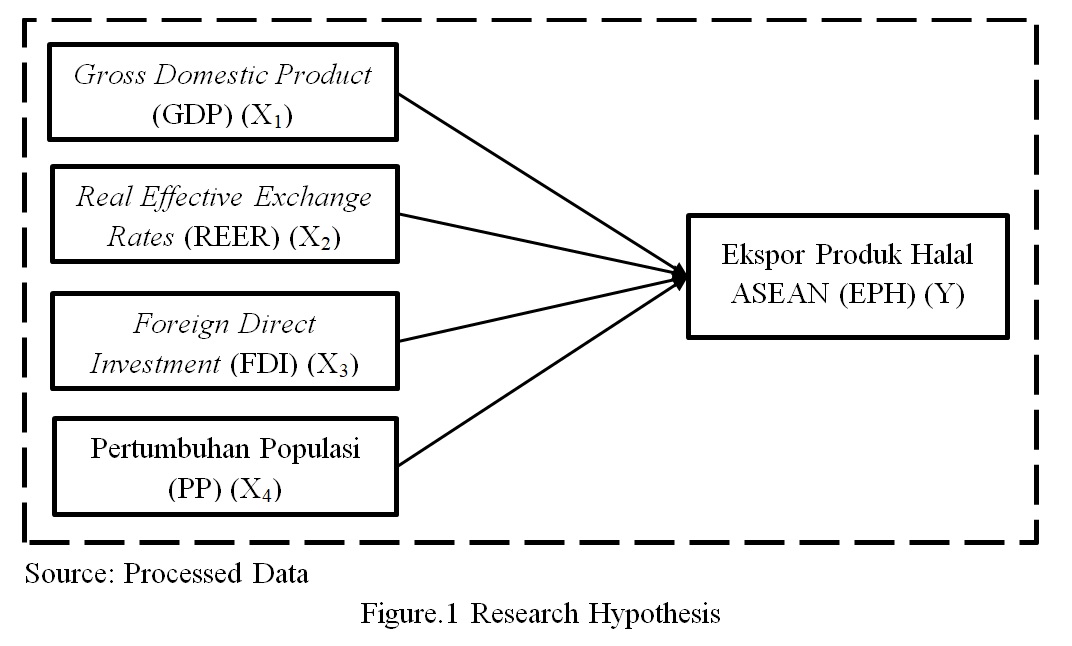
Purpose: This study aims to analyze the influence of macroeconomic indicators, foreign investment, and demographic factors on the export of halal products among ASEAN countries, namely Indonesia, Malaysia, Brunei Darussalam, Thailand, Singapore, the Philippines, Vietnam, Laos, Cambodia, and Myanmar during the period 2014–2023.
Design/Methodology/Approach: This research employs a quantitative approach using panel data regression analysis. Model selection was conducted through the Chow test, Hausman test, and Lagrange Multiplier test, with the results indicating that the most appropriate model is the Fixed Effect Model (FEM).
Findings: The study reveals that the Real Effective Exchange Rate (REER) and population growth exert a significant positive impact on ASEAN halal product exports. Conversely, Foreign Direct Investment (FDI) demonstrates a significant negative effect, while Gross Domestic Product (GDP) does not show a statistically significant partial influence. Collectively, all independent variables have a significant joint effect on halal product exports.
Practical Implications: This study is expected to offer valuable implications for governments and policymakers across ASEAN in formulating strategies that support the region’s halal export development.
Originality/Value: This research contributes to Halal Product Industry by highlighting macroeconomic indicators and demographic factors on the export of halal products among ASEAN countries.
Downloads
References
Adi, A. R., Fachrurrozi, K., & Aidar, N. (2022). Dampak Keterbukaan Perdagangan, FDI, dan Pertumbuhan Ekonomi terhadap Stabilitas Moneter melalui Nilai Tukar Efektif Riil di Indonesia. EKAPI: Ekonomi dan Kebijakan Publik Indonesia.
Albar, M., & Ratnasari, R. T. (2022). Analysis of the Effect of Consumption Expenditure, Foreign Direct Investment, and Manufacturing Industry moderated by Labor force on Growth of Economy of OIC Countries during the Covid-19 Pandemic. Jurnal Ekonomi Syariah Teori dan Terapan.
Baso, Sapa, N. B., Mutihiadin, C., & Sumarni. (2024). Pentingnya Sertifikat Halal Dalam Perdagangan Internas. EKOMA : Jurnal Ekonomi, Manajemen, Akuntansi.
Cupian, Smitasari, D., & Noven, S. A. (2024). Analisis Pengaruh Ekspor Halal, Foreign Direct Investment, Trade Openness, Nilai Tukar, dan Pertumbuhan Populasi Terhadap Produk Domestik Bruto Riil ASEAN. JIEI: Jurnal Ilmiah Ekonomi Islam.
Gujarati, D. N., & Porter, D. C. (2009). Basic Econometrics. In A. E. Hilbert. Douglas Reiner.
Gul, M., J. A., Ikramullah, M., & Raza, A. (2022). International Halal Industry And Its Impact On Global Halal Market (A Historical Review And Future Business Prospect). Journal of Positive School Psychology.
Hendra, & Fauziah, N. (2023, Desember). Peran Dan Strategi Peningkatan Sertifikasi HalalDalam Ekspor Produk Halal Di Pasar Internasional. Jurnal Minfo Polgan.
Iba, Z., & Wardhana, A. (2024). Operasional Variabel, Skala Pengukuran & Instrumen Penelitian Kuantitatif. Jawa tengah: Eureka Media Aksara.
ITC. (2025, Juli 2). Trade statistics for international business development Monthly, quarterly and yearly trade data. Import & export values, volumes, growth rates, market shares, dll. Retrieved from Trade Map: https://www.trademap.org/Index.aspx
Johan, E., & Plana-Casado, M. J. (2023). Harmonizing Halal in ASEAN: Analysis of Halal Food Guidelines under the ASEAN Way Approach. JAS: Journal of ASEAN Studies.
Lavenia, M., & Hwihanus. (2024). Pengaruh Faktor Ekonomi Makro, Risiko Investasi, Kinerja Keuangan, dan Struktur Kepemilikan terhadap Return Saham Perusahaan di BEI. Jurnal Ekonomi, Akuntansi dan Manajemen.
Marshall, I. G., Pamungkas, M. S., Zaki, I., Millatina, A. N., & Widiantika, W. (2024). Determinants of Foreign Direct Investment in Organization of Islamic Cooperation (OIC) Countries’ Economy. Falah: Jurnal Ekonomi Syariah.
Meilaniwati, H., & Tannia. (2021). Analisis Pengaruh Penanaman Modal Asing (PMA), Penanaman Modal Dalam Negeri (PMDN), Trade Openness (TO) dan Inflasi terhadap Pertumbuhan Ekonomi di ASEAN-5 Tahun 2009-2018. Business Management Journal.
Muharromy, N. S., & Auwalin, I. (2021). The Effect of Population Growth and Trade Openness on Economic Growth of the OIC Countries. Jurnal Ekonomi Syariah Teori dan Terapan.
Ramdan, M., & Bustomi, H. (2023). Faktor-faktor yang mempengaruhi PDB Negara-Negara ASEAN pada Tahun 2015 hingga 2022 menggunakan Regresi Data Panel. Journal of Industrial Engineering & Management Research.
RISSC. (2024). The Muslim 500: The World's 500 Most Influential Muslims 2025. (P. S. Schleifer, D. T. Elgawhary, & M. A. Ahmed, Eds.) Amman, Jordan.
Rizaldy, M. R., & Ahmed, H. (2019). Islamic legal methodologies and Shariah screening standards: Application in the Indonesian stock market. Thunderbird International Business Review.
Rosyida, N. F., & Yuliani, I. (2024). The Impact of Macroeconomics and Halal Certification on Exports: Evidence of Indonesian Halal Product 2012 – 2022. Annual International Conference on Islamic Economics (AICIE) .
Sa'adah, L., Marfu'ah, Azhari, S., Safitri, S., & Sinta. (2023). Resesi Sebagai Masalah Makro Ekonomi di Indonesia. Al – Amal : Jurnal Manajemen Bisnis Syariah.
Sechan, I., Ihsan, D. N., & Ningsih, P. K. (2023). The Effect of the Halal Industry on the Export of Indonesian Halal Products. Journal of Enterprise and Development (JED).
Sekretariat ASEAN. (2024). The Association of Southeast Asian Nations (ASEAN) Key Figures 2024. Jakarta. Retrieved from www.asean.org
SGIER. (2024). State of the Global Islamic Economy Report. Dinar Standard: Growth Strategy Research & Advisory.
Sultan, Rahayu, H. C., & Purwiyanta. (2023). Analisis Kesejahteraan Masyarakat terhadap Pertumbuhan Ekonomi di Indonesia. INFEB: Jurnal Informatika Ekonomi Bisnis.
Wau, T., Sarah, U. M., Pritanti, D., Ramadhani, Y., & Ikhsan, M. S. (2022). Determinan Pertumbuhan Ekonomi Negara ASEAN: Model Data Panel. Samudra Ekonomi & Bisnis.
World Bank. (2025, Juli 12). World Bank Open Data. Retrieved from https://data.worldbank.org/