Global and Domestic Drivers of Inflation Dynamics in ASEAN: Evidence from Panel Econometric Analysis
DOI:
https://doi.org/10.35891/vz45gs19Keywords:
Inflation, Central Bank Independence, Policy Rate, Global Oil PriceAbstract
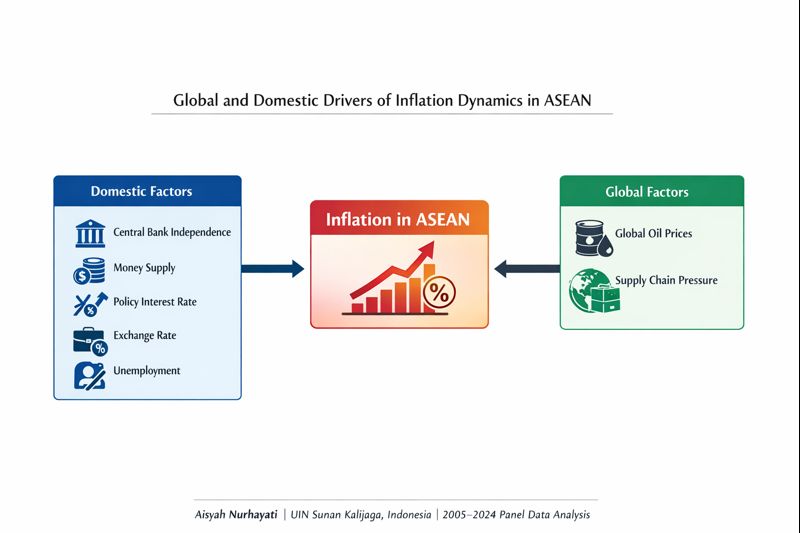
Purpose: This study aims to analyze the determinants of inflation in ASEAN countries by integrating institutional, monetary, and external factors into a unified empirical framework. The post-COVID-19 inflation surge and global supply chain disruptions underscore the importance of understanding inflation dynamics in emerging ASEAN economies.
Design/methodology/approach: This study employs a quantitative panel data approach covering the period 2005–2024. Panel data regression analysis was conducted, preceded by Chow, Hausman, and Lagrange Multiplier tests, which identified the Random Effect Model as the most suitable for the analysis.
Findings: The empirical results indicate that both domestic and global factors significantly affect inflation in ASEAN countries. Central bank independence (CBI), exchange rates, policy interest rates, unemployment, and world oil prices have a significant impact on inflation, whereas money supply and global supply chain pressures are not statistically significant.
Practical implications: The findings provide guidance for policymakers in ASEAN to maintain price stability by strengthening central bank independence, enhancing monetary policy credibility, and effectively managing external risks, particularly energy price shocks.
Originality/value: This study contributes to the macroeconomic literature by offering a comprehensive empirical analysis of inflation determinants in ASEAN, highlighting the interplay between domestic macroeconomic fundamentals and global shocks in shaping inflation behavior.
Downloads
References
Alekseievska*, H., Kyfak, A., Rodionova, T., & Yakubovskiy, S. (2019). Modeling Outcomes of Unconventional Monetary Policy. International Journal of Recent Technology and Engineering (IJRTE). https://doi.org/10.35940/ijrte.d4503.118419
Ali, M., Raza, S. A., Abdul Wahab, N. S., Puah, C. H., Amin, H., & Abadullah, A. (2025). Islamic Finance and Corporate Governance: Synergies for Sustainable Growth. Islamic Finance and Corporate Governance: Synergies for Sustainable Growth. https://doi.org/10.1108/9781836623465
Anwar, C. J. (2023). Heterogeneity Effect of Central Bank Independence on Inflation in Developing Countries. Global Journal of Emerging Market Economies. https://doi.org/10.1177/09749101221082049
Arrafi Juliannisa, I., & Artino, A. (2022). Determinants analysis of GDP Per capita’s growth and state regulations of 7 ASEAN countries. International Journal of Research in Business and Social Science (2147- 4478). https://doi.org/10.20525/ijrbs.v11i2.1664
Balázsi, L., Baltagi, B. H., Mátyás, L., & Pus, D. (2024). Random Effects Models. In Advanced Studies in Theoretical and Applied Econometrics. https://doi.org/10.1007/978-3-031-49849-7_3
Barkoulas, D. R., & Chionis, D. (2024). Macroeconomic Dynamics in the Greek Economy during the Pre- and Post-Euro Adoption Periods. Journal of Risk and Financial Management. https://doi.org/10.3390/jrfm17040156
Bigerna, S. (2023). Energy price shocks, exchange rates and inflation nexus. Energy Economics, 128, 107156. https://doi.org/10.1016/j.eneco.2023.107156
Bogari, A. (2020). Central Bank Independence, Economic Growth and Inflation: Theories and Empirical Validations. International Journal of Applied Economics, Finance and Accounting. https://doi.org/10.33094/8.2017.2020.61.11.21
Carstensen, K., & Salzmann, L. (2017). The G7 business cycle in a globalized world. Journal of International Money and Finance. https://doi.org/10.1016/j.jimonfin.2017.02.002
Chidimma Maria-Gorretti Umeaduma. (2022). Interplay between inflation expectations, wage adjustments, and aggregate demand in post-pandemic economic recovery. World Journal of Advanced Research and Reviews. https://doi.org/10.30574/wjarr.2022.13.3.0258
Choirunnisa, N. H., & Yusfi, R. H. (2025). Macroeconomic Drivers of GDP per Capita Growth in Five Middle-Income ASEAN Countries. Journal of Enterprise and Development. https://doi.org/10.20414/jed.v7i3.14155
Clarke, T. (2024). The Asian financial crisis 1997. In Elgar Encyclopedia of Corporate Governance. https://doi.org/10.4337/9781839107061.ch123
Cline, W. (2023). Fighting the Pandemic Inflation Surge of 2021-2022. SSRN Electronic Journal. https://doi.org/10.2139/ssrn.4408811
Dacuycuy, L. B. (2021). How influential are COVID–19 data points? A fresh look at an estimated small scale DSGE model for the Philippines. Philippine Review of Economics. https://doi.org/10.37907/2ERP1202JD
De Alwis, T., & Dewasiri, N. J. (2021). Demand-Driven Factors of Inflation in Sri Lanka: An ARDL Approach. Sri Lanka Journal of Management Studies. https://doi.org/10.4038/sljms.v3i2.83
Dritsaki, C., & Dritsaki, M. (2012). Inflation, Unemployment and the NAIRU in Greece. Procedia Economics and Finance. https://doi.org/10.1016/s2212-5671(12)00015-9
Drivers of Food Price Inflation in Turkey. (2020). Drivers of Food Price Inflation in Turkey. https://doi.org/10.1596/37481
Elgin, C., & Öztunall, O. (2024). Central Bank Independence and Inflation under Asymmetric Information: Delegation vs. Seesaw Effects. Journal of Central Banking Theory and Practice. https://doi.org/10.2478/jcbtp-2024-0029
Elmassah, S. (2024). Determinants of renewable energy production in emerging and developed countries. International Journal of Energy Sector Management. https://doi.org/10.1108/IJESM-08-2021-0031
Furuoka, F., Pui, K. L., Chomar, M. T., & Nikitina, L. (2023). TRADE OPENNESS AND THE PHILLIPS CURVE: EVIDENCE FROM ASEAN COUNTRIES. Singapore Economic Review. https://doi.org/10.1142/S0217590820500599
Galvao, A. F., Parker, T., & Xiao, Z. (2024). Bootstrap Inference for Panel Data Quantile Regression. Journal of Business and Economic Statistics. https://doi.org/10.1080/07350015.2023.2210189
Garriga, A. C., & Rodriguez, C. M. (2023). Central bank independence and inflation volatility in developing countries. Economic Analysis and Policy. https://doi.org/10.1016/j.eap.2023.05.008
Gojčaj, V. (2025). Does Central Bank Independence Affect Inflation? Journal of Central Banking Theory and Practice. https://doi.org/10.2478/jcbtp-2025-0027
Ha, J., Kose, M. A., & Ohnsorge, F. (2022). From Low to High Inflation: Implications for Emerging Market and Developing Economies. SSRN Electronic Journal. https://doi.org/10.2139/ssrn.4074459
Hermawan, & Amirullah. (2021). Metode Penelitian Bisnis: Pendekatan Kuantitatif dan Kualitatif. Media Nusa Creative.
Hidthiir, M. H. bin, Ahmad, Z., Junoh, M. Z. M., & Yusof, M. F. Bin. (2024). Dynamics of economic growth in ASEAN-5 countries: a panel ARDL approach. Discover Sustainability. https://doi.org/10.1007/s43621-024-00351-x
Jaswal, A., & Ahuja, B. R. (2024). Unconventional US Monetary Policy: Impact on the Indian Economy. Indian Economic Journal. https://doi.org/10.1177/0019466221998627
Kocoglu, M. (2023). Drivers of inflation in Turkey: a new Keynesian Phillips curve perspective. Economic Change and Restructuring. https://doi.org/10.1007/s10644-023-09532-6
Lim, J. J. (2021). The limits of central bank independence for inflation performance. Public Choice. https://doi.org/10.1007/s11127-019-00771-8
Malaviarachchi, D., & Korale-Gedara, P. M. (2025). Decomposition of food price inflation in Sri Lanka. Journal of the Asia Pacific Economy. https://doi.org/10.1080/13547860.2024.2378532
Marafa, H. (2024). Revamping Legal and Institutional Framework for the Management of Inflation Targeting in Developing Economies. International Journal of Development and Economic Sustainability. https://doi.org/10.37745/ijdes.13/vol12n288102
Mergel, I. (2012). OpenCollaboration in Public Sector: The case of social codign on Github. Government Information Quarterly.
Mishra, A., Dash, A. K., & Padhan, P. C. (2024). Does global crude oil price transmit an asymmetric shock on food inflation? Evidence from south and southeast Asian economies. Journal of Agribusiness in Developing and Emerging Economies. https://doi.org/10.1108/JADEE-01-2024-0042
Muhammad, A. A. (2023). Examining the Relationship among Unemployment, Inflation, and Economic Growth. Journal of Business and Economic Options.
Nookhwun, N., & Waiyawatjakorn, R. (2024). Flexible Inflation Targeting and Macroeconomic Performance: Evidence from ASEAN. Asian Economic Policy Review. https://doi.org/10.1111/aepr.12459
Pegkas, P. (2024). The Asymmetric Effects of Unemployment and Output on Inflation in Greece: A Nonlinear ARDL Approach. Economies. https://doi.org/10.3390/economies12120346
Platitas, R. J. C., & Ocampo, J. C. G. (2025). From bottlenecks to inflation: Impact of global supply-chain disruptions on inflation in select Asian economies. Latin American Journal of Central Banking. https://doi.org/10.1016/j.latcb.2024.100141
Putranto, P. (2022). Metodologi penelitian kuantitatif. Jurnal. Bandung: UIN Sunan Gunung Djati.(Tersedia Di Http://Komunikasi. Uinsgd. Ac. Id).
Radjab, Enny Jam’an, A. (2017). Metode Penelitian Bisnis. Syria Studies.
Sahnoun, M., & Abdennadher, C. (2023). Active labor market policies and institutional quality of governance: evidence from OECD countries. Eurasian Economic Review. https://doi.org/10.1007/s40822-023-00247-7
Saqib, M. (2025). Analyzing Inflation Dynamics in Pakistan: The New Keynesian Phillips Curve Perspective. Journal of the Knowledge Economy. https://doi.org/10.1007/s13132-024-02380-3
Selvanayagam, S., & Mustafa, A. M. M. (2018). The Impact Of Unemployment And Interest Rate On Inflation In Sri Lanka. GIS Business. https://doi.org/10.26643/gis.v13i4.4685
Suciany, A. D., Damayanti, C. R., & Darmawan, A. (2024). Exchange Rate , Inflation , Interest Rate and Economic Growth : How They Interact in ASEAN. Jurnal Administrasi Bisnis.
Suidarma, I. M., Arta Yasa, I. N., Nina Eka Lestari, N. P., Ketut Gede Prabawa, I. D., Lasmi, N. W., & Sunarta, I. N. (2023). Exploring The Global Slack Hypothesis On Inflation Dynamics: A Study In ASEAN-5. International Journal of Social Science and Business. https://doi.org/10.23887/ijssb.v7i2.54440
Tan, K. (2020). Economic impacts of and policy responses to the coronavirus pandemic : early evidence from Nigeria. Support Economic Transformation.
Tran, T. B. N., & Pham, H. C. H. (2020). The Spillover Effects of the US Unconventional Monetary Policy: New Evidence from Asian Developing Countries. Journal of Risk and Financial Management. https://doi.org/10.3390/jrfm13080165
Trinh, P. T. T., & Nhan, L. P. A. (2023). The Global Factors Driving Common Inflation In ASEAN. Global Business and Finance Review. https://doi.org/10.17549/gbfr.2023.28.4.90
Yilmazkuday, H. (2022). Drivers of Turkish inflation. Quarterly Review of Economics and Finance. https://doi.org/10.1016/j.qref.2022.03.005
Yin, R. K. (2011). Qualitative Research form Start to Finish. New York: The Guilford Press.