The Impact of Gig Economy Growth and Islamic Bank Financing on Youth Unemployment Rates in Indonesia
DOI:
https://doi.org/10.35891/aa13js71Keywords:
Gig Economy, Islamic Bank Financing, Youth Unemployment, Digital Labor MarketAbstract
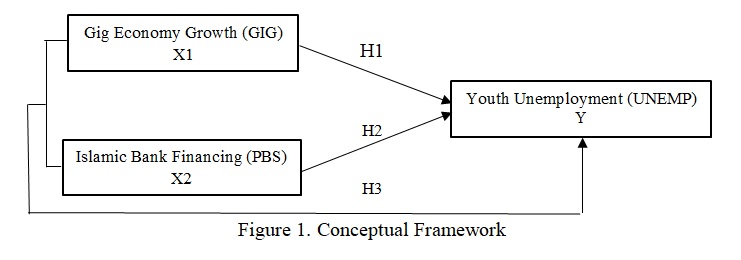
Introduction: High youth unemployment in Indonesia reflects a mismatch between labor force growth and the availability of formal employment. At the same time, the expansion of the digital platform–based gig economy offers flexible job opportunities for young people, while Islamic bank financing holds potential to stimulate productive economic activities through profit-sharing schemes. However, empirical evidence on the effectiveness of these sectors in reducing youth unemployment remains limited. This study examines the impact of gig economy growth and Islamic bank financing on youth unemployment in Indonesia.
Methods: A quantitative approach was applied using panel data from 34 provinces during 2019–2023. Panel regression analysis was employed, with model selection through Chow and Hausman tests, which identified the Fixed Effect Model as the most appropriate. Robust Standard Errors were used to correct heteroscedasticity.
Results: Gig economy growth shows a negative and significant effect on youth unemployment, indicating its role in absorbing young workers. In contrast, Islamic bank financing has a positive and significant effect, suggesting that financing has not been optimally directed toward labor-intensive sectors or young productive entrepreneurs. Jointly, both variables significantly influence youth unemployment, with an explanatory power of 87.4%.
Conclusion and Suggestion: The gig economy functions as an effective short-term employment channel, whereas Islamic financing requires policy reorientation toward youth-driven productive sectors. It is also necessary to enhance Islamic financial literacy and strengthen integration with the digital gig ecosystem to maximize its impact on reducing youth unemployment.
Practical Implications: The findings provide important insights for policymakers, financial institutions, and digital platform providers in designing strategies to reduce youth unemployment. Strengthening collaboration between Islamic banks and gig platforms, improving access to financing for young entrepreneurs, and promoting inclusive digital ecosystems can enhance employment opportunities and economic participation among youth.
Originality/Value: This study contributes to the literature by integrating the roles of the gig economy and Islamic bank financing in a single empirical model using panel data across Indonesian provinces. It offers a novel perspective on how digital labor markets and Sharia-compliant financial systems jointly influence youth employment in a developing country context.
Downloads
References
Adha, M. A., Nahar, F. H., & Fathurrahman, A. (2025). The Analysis of Financing Risk and Its Mitigation Based on Gender : A Study on Islamic Banks in Indonesia. International Journal of Islamic Economics and Finance (IJIEF), 8(2), 293–308.
Ananda Dwi Cahya, T. A. (2022). Analisis Problematika Bank Syariah Indonesia Setelah Marger Studi Kasus Bank Syariah Indonesia (BSI). Syntax Literate: Jurnal Ilmiyah Indonesia, 7(12), 17230–17241.
Arafah, S., Putra, Y. E., Sirega, S., Arafah, S., Putra, Y. E., Siregar, S., … Sumatera, N. (2025). Factors Influencing Customer Risk Perception of iB Mudharabah Deposits at PT. Bank Sumut KCPSy Hamparan Perak. Malia, 17(1), 110–126.
Ariani, N. I., & Nurcahyo, O. H. (2020). DIGITALISASI PASAR TRADISIONAL: Perspektif Teori Perubahan Sosial. Jurnal Analisa Sosiologi, 3(April), 1–12.
Arif, M., Rokan, M. K., & Kumala, R. (2023). Quadruple Helix Model in the Development of Halal Micro Business in North Sumatra. Share: Jurnal Ekonomi Dan Keuangan Islam, 12(1), 201. https://doi.org/10.22373/share.v0i0.15628
Arum, H. S., Arum, H. S., Andrini, R., & Info, A. (2025). The Marginalized Maqasid al-Shariah: Problems of Profit Orientation in Indonesia’s Islamic Financial System. Malia, 16(2), 408–421. https://doi.org/10.35891/ml.v16i2.6244
Ayu Lestari Siregar, Bela Harti Pratiwi, Reny Dian Aprilla, N. A., & Dewi. (2024). Analisis Pengaruh Pertumbuhan Ekonomi Terhadap Tingkat Pengangguran Di Kota Medan. Az-Ziyadah: Jurnal Ekonomi Syariah, I(2), 117–122.
Balaka, M. Y. (2022). Metode penelitian Kuantitatif. In Metodologi Penelitian Pendidikan Kualitatif (Vol. 1).
Banik, N., & Padalkar, M. (2021). The Spread of Gig Economy: Trends and Effects. Foresight And Sti Governance, 15(1), 28–38. https://doi.org/10.17323/2500-2597.2021.1.19.29
Boukhatem, J., & Moussa, F. Ben. (2018). The effect of Islamic banks on GDP growth : Some evidence from selected. Borsa Istanbul Review, 18(3), 231–247. https://doi.org/10.1016/j.bir.2017.11.004
BPS. (2025). Indeks pembangunan manusia 2024 (Vol. 19). Jakarta: Badan Pusat Statistik.
Casalhay, S. F., Guevarra, C. M., & Bragas, C. M. (2025). The Gig Economy: Financial Challenges and Opportunities Faced by Freelancers. International Journal of Research Publication and Reviews, 6(5), 3545–3560.
Celestin, M., & Vanitha, N. (2021). The Gig Economy And Its Effects On Personal Finance. Indo American Journal of Multidisciplinary Research and Review, 5(2), 39–46.
Daulay, A. H., & Harahap, I. (2023). Investment , Islamic Human Development Index and Banking Financing on Economic Growth and Their Impact on Labor Absorption. Amwaluna : Jurnal Ekonomi Dan Keuangan Syariah, 7(2), 339–346.
El-galfy, A., & Khiyar, K. A. (2012). Islamic Banking And Economic Growth : A Review. The Journal of Applied Business Research, 28(5), 945–956.
Eliya, L., Fathan, N., Eliya, L., Fathan, N., & Permatasari, D. (2025). The Effect of Financial Ratios on Financial Distress with the Springate Approach. Malia, 17(1), 39–57. https://doi.org/10.35891/ml.v13i2.3267
Fadilah Mat Nor, Sa’diah Abd Karim, Mawar Murni Yunus, Ahmad Fatin Mohamad Suhaimi Ismail, M. (2025). Youth Participation in the Gig Economy: A Scoping Review of Socioeconomic and Maqasid Shariah Perspectives. E-JURNAL PENYELIDIKAN DAN INOVASI, 12(4), 277–288. https://doi.org/10.53840/ejpi.v12i4.300
Hazizah, S. N., & Padli Nasution, M. I. (2022). Peran Media Sosial Instagram Terhadap Minat Berwirausaha Mahasiswa. Fair Value: Jurnal Ilmiah Akuntansi Dan Keuangan, 5(4). https://doi.org/10.32670/fairvalue.v5i4.2557
Hed, N. M., & Rosli, N. A. (2025). Navigating the Gig Economy : What Drives Malaysian Youth ? Journal of Applied Youth Studies, 11(2), 11–22. https://doi.org/10.1007/s43151-025-00192-z
Hwang, J. (2024). The GIG economy and its effects on the labor market. International Journal of Science and Research Archive, 13(2), 3394–3404.
Ikhsan Harahap, M., & Nurbaiti, Sari Purba, P. (2023). Analisis Pengembangan UMKM Go Digital dalam Penyelamatan Ekonomi Indonesia Menghadapi Resesi Ekonomi. EKONOMIKAWAN : Jurnal Ilmu Ekonomi Dan Studi Pembangunan, 23(2), 427–433.
Imsar, Nurhayati, & Harahap, I. (2023). Analysis of Digital Education Interactions, Education Openness, Islamic Human Development Index (I-HDI) and Indonesia’s GDE Growth. Edukasi Islami: Jurnal Pendidikan Islam, 12(1), 753–773.
Indayani, S., & Hartono, B. (2020). Analisis Pengangguran dan Pertumbuhan Ekonomi sebagai Akibat. J-EBIS (Jurnal Ekonomi Dan Bisnis Islam), 18(2), 201–208.
Indri Supriani, Bayu Arie Fianto, Najim Nur Fauziah, R. R. M. (2021). Revisiting the Contribution of Islamic Banks’ Financing to Economic Growth: The Indonesian Experience. Shirkah: Journal of Economics and Business, 6(1), 18–37.
Ishak, A. H., Nor, S., & Mohamad, A. (2025). Analysing the Contemporary Essentials of Sustainable Gig Economy Workforce From the Lenses of Maqasid Shariah. Millah: Journal of Religious Studies, 24(1), 491–528. https://doi.org/10.20885/millah.vol24.iss1.art14
Jain, P. A. (2024). The Gig Economy : Disruption, Innovation, and Economic Evolution. Educational Administration: Theory and Practice, 30(5), 5133–5140. https://doi.org/10.53555/kuey.v30i5.3755
Jaiswal, V. K. (2023). The Gig Economy: Transforming Work, Opportunities, and Challenges. International Journal of Engineering Research and Applications, 13(7), 263–271. https://doi.org/10.9790/9622-1307263271
Jauhari, F. F., Syahira, S., Yusoff, M., & Kassim, S. H. (2025). Islamic Fintech Financing Adoption Amongst Asnaf Micro Entrepreneurs In Malaysia: Extended Utaut2. Journal of Islamic Monetary Economics and Finance, 11(4), 779–806.
Jeyaraj, J. J., Chong, S. C., Chin, M. Y., & Foo, L. P. (2025). Gig labour regulation thresholds and youth unemployment : A dynamic panel threshold model analysis. Journal of Digital Economy, 4(2), 168–181. https://doi.org/10.1016/j.jdec.2025.07.003
Joshi, A., Jain, S., & Gupta, P. K. (2024). Challenges and impact of the gig economy. Sustainable Economies, 2(2), 1–10.
Junaidi, J. (2026). Islamic banks ’ contribution to Indonesia districts ’ economic growth and poverty alleviation. Journal of Economics, Finance and Administrative Science, 29(58), 294–308. https://doi.org/10.1108/JEFAS-06-2021-0097
Jusoh, W., & Author, W. N. H. C. (2024). Acceptance of Gig Economy as a Source of Halal Income Among Muslim Graduates. GJAT, 23(I), 1–20.
Kassim, S., Nur, M., Achsani, F. F., Kassim, S., Haron, R., & Info, A. (2025). Does The Covid-19 Pandemic Affect Financing of Islamic Banks in Indonesia? Malia, 16(2), 327–347. https://doi.org/10.35891/ml.v16i2.6252
Kiha, E. K., Seran, S., & Lau, H. T. (2021). Pengaruh jumlah penduduk, pengangguran, dan kemiskinan terhadap indeks pembangunan manusia (ipm) di kabupaten belu. INTELEKTIVA : JURNAL EKONOMI, SOSIAL & HUMANIORA PENGARUH, 2(07), 60–84.
Latifah, L., Rodoni, A., & Aziz, R. M. (2025). The Empowerment of MSMEs through Islamic P2P Financing : A Value-Based Social Entrepreneurship Framework. International Journal of Islamic Economics and Finance (IJIEF), 8(2), 246–267.
Ledhem, M. A., & Mekidiche, M. (2026). Economic growth and financial performance of Islamic banks : a CAMELS approach. Islamic Economic Studies, 28(1), 47–62. https://doi.org/10.1108/IES-05-2020-0016
Lestari, I. P., Hanafi, M. M., & Wardhana, L. I. (2025). Sustainability-Based Islamic Corporate Governance And Islamic Banks’ Multi Performance: Evidence From Indonesia. Journal of Islamic Monetary Economics and Finance, 11(4), 743–778.
Manalu, M. E., Siahaan, K. S. A., & Suharianto, J. (2025). Analisis Dampak Jumlah Penduduk, Pengangguran, dan IPM terhadap Tingkat Kemiskinan di Provinsi Sumatera Utara 2001-2021. Menawan: Jurnal Riset Dan Publikasi Ilmu Ekonomi, 3(2).
Martias, F. M. (2022). Dampak Kebijakan Tenaga Kerja Asing Era Pemerintahan Joko Widodo (2014–2019) terhadap Tenaga Kerja Lokal di Indonesia. Jurnal PolGov, 4(1), 67–123. https://doi.org/10.22146/polgov.v4i1.3774
Mehta, S. (2023). The Gig Economy and Labor Dynamics : A Study of the Impact of On-Demand Work on Traditional Employment Models. 11(3), 305–307.
Nasution, M. L. I. (2018). Manajemen Pembiayaan Bank Syariah. Medan: Febi Uin-Su Press.
Nur Ahmadi Bi Rahmani. (2016). Metodologi Penelitian Ekonomi. Medan: UIN SU Press.
Nur, S., Muhyi, A., Omar, S. I., & Adnan, S. F. (2023). The Drivers Force The Gig Workers Into Gig Economy : The Case Of Malaysia. Journal of Business and Social Development, 11(1), 1–12.
Pamungkas, P., Lepetit, L., & Rugemintwari, C. (2025). Sharia-Compliant Deposit Insurance And Deposit Flows : Evidence From A Dual Banking Market. Journal of Islamic Monetary Economics and Finance, 11(4), 689–712.
Pande, N. (2024). What Are The Economic Implications Of The Rise Of The Gig Economy On Employment Stability And Benefits ? IOSR Journal of Business and Management, 26(10), 1–13. https://doi.org/10.9790/487X-2610070113
Pida, Y., & Imsar, I. (2022). Pengaruh Literasi Keuangan dan Inklusi Keuangan Terhadap Scale Up Bisnis UMKM Kota Medan Dalam Kerangka Maqashid Syariah. Jurnal Sains Sosio Humaniora, 6(2), 104–118. https://doi.org/10.22437/jssh.v6i2.22897
Purbasari, R., Jamil, N., Novel, A., & Kostini, N. (2020). Digitalisasi Logistik Dalam Mendukung Kinerja E-Logistic Di Era Digital: A Literature Review. Management, Business and Logistics (JOMBLO), 01(02), 177–196.
Ramdhan, M. (2021). Metode penelitian. Medan: Cipta Media Nusantara.
Romadhani, K., Lestari, N. P., Herianingrum, S., & Abdurrahman, D. (2025). Determinants of Economic Growth in OIC Countries : Comparative Analysis by Income Level. International Journal of Islamic Economics and Finance (IJIEF), 8(2), 204–224.
Sakinah, G., & Kasri, R. A. (2022). Islamic finance and Indonesia’s economy: An empirical analysis. Jurnal Ekonomi Dan Keuangan Islam, 8(1), 47–59. https://doi.org/10.20885/JEKI.vol8.iss1.art4
Sankararaman, G., Rengaraju, N., Rengarajan, V., Vembu, N. R., & Indhumathi, D. (2024). Gig Economy ’ s Impact On Workforce Dynamics And Economic Resilience. Educational Administration: Theory and Practice, 30(6), 1627–1634. https://doi.org/10.53555/kuey.v30i6.5561
Setiawan, I., Tripuspitorini, F. A., Ruhana, N., & Yanti, T. S. (2024). The Role of Islamic Bank MSME Financing for Job Creation in Indonesia. Indonesian Journal of Economics and Management, 4(3), 380–391.
Singh, H. (2024). Gig Workers : A Comprehensive Analysis of the Rise, Challenges, and Future of the Gig Economy. International Journal for Multidisciplinary Research (IJFMR), 6(5), 1–7.
Subagiyo, R., Sudrajat, A., Wiyani, S., Subagiyo, R., Raisa, M., Rokhmatulloh, H., & Info, A. (2025). The Role of Attitude in Mediating Gen Z’s Intention in Use of Digital Sharia Banking. Malia, 16(2), 244–263. https://doi.org/10.35891/ml.v16i2.6249
Sun, Y. & N. S. (2023). Examining the Impact of Financial Inclusion on Unemployment in Africa ( A Panel Data Analysis ). Academic Journal of Research and Scientific Publishing, 5(51), 5–7.
Susanty, W., Muda, I., Soemitra, A., Susanty, W., Muda, I., Soemitra, A., & Info, A. (2025). The Influence of Digital Resilience and Service Quality on Switching Intention of Bank Syariah Indonesia (BSI) Customers in Aceh with Subjective Norm as a Mediating Variable. Malia, 16(2), 264–290. https://doi.org/10.35891/ml.v16i2.6284
Tiziano Dawid, Bielefeld University, G. (2024). The Rise Of The Gig Economy: Benefits, Drawbacks, And Future Prospects. Journal of Economics and Economic Education Research, 25(6), 1–3.
Wardani, W., & Riyadi, S. (2022). Pengaruh Digitalisasi Pelayanan Terhadap Loyalitas Konsumen Melalui Kepuasan Konsumen Sebagai Variabel Intervering Pada Kantor Pengawasan Dan Pelayanan Bea Dan Cukai Tipe Madya Pabean Juanda. Soetomo Business Review, 3(4), 512–532.
Widiastuti, A. S., & Kosasih. (2021). Pengaruh ZIS , Pertumbuhan Ekonomi , Pengangguran dan Inflasi Terhadap Tingkat Kemiskinan di Indonesia The Effect Of Zis , Economic Growth , Unemployment And Inflation On Poverty Levels In Indonesia. Maro; Jurnal Ekonomi Syariah Dan Bisnis, 4(1), 12.
Wulan Dayu, Windu Anggara, I. H. (2023). Dinamika Produksi Dalam Makro ekonomi Islam: Analisis Terhadap Prinsip-Prinsip Ekonomi dan Implikasinya Pada Pembangunan Berkelanjutan. AT-TAWASSUTH: Jurnal Ekonomi Islam, 8(2), 244–262.