Analysis of the Determinants of the Agricultural and Trade Sectors on Economic Growth Rate
DOI:
https://doi.org/10.35891/88h1fb61Keywords:
Agriculture, Trade, GRDP, Islamic Economics, Maqashid al-Shariah, Economic Growth, Deli SerdangAbstract
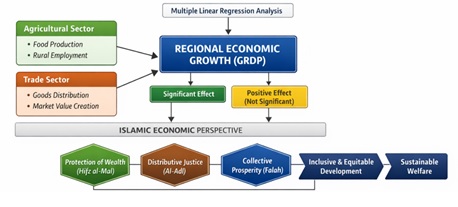
Purpose: This research examines the effect of the agricultural and trade sectors on regional economic growth in Deli Serdang Regency from 2015 to 2024, using Gross Regional Domestic Product (GRDP) data.
Design/Methodology/Approach: A quantitative approach was applied using multiple linear regression models to analyze the relationship between the agricultural and trade sectors and regional economic growth. Data from the Deli Serdang Central Statistics Agency (BPS) were utilized, and the analysis was conducted with a focus on determining the contributions of these sectors to GRDP.
Findings: The results indicate that both the agricultural and trade sectors have a significant simultaneous effect on GRDP, with an R² value of 0.892, meaning 89.2% of the variation in GRDP is explained by the contributions of both sectors. The agricultural sector showed a statistically significant positive contribution, while the trade sector, though positive, did not have a statistically significant impact.
Practical Implications: The findings highlight the importance of sectoral synergy in driving inclusive and sustainable regional development. Effective strategies to integrate the agricultural and trade sectors can promote equitable economic growth.
Originality/Value: This study contributes to the literature on regional economic growth by providing empirical evidence of the simultaneous contributions of the agricultural and trade sectors, underpinned by Islamic economic principles, particularly the protection of wealth, distributive justice, and the pursuit of collective welfare.
Downloads
References
Acheampong, A. O., & Opoku, E. E. O. (2023). Environmental degradation and economic growth: Investigating linkages and potential pathways. Energy Economics, 123, 106734. https://doi.org/10.1016/j.eneco.2023.106734
Anderson, K., & Ponnusamy, S. (2023). Structural transformation away from agriculture in growing open economies. Agricultural Economics, 54(1), 62–76. https://doi.org/10.1111/agec.12745
Anjum, M. I. (2022). An Islamic critique of rival economic systems’ theories of interest. International Journal of Ethics and Systems, 38(4), 598–620. https://doi.org/10.1108/IJOES-08-2021-0155
Athief, F. H. N., Herianingrum, S., Furqani, H., Rusydiana, A. S., & Marwini. (2025). Understanding the dynamics of criticism in Islamic economics and finance: Trends and insights. International Journal of Ethics and Systems, 1–27. https://doi.org/10.1108/IJOES-11-2024-0369
Avdukic, A., & Asutay, M. (2025). Testing the development impact of islamic banking: Islamic moral economy approach to development. Economic Systems, 49(2), 101229. https://doi.org/10.1016/j.ecosys.2024.101229
Barolli, L., & Miwa, H. (2022). Advances in Intelligent Networking and Collaborative Systems: The 14th International Conference on Intelligent Networking and Collaborative Systems (INCoS-2022). Springer Nature.
Barom, M. N. (2013). Conceptualizing A Strategic Framework Of Social Responsibility in Islamic Economics. International Journal of Economics, Management and Accounting, 21(1). https://doi.org/10.31436/ijema.v21i1.231
Becker, C. M., & Craigie, T.-A. (2007). W. Arthur Lewis in Retrospect. The Review of Black Political Economy, 34(3–4), 187–216. https://doi.org/10.1007/s12114-008-9010-6
Ben Jedidia, K., & Guerbouj, K. (2020). Effects of zakat on the economic growth in selected Islamic countries: Empirical evidence. International Journal of Development Issues, 20(1), 126–142. https://doi.org/10.1108/IJDI-05-2020-0100
Bless, A., Davila, F., & Plant, R. (2023). A genealogy of sustainable agriculture narratives: Implications for the transformative potential of regenerative agriculture. Agriculture and Human Values, 40(4), 1379–1397. https://doi.org/10.1007/s10460-023-10444-4
Bounthone, S., & Phouphet, K. (2023). The Dynamic Relationship Between the Services Trade Sector and Economic Growth in the Lao People’s Democratic Republic*. In W. A. Barnett & B. S. Sergi (Eds.), Comparative Analysis of Trade and Finance in Emerging Economies (Vol. 31, p. 0). Emerald Publishing Limited. https://doi.org/10.1108/S1571-038620230000031011
Brueckner, M., & Vespignani, J. (2021). COVID-19 Infections and the Performance of the Stock Market: An Empirical Analysis for Australia. Economic Papers: A Journal of Applied Economics and Policy, 40(3), 173–193. https://doi.org/10.1111/1759-3441.12318
Chen, S., Zhang, H., & Wang, S. (2022). Trade openness, economic growth, and energy intensity in China. Technological Forecasting and Social Change, 179, 121608. https://doi.org/10.1016/j.techfore.2022.121608
Deininger, K., Jin, S., & Ma, M. (2022a). Structural Transformation of the Agricultural Sector In Low- and Middle-Income Economies. Annual Review of Resource Economics, 14(Volume 14, 2022), 221–241. https://doi.org/10.1146/annurev-resource-111820-033252
Deininger, K., Jin, S., & Ma, M. (2022b). Structural Transformation of the Agricultural Sector In Low- and Middle-Income Economies. Annual Review of Resource Economics, 14(Volume 14, 2022), 221–241. https://doi.org/10.1146/annurev-resource-111820-033252
Dewi Samad, T. F., & Sugeng, A. (2022). The Role of the Islamic Economic System in Achieving Fallah. Adzkiya : Jurnal Hukum Dan Ekonomi Syariah, 10(02), 175. https://doi.org/10.32332/adzkiya.v10i02.5295
Domingo-Martos, L., Domingo-Segovia, J., & Pérez-García, P. (2024). Broadening the view of inclusion from a social justice perspective. A scoping review of the literature. International Journal of Inclusive Education, 28(10), 2298–2320. https://doi.org/10.1080/13603116.2022.2095043
Firmansyah, & Raharja, A. B. (2025). Metropolitan Transformation: Analyising Urban Cluster Dynamics in the Mebidangro Region. Scientia. Technology, Science and Society, 2(11), 234–248. https://doi.org/10.59324/stss.2025.2(11).18
Furqani, H., & Echchabi, A. (2022). Who is Homo Islamicus? A Qurʾānic perspective on the economic agent in Islamic economics. ISRA International Journal of Islamic Finance, 14(2), 206–220. https://doi.org/10.1108/IJIF-05-2021-0102
Gollin, D. (2023). Agricultural productivity and structural transformation: Evidence and questions for African development. Oxford Development Studies, 51(4), 375–396. https://doi.org/10.1080/13600818.2023.2280638
Harris, R. (2011). Models of Regional Growth: Past, Present and Future. Journal of Economic Surveys, 25(5), 913–951. https://doi.org/10.1111/j.1467-6419.2010.00630.x
Hermawan Adinugraha, H., Rahmawati, S., Nailis, E., Arzaqina, S., & Riskiyani, D. (2023). Business Management: Lessons Learned From The Prophet Muhammad. Annals of the University of Craiova for Journalism, Communication and Management, 9(1), 31–40.
Huda, M., Suminto, A., Sa’diah, S., & Abadi, M. K. R. (2023). Analysis The Influence of Sharia Capital Market and Sharia Macroeconomic Variables on Indonesia’s Economic Growth. Jurnal Ilmu Ekonomi Dan Bisnis Islam, 5(2), 113–133. https://doi.org/10.24239/jiebi.v5i2.191.113-133
Indonesia, B.-S. (2024). Statistical Yearbook of Indonesia 2024. BPS RI. https://www.bps.go.id/en/publication/2024/02/28/c1bacde03256343b2bf769b0/statistical-yearbook-of-indonesia-2024.html
Islam, G. (2022). Business Ethics and Quantification: Towards an Ethics of Numbers. Journal of Business Ethics, 176(2), 195–211. https://doi.org/10.1007/s10551-020-04694-z
Kader, H. (2021). Human well-being, morality and the economy: An Islamic perspective. Islamic Economic Studies, 28(2), 102–123. https://doi.org/10.1108/IES-07-2020-0026
Karimah, H., Akbariani Ahmad, A., & Athallah Akbar, M. A. (2025). Empowering The Informal Economy Through Islamic Social Finance: Insights from Islamic Economic Principles for Inclusive Development. At-Taradhi: Jurnal Studi Ekonomi, 16(1), 14–33. https://doi.org/10.18592/taradhi.v16i1.16301
Karimullah, S. S. (2023). Exploration of Maqasid Al-Shariah Concepts in The Development of Islamic Economic Policies. Mu’amalah: Jurnal Hukum Ekonomi Syariah, 2(2), 153–172. https://doi.org/10.32332/muamalah.v2i2.7747
Kato, T. (2022). Islamic and capitalist economies: Comparison using econophysics models of wealth exchange and redistribution. PLOS ONE, 17(9), e0275113. https://doi.org/10.1371/journal.pone.0275113
Khatri, P., Kumar, P., Shakya, K. S., Kirlas, M. C., & Tiwari, K. K. (2024). Understanding the intertwined nature of rising multiple risks in modern agriculture and food system. Environment, Development and Sustainability, 26(9), 24107–24150. https://doi.org/10.1007/s10668-023-03638-7
Khawar, M. (2023). Economic agency of women in Islamic economic philosophy: Going beyond Economic Man and Islamic Man. International Journal of Social Economics, 51(3), 364–376. https://doi.org/10.1108/IJSE-05-2023-0366
Lestari, D., & Arumi, N. A. (2024). Factors that influence the Islamic Perspective Human Development Index as Evidence of the Development of the Muslim Community. Journal of Lslamic Economics and Bussines Ethics, 1(2), 75–93. https://doi.org/10.24235/jiesbi.v1i2.133
Lubis, A., Siregar, D., & Pane, A. A. (2025). Building Local Economic Resilience Through Local Wisdom-Based Tourism Village Development In Pantai Labu Regency. Journal of Lifestyle and SDGs Review, 5(2), e04057–e04057. https://doi.org/10.47172/2965-730X.SDGsReview.v5.n02.pe04057
MacFeely, S., van de Ven, P., & Peltola, A. (2024). To GDP and beyond: The past and future history of the world’s most powerful statistical indicator. Statistical Journal of the IAOS, 40(3), 685–711. https://doi.org/10.3233/SJI-240003
Mahmood, S., Misra, P., Sun, H., Luqman, A., & Papa, A. (2025). Sustainable infrastructure, energy projects, and economic growth: Mediating role of sustainable supply chain management. Annals of Operations Research, 355(1), 1099–1130. https://doi.org/10.1007/s10479-023-05777-6
Moloi, T., & Marwala, T. (2020). The Dual-Sector Model. In T. Moloi & T. Marwala (Eds.), Artificial Intelligence in Economics and Finance Theories (pp. 33–41). Springer International Publishing. https://doi.org/10.1007/978-3-030-42962-1_4
Naseemullah, A. (2023). The political economy of national development: A research agenda after neoliberal reform? World Development, 168, 106269. https://doi.org/10.1016/j.worlddev.2023.106269
Nasution, M. S. A., & Nasutio, R. H. (2022). Filsafat Hukum Islam dan Maqashid Syariah: Edisi Kedua. Prenada Media.
Niekerk, A. J. van. (2020). Inclusive Economic Sustainability: SDGs and Global Inequality. Sustainability, 12(13). https://doi.org/10.3390/su12135427
Nurdiana, N., Muin, R., & Wahab, A. (2025). Fundamental Principles of Islamic Economic System: Justice, Equity, and Moral Conduct. Formosa Journal of Multidisciplinary Research, 4(6), 2627–2646. https://doi.org/10.55927/fjmr.v4i6.271
Pinto, H., Odoi, E., Nogueira, C., & Viana, L. F. C. (2025). Pathways to Progress: Unveiling Structural Change in Africa Through Economic Transformation, Technology, Talent, and Tourism. Economies, 13(1). https://doi.org/10.3390/economies13010021
Rostow, W. W. (2000). The Stages of Economic Growth. In Sociological Worlds. Routledge.
Sadik-Zada, E. R., Loewenstein, W., & Dumbuya, F. S. (2023). Modernization through solar off-grid electrification? A mixed picture for rural Sierra Leone. The Electricity Journal, 36(7), 107316. https://doi.org/10.1016/j.tej.2023.107316
Serdang, B. P. S. K. D. (2023). Badan Pusat Statistik Kabupaten Deli Serdang. BPS. Badan Pusat Statistik Kabupaten Deli Serdang. https://deliserdangkab.bps.go.id
Shrotriya, S., Dhir, S., & Sushil. (2018). Innovation driven ecosystem for quality skill development in India. Benchmarking: An International Journal, 25(8), 2997–3020. https://doi.org/10.1108/BIJ-11-2017-0320
Sudaryanto, T., Erwidodo, Dermoredjo, S. K., Purba, H. J., Rachmawati, R. R., & Irawan, A. R. (2023). Regional rural transformation and its association with household income and poverty incidence in Indonesia in the last two decades. Journal of Integrative Agriculture, 22(12), 3596–3609. https://doi.org/10.1016/j.jia.2023.11.029
Tobing, I. F., Batubara, M., & Yusrizal, Y. (2024). The role of the agricultural sector in increasing economic growth from an Islamic economic perspective: A study in Deli Serdang Regency, North Sumatera Province, Indonesia. Journal of Islamic Economics Lariba, 10(2), 927–950. https://doi.org/10.20885/jielariba.vol10.iss2.art17
Traugh, G. (2022). Reading Rostow in a Rhodesian Prison: Anticolonialism and the Reinvention of Modernization in British Central Africa. Comparative Studies in Society and History, 64(4), 1088–1117. https://doi.org/10.1017/S0010417522000287
Wang, G., Sadiq, M., Bashir, T., Jain, V., Ali, S. A., & Shabbir, M. S. (2022). The dynamic association between different strategies of renewable energy sources and sustainable economic growth under SDGs. Energy Strategy Reviews, 42, 100886. https://doi.org/10.1016/j.esr.2022.100886
Yilmaz, I. (2024). Exploring the foundations of Islamic moral economy: A return to substantive morality. International Journal of Ethics and Systems. https://doi.org/10.1108/IJOES-03-2024-0085
Yudita, M. A., & Sugiyono, S. (2021). Pengaruh Kualitas Produk, Harga, Dan Kualitas Layanan Terhadap Kepuasan Pelanggan. Jurnal Ilmu Dan Riset Manajemen (JIRM), 10(10). https://jurnalmahasiswa.stiesia.ac.id/index.php/jirm/article/view/4345
Zailani, M. N., Satar, N. H. M., & Zakaria, R. H. (2022). Maqasid Al-Shariah Based Index of Socio-Economic Development: A Literature Review. The Journal of Muamalat and Islamic Finance Research, 47–62. https://doi.org/10.33102/jmifr.v19i1.409
ضيف), A. M. D. (أحمد, & كوكران), L. C. (لوجان. (2022). A Values-Based Approach for Development: An Islamic Perspective. Journal of Islamic Ethics, 6(2), 284–310. https://doi.org/10.1163/24685542-12340082