Professionalization of Muhammadiyah Nazhir in Productive Waqf Governance: Competency, Intitutional and Implementation Challenge Analysis
DOI:
https://doi.org/10.35891/sry0kw13Keywords:
Nazhir Professionalization, Productive Waqf, Muhammadiyah, Competency, Waqf GovernanceAbstract
Introduction: This study analyzes the professionalization of Muhammadiyah waqf nazhir in productive waqf management through three dimensions: competencies, institutional strengthening, and implementation challenges.
Methods: A qualitative, descriptive-exploratory design was used. Data were collected through in-depth interviews with 12 informants, Muhammadiyah Waqf and Asset Management Council administrators, waqf managers, academics, and BWI representatives, and analyzed using thematic analysis, with triangulation and member checking for credibility.
Results: Nazhir professionalism remains limited, particularly in managerial, entrepreneurial, and digital capability. Required competencies span Sharia and regulatory, managerial and entrepreneurial, digital, and personal dimensions (integrity, amanah, leadership). Institutionally, Muhammadiyah supports professionalization through certification programs, the SIMAM information system, and stakeholder collaboration. Implementation is still constrained by limited human resources, weak incentives, a conventional organizational culture, and low public literacy on productive waqf.
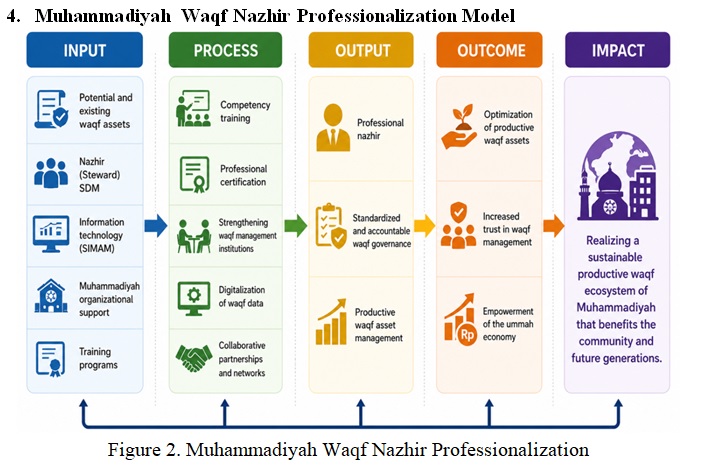
Conclusion and Suggestion: The study proposes an integrated nazhir professionalization model combining competency development, institutional strengthening, and organizational culture transformation.
Practical Implications: Muhammadiyah and BWI can use the model to design performance-linked certification, harmonize internal regulations, and build incentive structures that professionalize the nazhir role.
Originality/Value: Unlike prior studies that examine nazhir competency or institutional structure separately, this study integrates both within a single large Islamic organization.
Downloads
References
Abdullah, M. (2018). Waqf, sustainable development goals (SDGs) and maqasid al-shariah. International Journal of Social Economics, 45(1), 158–172.
adminMu. (2025, October 13). Muhammadiyah Teguhkan Gerakan Wakaf Produktif Berbasis Inovasi dan Kolaborasi | Muhammadiyah. MUHAMMADIYAH.OR.ID. https://muhammadiyah.or.id/2025/10/muhammadiyah-teguhkan-gerakan-wakaf-produktif-berbasis-inovasi-dan-kolaborasi/
Astuti, T., Junarti, J., & Novida, I. (2022). Muhammadiyah Nazhir organization: is that productive Waqf literacy needed. Proceedings of the 3rd International Conference of Business, Accounting, and Economics, ICBAE, 10–11.
BWI. (n.d.). Ketua Badan Wakaf Indonesia Ungkap Potensi Wakaf Rp400 Triliun - Badan Wakaf Indonesia | BWI.go.id. Retrieved June 10, 2026, from https://www.bwi.go.id/11361/2025/07/21/ketua-badan-wakaf-indonesia-ungkap-potensi-wakaf-rp400-triliun/
BWI. (2025). Data Wakaf Indonesia 2020-2025. Badan Wakaf Indonesia. https://apps.bwi.go.id/data-wakaf
BWI. (2026, January 6). Wakaf Produktif: Solusi Berkelanjutan untuk Umat. Badan Wakaf Indonesia Kabupaten Trenggalek. https://kabtrenggalek.baznas.go.id/artikel/show/wakaf-produktif-solusi-berkelanjutan-untuk-umat/35076
BWI.Go.ID. (2021). Sejarah Badan Wakaf Indonesia. Https://Www.Bwi.Go.Id/. https://www.bwi.go.id/profil-badan-wakaf-indonesia/sejarah-badan-wakaf-indonesia/
Charda, F. E., Senjiati, I. H., & Maulida, I. S. R. (2020). Analisis kompetensi nazhir pada lembaga wakaf: Literature review. Prosiding Hukum Ekonomi Syariah, 6(2), 1–12.
Choiri, M., & Makhtum, A. (2021). Traditionalism Nazhir Kyai On Waqf Asset Development In Bangkalan Madura. Ziswaf: Jurnal Zakat Dan Wakaf, 8(1), 72.
Evrytanadha, A., & Erma, D. (2024). Peningkatan Kepercayaan Wakif Melalui Prinsip Transparansi dan Akuntabilitas. Al-Awqaf: Jurnal Wakaf Dan Ekonomi Islam, 17(1), 57–64.
Faris, H. ;, Sidqi, A., Kalimantan, I., Banjarmasin, M., Adhyaksa Nomor, J., & Banjarmasin, K. (2019). REVITALISASI BADAN WAKAF INDONESIA (BWI) ANALISIS KRITIS UNDANG-UNDANG NOMOR 41 TAHUN 2004 TENTANG WAKAF. 1. http://sigitsoebroto.blogspot.com/2009/06/peran-
Junarti, Syed Musa Alhabshi, Isnan Hari Mahardika, S. A. (2021). Sustainability of Waqf Muhammadiyah : A Historical Study from Past to Present. THE INTERNATIONAL JOURNAL OF BUSINESS REVIEW (THE JOBS REVIEW), 4(1), 41–54.
Karim, M. S. A., Kadir, A., & Hidajat, R. (2025). Peran Zakat dan Wakaf dalam Mewujudkan Keadilan Distributif: Optimalisasi Instrumen Ekonomi Islam untuk Kesejahteraan Sosial dan Ekonomi. Iqtisad: Journal of Islamic Economic and Civilization, 1(2), 236–256. https://doi.org/10.61630/ijiec.v1i2.15
Mahsun, M., Djalaluddin, A., Asnawi, N., Wahyuni, N., Danila, N., & Ali, M. M. (2022). Green waqf: Sustainable surplus perspective balanced scorecard analysis. Karsa: Journal of Social and Islamic Culture, 30(2), 266–297.
Medias, F., Pratiwi, E. K., & Umam, K. (2019). Waqf Development in Indonesia: Challenges Faced by Muhammadiyah Waqf Institutions. Economica: Jurnal Ekonomi Islam, 10(2), 239–254.
MUI Digital. (n.d.). Sekjen Kemenag Ungkap Potensi Wakaf Mencapai Rp180 Triliun per Tahun - mui.or.id. Retrieved June 10, 2026, from https://mui.or.id/baca/berita/sekjen-kemenag-ungkap-potensi-wakaf-mencapai-rp180-triliun-per-tahun
Mukhlishin, N. H. (2024). IDENTIFIKASI POTENSI WAKAF PERSYARIKATAN MUHAMMADIYAH: STUDI FENOMOLOGI PENGELOLAAN WAKAF DI KABUPATEN SINTANG, BENGKAYANG DAN KETAPANG PROVINSI KALIMANTAN BARAT. Tarbawi Khatulistiwa: Jurnal Pendidikan Islam, 10(2).
Munawar, W., & Mufraini, M. A. (2021). Productive waqf, economic empowerment, and public welfare: Evidence from benefit recipients at Daarut Tauhiid Waqf Institution. INFERENSI: Jurnal Penelitian Sosial Keagamaan, 15(1), 1–24.
NU Online. (n.d.). Aset Wakaf di Indonesia Capai 451 Ribu Titik, tapi Banyak yang Belum Dikelola Secara Produktif. Retrieved June 10, 2026, from https://www.nu.or.id/nasional/aset-wakaf-di-indonesia-capai-451-ribu-titik-tapi-banyak-yang-belum-dikelola-secara-produktif-NCaLC
Nurfattah, A., & Bachtiar, R. (2023). Optimizing Waqf Management For Social Impact. Islamic Business and Management Journal. https://doi.org/10.21111/ibmj.v6i2.11376
Osman, A. Z., & Agyemang, G. (2020). Privileging downward accountability in Waqf management. Journal of Islamic Accounting and Business Research, 11(3), 533–554. https://doi.org/10.1108/JIABR-05-2017-0064
Othman, Y., Yusuff, M. S. S., & Hussain, M. N. M. (2025). An Analysis of Green Waqf as an Instrument for Sustainable Development. Environment-Behaviour Proceedings Journal, 10(SI24), 267–272.
Pamungkas, T. C. (2025). Model Wakaf Produktif Muhammadiyah: Filantropi untuk Pembangunan Berkelanjutan. Litera Inti Aksara, 47–55.
Priyadi, U., Achiria, S., Imron, M. A., & Zandi, G. R. (2023). Waqf management and accountability: Waqf land financing models for economic wellbeing. Asian Economic and Financial Review, 13(1), 74.
Rahmah, N. F. (2021). Manajemen pengembangan wakaf era digital dalam mengoptimalkan potensi wakaf. Al-Awqaf: Jurnal Wakaf Dan Ekonomi Islam, 14(2), 139–154.
Rozalinda. (2015). Manajemen Wakaf Produktif. PT Raja Grafindo Persada.
Safitri, A. W., Hasan, A., & Oktaviany, M. (2021). Model kelembagaan nazhir dalam pengelolaan wakaf produktif di Indonesia. Al-Mashrafiyah: Jurnal Ekonomi, Keuangan, Dan Perbankan Syariah, 5(1), 75–91.
Sanusi, S., & Shafiai, M. H. M. (2015). The Management of Cash Waqf: Toward Socio economic Development of Muslims in Malaysia. Jurnal Pengurusan, 43.
Saputra, W. (2025). Digital Green Waqf: A Systematic Literature Review on Sustainable Islamic Philanthropy in the Digital Era. Sujud: Jurnal Agama, Sosial Dan Budaya, 1(3), 302–316.
Sari Pertiwi, R., Nafik Hadi Ryandono, M., Rofiah, K., & . A. (2019). Regulations and Management of Waqf Institutions in Indonesia and Singapore: A Comparative Study. KnE Social Sciences, 3(13), 766. https://doi.org/10.18502/kss.v3i13.4246
Shiddiqy, M. A. (2022). Nazhir Capacity Analysis and Cooperation in Productive Waqf Management. Az-Zarqa’: Jurnal Hukum Bisnis Islam, 14(1), 111–130.
Shulthoni, M., & Saad, N. M. (2018). Waqf fundraising management: a conceptual comparison between traditional and modern methods in the waqf institutions. Indonesian Journal of Islam and Muslim Societies, 8(1), 57–86.
Spencer, L. M., & Spencer, P. S. M. (2008). Competence at Work models for superior performance. John Wiley & Sons.
Standen, P. J., Brown, D. J., Taheri, M., Galvez Trigo, M. J., Boulton, H., Burton, A., Hallewell, M. J., Lathe, J. G., Shopland, N., & Blanco Gonzalez, M. A. (2020). An evaluation of an adaptive learning system based on multimodal affect recognition for learners with intellectual disabilities. British Journal of Educational Technology, 51(5), 1748–1765.
Sugiyono. (2022). Metode Penelitian Kuantitatif, Kualitatif, dan R&D. Alfabeta.
Syafariah, A. (2020). Peran nazir dalam pengelolaan wakaf produktif. In Jurnal Ekonomi KIAT (Vol. 27, Number 1, p. 29). Surabaya.
Timredaksi. (2026, January 15). Transformasi Wakaf Muhammadiyah, Lazismu Dukung Pendayagunaan Produktif. MUHAMMADIYAH.OR.ID. https://muhammadiyah.or.id/2026/01/transformasi-wakaf-muhammadiyah-lazismu-dukung-pendayagunaan-produktif/
Utami, Y., Sawarjuwono, T., Al-Hadi, A. A., & Yuliadi, I. (2017). Priority of Waqf development and its barriers among the Muhammadiyah Awqaf AUM (Amal Usaha Muhammadiyah) units: an AHP approach. Global Waqf Conference Riau, 1–12.
Widiari, I. A. R., & Darma, G. S. (2017). Evaluasi Kinerja Pegawai Kontrak Melalui Tujuh Kompetensi Spencer Pada Pelayanan Denpasar Sewerage Development Project (DSDP). Jurnal Ilmiah Manajemen Dan Bisnis, 2(2), 360–367.
Winiarti, S., Rosyda, M., & Putri, C. M. (2023). Pemetaan Kehartabendaan Muhammadiyah untuk Optimalisasi Sistem Sistem Informasi Aset dengan Penerapan Kecerdasan Buatan. Sainteks, 20(1), 71. https://doi.org/10.30595/sainteks.v20i1.14537
Yusuf, M. Z., & Satibi, I. (2022a). Pendataan Aset Wakaf Muhammadiyah: Tinjauan Akuntansi Syariah. El Muhasaba Jurnal Akuntansi, 13(1), 61–70. https://doi.org/10.18860/em.v13i1.14094
Yusuf, M. Z., & Satibi, I. (2022b). Pendataan Aset Wakaf Muhammadiyah: Tinjauan Akuntansi Syariah. El Muhasaba Jurnal Akuntansi, 13(1), 61–70. https://doi.org/10.18860/em.v13i1.14094