
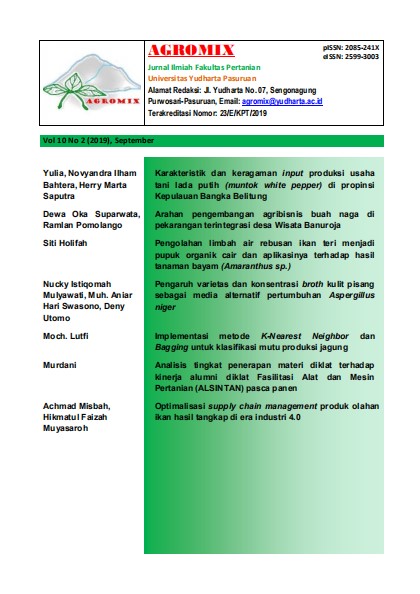
Optimalisasi supply chain management produk olahan ikan hasil tangkap di era Industri 4.0
DOI:
https://doi.org/10.35891/agx.v10i2.1663Keywords:
Supply Chain Management (SCM), Analytical Hierarchy Process (AHP)Abstract
The UMKM which is the target of this research is the UMKM which is engaged in processing fish caught in Pasuruan Regency. There are several superior products of processed fish caught in Pasuruan Regency which are managed by UMKM so far so many and can be one alternative to improve the welfare of MSME entrepreneurs. However, from the processed fishery products to become a valuable product, a good management is needed so that the supply or availability of catched fish is sufficient in order to equalize and fulfill the desired demand. In supporting this inventory control activity, a management concept is needed that can regulate the flow of goods and information that is precise and accurate from the supply chain, namely the concept of Supply Chain Management (SCM). The focus of the research is on how to manage the supply chain of fish raw materials from captured products through research methods using Supply chain Management (SCM) with the Fuzzy Analytical Hierarchy Process (AHP) method, to then proceed with the implementation of a sales development strategy for MSME Coastal Superior Products. From the results of the analysis and discussion obtained in the determination of supplier selection criteria, a pairwise comparison between criteria, sub-criteria and alternatives using the Fuzzy AHP method to produce weights. Based on the criteria and sub-criteria in supplier selection, overall supplier A (UMKM in the Lekok District Region) was rated as the best supplier weighing 1,699, the second priority was supplier B (UMKM in the Nguling District Region) with a weight of 1,345, while supplier C (UMKM in the Region Kraton District) is the last priority with a weight of 1,098
References
Adrian, A. (2019). Kesiapan sumber daya manusia indonesia dalam era industri 4.0. Jurnal Manajemen & Bisnis Jayakarta, 1(1), 33-38.
Amalina, R., & Khasanah, I. (2015). Analisis pengaruh persepsi harga, kualitas layanan dan lokasi terhadap keputusan pembelian (studi pada rocket chicken sukorejo kendal). Semarang: Doctoral dissertation Fakultas Ekonomika dan Bisnis Universitas Diponegoro.
Caesaron, D. (2014). Penentuan strategi pembinaan UMKM provinsi DKI Jakarta dengan menggunakan metode AHP TOPSIS. Jurnal Metris,, 15(2), 77-82.
Nizar, M., & Mashuri, M. (2018). Pengembangan potensi lokal melalui pemberdayaan lingkungan dan umkm pada masyarakat pesisir. Soeropati, 1(1), 41-56.
Nugroho, M. (2015). Pemberdayaan masyarakat nelayan di kabupaten Pasuruan: kajian pengembangan model pemberdayaan sumberdaya manusia di wilayah pesisir pantai. Jurnal Teknologi Pangan, 6(1).
Pambudy, A. P., & Fathoni, A. (2017). Pengaruh Produksi Hasil Laut Terhadap Pertumbuhan Umkm Olahan Ikan. Jurnal EMA, 2(2).
Prasetyo, H., & Sutopo, W. (2018). Telaah Klasifikasi aspek dan arah perkembangan riset. Jurnal Teknik Industri, 3(1), 17-26.
Saaty, T. L. (2013). The modern science of multicriteria decision making and its practical applications The AHP/ANP approach. Operations Research, 61(5), 1101-1118.
Sudri, M. N., Nendissa, C. B., & Wibisono, S. (2014). Perancangan vendor appraisal dengan metode fuzzy analytical hierarchy process pada PT. XYZ. Teknik dan Ilmu Komputer, 3(10).
Sukandar, N. K. (2014). Penerapan metode fuzzy analytic hierarchy process (FAHP) dalam penilaian kinerja pegawai: studi kasus di PT. Asuransi Jiwasraya (Persero) Branch Office Bandung Barat. Bandung: Universitas Pendidikan Indonesia.
Surjasa, D., Astuti, P., & Nugroho, H. (2016). Usulan supplier selection dengan analytical hierarchy process dan penerapan sistem informasi dengan konsep vendor managed inventory pada PT ABC. Jurnal dosen dan alumni teknik industri, 1, 5-6.
Triadiyatma, A. (2016). Model penyelesaian konflik nelayan berbasis kearifan lokal sebagai modal sosial di Kecamatan Lekok Kabupaten Pasuruan. Doctoral dissertation, Universitas Airlangga.
Downloads
Published
Issue
Section
License
Copyright Notice
The author sends the manuscript with the understanding that if accepted for publication, the copyright of the article belongs to the author and retains publishing rights without restriction.
Copyright includes the non-exclusive right to reproduce and submit articles in all forms and media, including reprints, photographs, microfilm, and other similar reproductions, as well as translations. Reproduction of any part of this journal, its storage in the database and its transmission by all forms of media, such as electronic, electrostatic and mechanical copies, photocopying, recording, magnetic media, etc.
The journal editorial board makes every effort to ensure that no false or misleading data, opinions, or statements are published in the journal. Either way, the contents of articles and advertisements published in journals are the sole and exclusive responsibility of each writer and advertiser.
All articles published Open Access will be immediately and permanently free for everyone to read and download. We are continuously working with our author communities to select the best choice of license options, currently being defined for this journal as follows: Attribution 4.0 International (CC BY 4.0)

 Download Template