INDONESIA

ISSN
- Print : 2088-0626

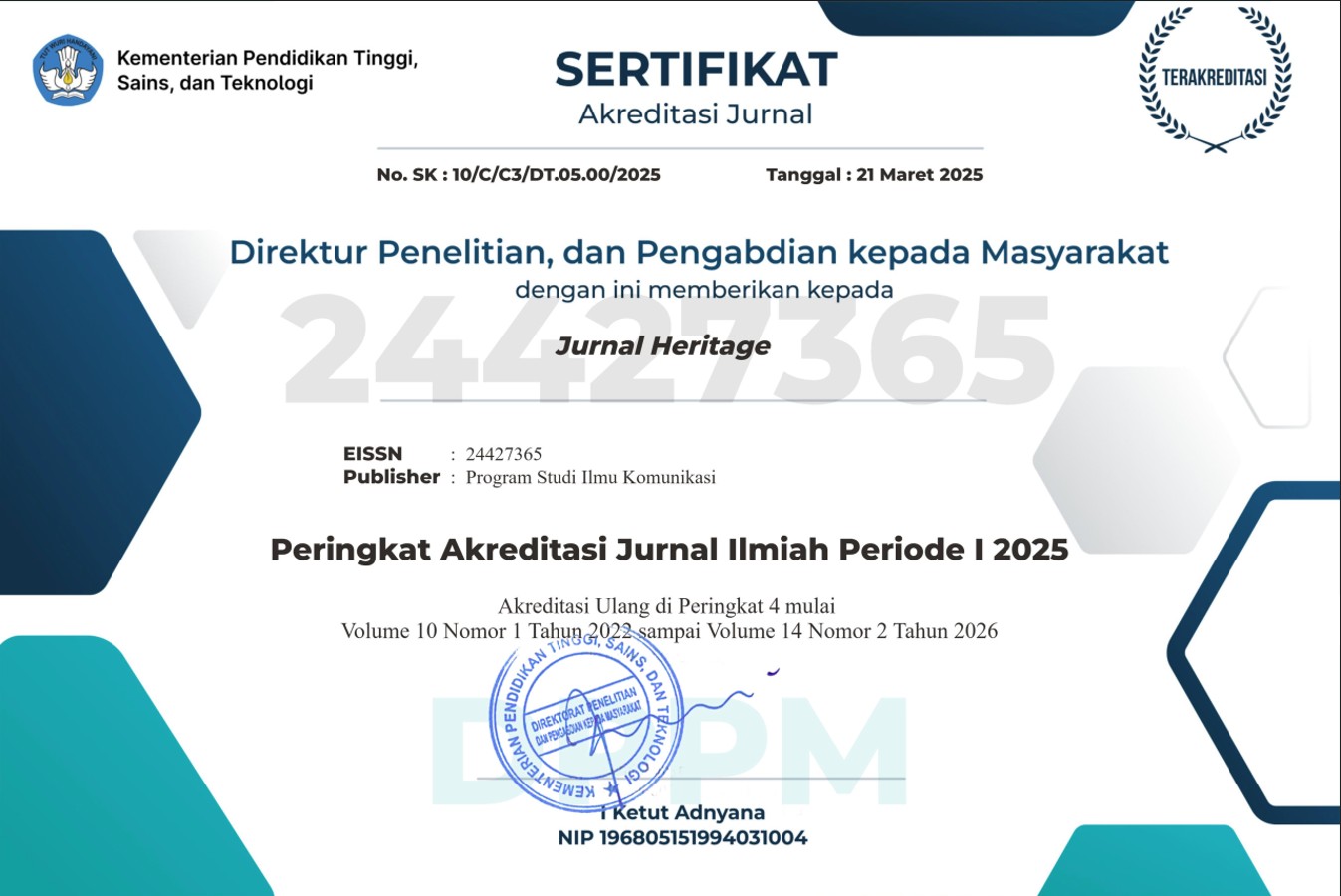
- Online : 2442-7365


Jurnal Heritage (JH) adheres strictly to the authorship guidelines established by the Committee on Publication Ethics (COPE) and the International Committee of Medical Journal Editors (ICMJE). Authorship confers credit and has important academic, social, and financial implications. It also implies responsibility for the published work.
1. Authorship Qualifications
To qualify for authorship of a manuscript submitted to Jurnal Heritage, each author must have made substantial intellectual contributions to the study. Individuals must meet ALL of the following four criteria:
a. Substantial contributions** to the conception or design of the work; or the acquisition, analysis, or interpretation of data for the work; AND
b. Drafting the work** or revising it critically for important intellectual content; AND
c. Final approval** of the version to be published; AND
d. Agreement to be accountable** for all aspects of the work in ensuring that questions related to the accuracy or integrity of any part of the work are appropriately investigated and resolved.
2. Roles of Authors
a. First Author: The individual who conducts the primary research, performs the core analysis, and writes the initial draft of the manuscript.
b. Co-Author(s): Individuals who fulfill all four authorship criteria listed above and provide specialized expertise or substantial contributions to the research process.
c. Corresponding Author: The individual who takes primary responsibility for communication with Jurnal Heritage during the manuscript submission, peer review, and publication process. This author must ensure that all listed co-authors have approved the final manuscript before submission.
3. Non-Author Contributions (Acknowledgments)
Contributors who do not meet all four criteria mentioned above should not be listed as authors. However, their contributions should be acknowledged in the "Acknowledgments" section. Examples of non-author contributions include:
a. Providing acquisition of funding or general supervision of the research group.
b. Administrative, technical, language editing, or proofreading support.
c. Assisting with data collection or technical tasks without contributing to the conceptual analysis.
INDONESIA
ISSN

Refferenci Aplication



Indexing by:




Support by

Incorporate with

| Dikutip oleh | LIHAT SEMUA |
| Semua | Sejak 2021 | |
| Kutipan | 581 | 544 |
| indeks-h | 13 | 13 |
| indeks-i10 | 15 | 15 |
| 140 105 70 35 0 |
|
Statistik kutipan publikasi ilmiah.
Support by


Incorporate with


Editorial Office: Communication Science Study Program, Faculty Of Social and Politics Yudharta Pasuruan University, Jl. Yudharta (Pondok Ngalah) No. 7 Sengonagung Purwosari Pasuruan Kode pos 67162, Wa: 085739715188 (an. Faris), email: faris@yudharta.ac.id. dan email jurnal: heritage@yudharta.ac.id. if you have anything to ask , pleas contact us.
LICENSE
This work is licensed under a Creative Commons Attribution-ShareAlike 4.0 International License.

