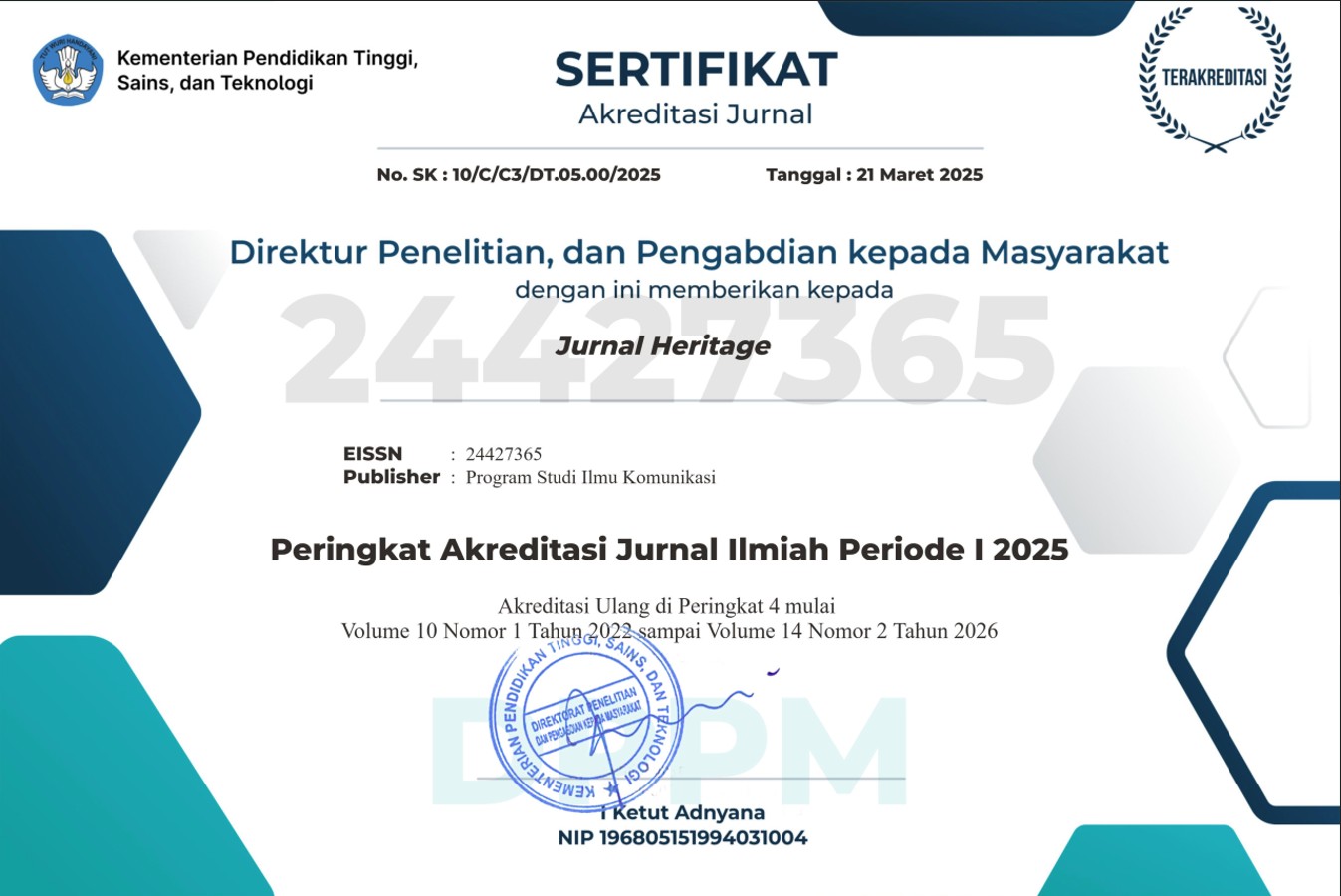
INDONESIA

ISSN
- Print : 2088-0626

- Online : 2442-7365


Jurnal Heritage (JH) recognizes the importance of long-term digital preservation to ensure that published scientific articles remain secure, stable, and accessible for future generations of researchers, readers, and institutions. To achieve this, Jurnal Heritage implements the following electronic archiving policies:
1. Open Journal Systems (OJS) Archiving
Jurnal Heritage utilizes the Open Journal Systems (OJS) platform, which supports the following international preservation networks:
a. LOCKSS (Lots of Copies Keep Stuff Safe): Jurnal Heritage uses the LOCKSS system to create a distributed archiving system among participating libraries. This allows these libraries to create permanent archives of the journal for purposes of preservation and restoration.
b. CLOCKSS (Controlled Lots of Copies Keep Stuff Safe): Jurnal Heritage also relies on the CLOCKSS system to ensure a secure and permanent dark archive for the journal's content, guaranteeing long-term open access to the scholarly literature.
2. National Repository and Indexing Archiving
To ensure redundant backups and high availability within the national academic network, all published metadata and full-text PDFs are regularly deposited into:
a. Garuda (Garba Rujukan Digital): The official digital reference gateway managed by the Ministry of Higher Education, Science, and Technology of the Republic of Indonesia.
b. Indonesia OneSearch (IOS): A single search gateway for all public collections from libraries, archives, and repositories across Indonesia.
c. Indonesian National Library (Perpustakaan Nasional Republik Indonesia): Legal deposit of digital publications via the International Standard Serial Number (ISSN) network.
3. Self-Archiving (Author Self-Archiving Policy)
Authors are permitted and encouraged to post their work online (e.g., in institutional repositories or on their personal websites) prior to and during the submission process, as it can lead to productive exchanges, as well as earlier and greater citation of published work. Jurnal Heritage permits authors to archive:
a. Pre-print version
b. Post-print version (Accepted Manuscript)
c. Publisher's version (Final PDF Edition)
4. Website Redundancy and Local Backups
The Editorial Office of Jurnal Heritage maintains regular local and cloud-based backups of the OJS database and asset directories. In the event of a catastrophic server failure, the journal can be fully restored to its latest published state with minimum downtime.
INDONESIA
ISSN

Refferenci Aplication



Indexing by:




Support by

Incorporate with

| Dikutip oleh | LIHAT SEMUA |
| Semua | Sejak 2021 | |
| Kutipan | 581 | 544 |
| indeks-h | 13 | 13 |
| indeks-i10 | 15 | 15 |
| 140 105 70 35 0 |
|
Statistik kutipan publikasi ilmiah.
Support by


Incorporate with


Editorial Office: Communication Science Study Program, Faculty Of Social and Politics Yudharta Pasuruan University, Jl. Yudharta (Pondok Ngalah) No. 7 Sengonagung Purwosari Pasuruan Kode pos 67162, Wa: 085739715188 (an. Faris), email: faris@yudharta.ac.id. dan email jurnal: heritage@yudharta.ac.id. if you have anything to ask , pleas contact us.
LICENSE
This work is licensed under a Creative Commons Attribution-ShareAlike 4.0 International License.

