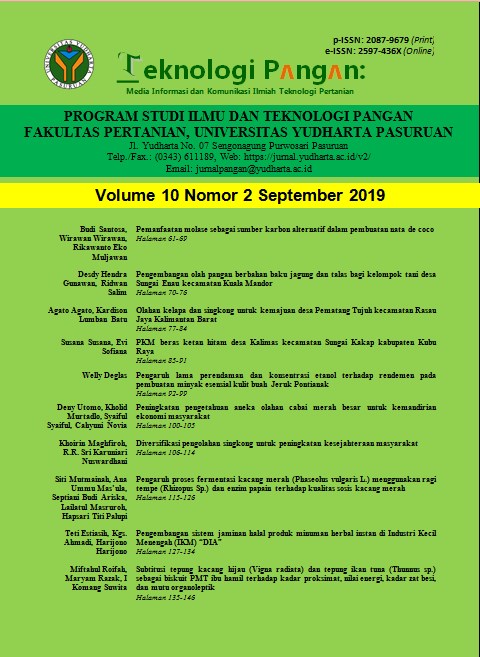
Pengembangan sistem jaminan halal produk minuman herbal instan di industri kecil menengah (ikm) “diaâ€
DOI:
https://doi.org/10.35891/tp.v10i2.1651Keywords:
certification, halal, halal assurance system, instant herbal drinkAbstract
Indonesian law obliges that all marketed, distributed, and trade products in the territory of Indonesia should have comply halal requiremnets. Small and Medium Enterprise (SME) DIA produces instant herbal drink products with the largest consumer is being Muslim. In accordance with the law, thatall products are required to halal certified and have a halal logo on the label, the SME DIA also prepares for halal certification. To certify halal, a halal assurance system must be implemented. Development of halal assurance system is required for small and medium industries in order to halal certification. Development of the halal assurance system is based on the HAS 23000 guide from LPPOM MUI. In fulfillment of HAS 23000, SME DIA has implemented 11 clausuls that are halal policy, halal management team, materials, products, production facilities, training and education, written standardoperating procedures, traceability, uncomplied halal product handling, internal audit, and management review. HCCCP analysis shows that no halal critical points in producing instant herbal drinks at SME DIA.
References
Ali, A., Xiaoling, G., Sherwani, M., & Ali, A. (2017). Factors affecting Halal meat purchase intention: evidence from international muslim students in China. British Food Journal, 119(3), 527-541.
Annabi, C. A., & Ahmed, J. L. (2015). Halal Beef Handling in Nigeria: The Abattoir Workers' Perspective. Journal of Emerging Economies & Islamic Research, 3(2).
Badruldin, B., Mohamed, Z., Sharifuddin, J., Rezai, G., Mahir Abdullah, A., Abd Latif, I., & Ghazali Mohayidin, M. (2012). Clients' perception towards JAKIM service quality in Halal certification. Journal of Islamic Marketing, 3(1), 59-71.
Bakar, N. A., Peszynski, K., Azizan, N., Sundram, K., & Pandiyan, V. (2016). Abridgment of Traditional Procurement and E-Procurement: Definitions, Tools and Benefits. Journal of Emerging Economies & Islamic Research, 4(1).
Fuseini, A., Knowles, T. G., Hadley, P. J., & Wotton, S. B. (2016). Halal stunning and slaughter: Criteria for the assessment of dead animals. Meat Science, 119, 132–137.
Hanzaee, K.H., & Ramezani, M.R. (2011). Intention to halal products in the world markets. Interdisciplinary Journal of Research in Business, 1(5), 1-7.
Hassan, F., & Hanif, A.(2017). Halal issues in processed food:Misuse of the halal logo. Journal of Emerging Economies and Islamic Research, 5(3), 1-5.
Kamaruddin, R., Iberahim, H., & Shabudin, A.(2012). Halal compliance critical control points analysis of processed foods. IEEE Business, Engineering & Industrial Applications Colloquium (BEIAC), 383-387.
LPPOM MUI. (2008). Panduan umum sistem jaminan halal LPPOM MUI. Lembaga Pengkajian Pangan Obat-Obatan Dan Kosmetika Majelis Ulama Indonesia.
Majid, M. B., Sabir, I., & Ashraf, T. (2015). Consumer purchase intention towards halal cosmetics & personal care products in Pakistan. Global of Research in Business & Management, 1(1), 45–53.
Mohamed, Z., Rezai, G., Shamsudin, M. N., & Chiew, E. F. C. (2008). Halal logo and consumers’ confidence: What are the important factors. Economic and Technology Management Review, 3(1), 37-45.
Mohamed, Z., Shamsudin, M. N., & Rezai, G. (2013). The effect of possessing information about halal logo on consumer confidence in Malaysia. Journal of International Food & Agribusiness Marketing, 25(sup1), 73-86.
Nakyinsige, K., Man, Y. B. C., & Sazili, A. Q. (2012). Halal authenticity issues in meat and meat products. Meat science, 91(3), 207-214.
Nasirun, N., Noor, S. M., Sultan, A. A., & Haniffiza, W. M. H. W. M. (2019). Role of marketing mix and halal certificate towards purchase intention of agro based products. International Journal, 2(7), 37-46.
Rajagopal, S., Ramanan, S., Visvanathan, R., & Satapathy, S. (2011). Halal certification: implication for marketers in UAE. Journal of Islamic Marketing, 2(2), 138-153.
Razaly, M.M., Zakaria, Z., Ismail, S.Z., & Jusoh, A.(2016). The determination of halal critical point in halal certified chicken slaughterhouses and its significance. Proceedings of the 3rd International Halal Conference (INHAC 2016), 259-271.
Rezai, G., Mohamed, Z., & Shamsudin, M. N. (2012). Assessment of consumers’ confidence on halal labelled manufactured food in Malaysia. Pertanika Journal of Social Science & Humanity, 20(1), 33-42..
Undang-Undang Republik Indonesia Nomor 33 Tahun 2014 tentang Jaminan Produk Halal
Wallace, C.A., Holyoak, L., Powell, S.C., & Dykes, F.C. (2014). HACCP-The difficulty with hazard analysis. Food Control, 35(1), 233-240.
Wilson, J. A., & Liu, J. (2010). Shaping the halal into a brand?. Journal of Islamic Marketing, 1(2), 107-123.
Downloads
Published
Issue
Section
License
Authors send the manuscript with the understanding that if accepted for publication, the copyright of the article belongs to the authors and retains publishing rights without restriction. More...


 Mendeley
  Zotero
  Grammarly
  Spelling & Grammar
  Turnitin Plagiarism Checker